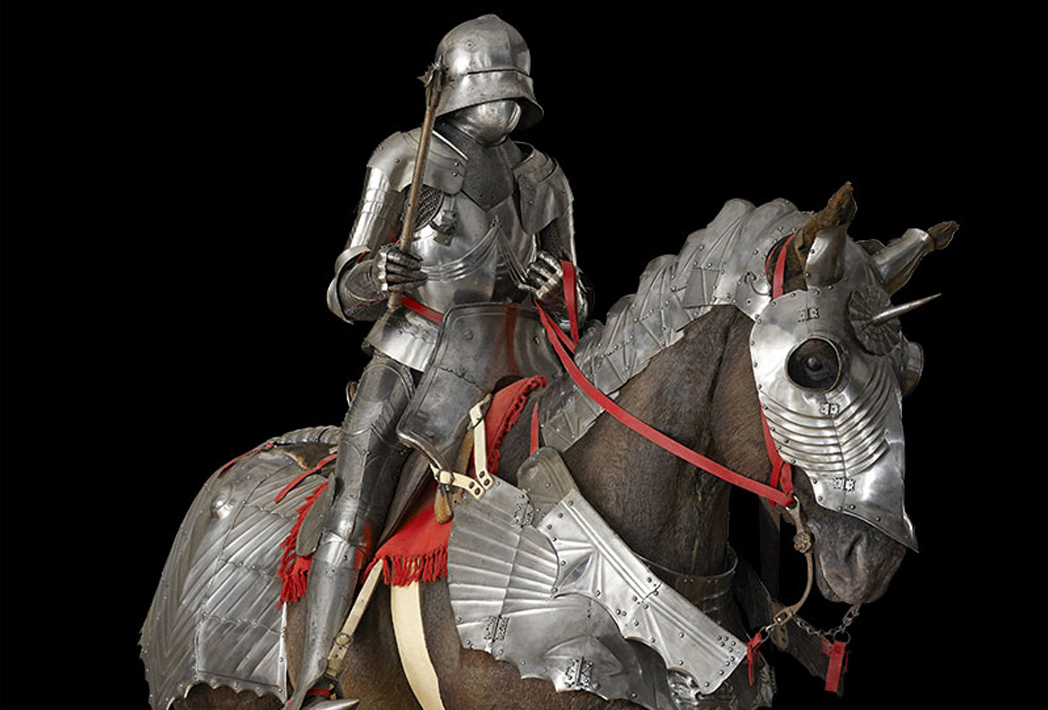
Leeds is not only famous for its International Medieval Congress. It is also home to the Royal Armouries. No Wonder the University is home to researchers working with aspects of Late Medieval Warfare and Tournaments.
The sessions are sponsored by the Institute for Medieval Studies, University of Leeds
The Tournament as Spectacle, I: Honour and Status [Session No: 1508]
The Tournament as Spectacle, II: Equipment and Iconography [Session No: 1608]
The Tournament as Spectacle, III: Court Culture [Session No: 1708]
The period from the 13th to the 16th centuries witnessed a rapid development of the tournament. Alongside the original tourney, a mass battle fought between opposing armies of knights with minimal and rudimentary regulation, new forms of chivalric military contests emerged, in which representation and entertainment figured just as much as the necessity of practice for warfare. The joust featured individual combats, with increasingly elaborate rules and variations in form and accompanying pageantry, while the passage of arms placed tournaments within theatrical and allegorical formats. Such events, particularly at the courts of France, Burgundy, England, and the German principalities, were increasingly integrated in wider festivities, ceremonies, and diplomatic negotiations.
Transition and Change in Later Medieval War, I: Perceptions and Implications [Session No: 524]
This session examine the perceptions and implications of change in later medieval war. Dr Bennett opens the subject by analysing the many supposed ‘military revolutions’, and argues that economic and social factors encouraged a slower evolutionary development. Dr Hodgkins explores the varied representation and perception of rebel forces in 16th-century England, and how they have affect our understanding of the past. Ms Kaske tracks changing military and political symbolism of knights and their equipment in late 13th- to early 14th-century German manuscript illuminations of the Willehalm-cycle, and their reflections of contemporary reality.
Transition and Change in Later Medieval War, II: Preparing for War [Session No: 624]
This session explores how changing theory, texts, and material production helped to prepare men for war in the later Middle Ages. Ms Harwood examines such themes as strategy, political planning, triumph, and hardship in the c. 1400 ‘Spalding’ Manuscript’s texts, and how this reveals the interests and values of the text’s patron, Henry Despenser. Mr Tzouriadis examines the increasing emphasis and formalization of staff weapon combat in 15th-century fighting manuals, and will argue that this reflects a recognition of their increasing use and importance. He will also explore the complimentary instruction of text and image, and varied contemporary interpretations in marginalia. Mr Kirkland explores developing craftsmanship, production, and market implications of London’s armour smiths in the 14th century, and how this affected contemporary war.
Transition and Change in Later Medieval War, III: Models of Military Conduct in the Hundred Years War [Session No: 724]
This session explores changing models of military practice during the Hundred Years War. Mr Smith examines English writings for changing perceptions of the morality and effectiveness of (earlier) campaigns of devastation and (contemporary) conquest to achieve victory in the late 14th and early 15th centuries. Using local history, Professor Livingston reassesses the path of Edward III’s 1346 campaign, that led to the battle of Crécy, in the context of contemporary military conduct. Professor DeVries reexamines how the Genoese crossbowmen were defeated at the battle of Crécy and how this affected the battle’s outcome, through a reevaluation of textual and material evidence.
VISIT: