Did Viking Women participate in war and piracy? Were shield-maidens more than a mythological or literary construct? Or did Viking women primarily lead lives centered on feeding their households, tending their children and spinning their wool? A new survey explores these questions from an archaeological point of view
‘Warrior-women’ in Viking Age Scandinavia? A preliminary archaeological study
by Leszek Gardela
In: Analecta Archaeologica Ressoviensia. Rzeszow 2013, Vol. 8, pp. 273 – 309 (both English and Polish text)
ABSTRACT:

© Leszek Gardeła and Mirosław Kuźma (By kind permission)
Did Viking Women participate in war and piracy? Were shield maidens more than a mythological or literary construct? Or did Viking women primarily lead lives centred on feeding their households, tending their children and spinning their wool?
A systematic reconsideration of a series of odd Viking burials might shed light on this question in the future.
As is well known, Viking burial customs were very diverse; different practices governed through time and inside the same burial ground, where cremation and inhumation were used simultaneously. As to furnishing, a wide variety in terms of grave goods (or not) has been documented by archaeologists.
This article focuses on a handful of select graves from Denmark, Norway, and Southern Sweden, which have puzzled archaeologists for some time. These graves, which hold either solitary females or females buried together with males, are characterised by being furnished with weapons or war gear, which might be identified as having belonged to the dead woman.
Weapons present were axes, spears, arrows and shield buckles, but no swords. These assemblages are not easily understood, and Leszek Gardela, who has surveyed the material, is very careful to pinpoint that no firm conclusions may be reached at present. For instance, the presence of axes in these graves might reflect the need for the woman to have a helpful axe for cutting up meat. Or axes might be symbolically placed in the graves, referring to Mjöllnir, the hammer of Thor. Some of these axes were very old and appear to be heirlooms.
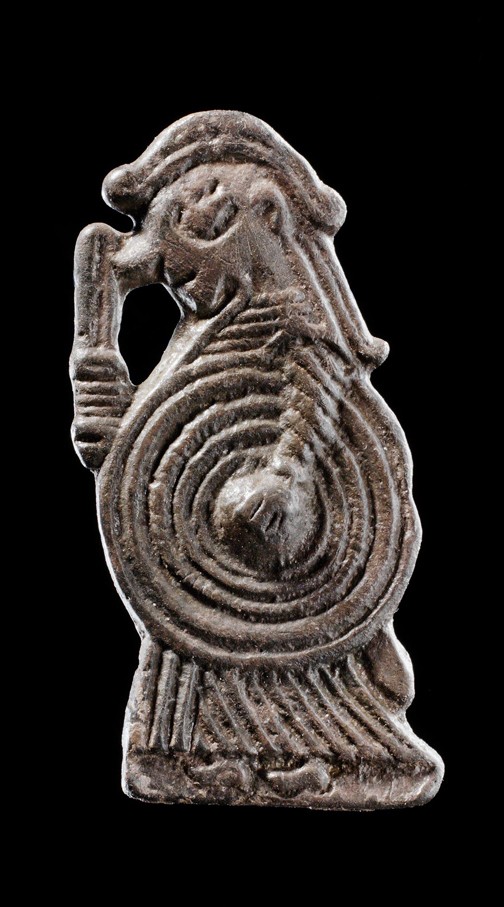
Valkyrie from Vrejlev, Denmark
However, perhaps we glimpse something else, such as graves, where wise women well versed in seiðr (shapeshifting) and other obscure magic were buried together with their staffs, which sometimes might be a spear (Vølva means “staf”. Often these graves were located in liminal positions within the burial ground. Literary texts indicate that the bereaved also threw spears or axes into the graves to keep the women from haunting the living. In some graves, boulders were placed to keep the dead in their place. However, this practice was decidedly Swedish.
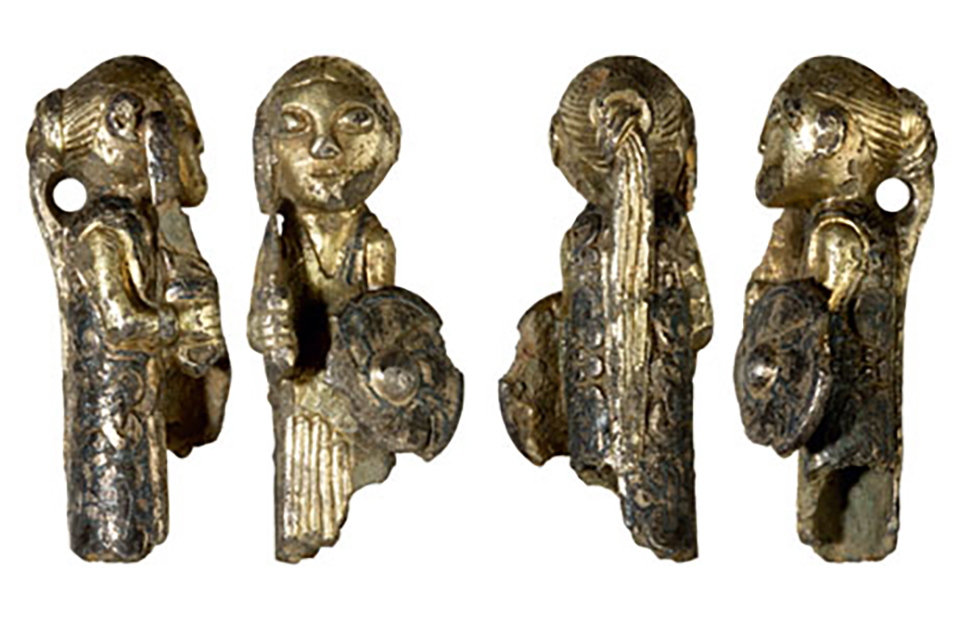
Some of these ‘warrior women’ may thus have been known as Völver or spæwīfes, which they tended to be called in an Old English – wise women in the broadest sense. Others might have been known as ‘warrior women’ or ‘Valkyries’ as they were called in Norse Mythology and other written sources. Such Valkyries had spears as their attributes (although brooches seem to show them with swords). But perhaps the two roles were mingled?
To conclude, the author states that it is likely too early to offer definite answers as to whether some women lived out their lives as shield maidens in Viking society. Much information lacks, for instance, detailed anthropological explorations of the skeletal material (for example, were the women in these graves able to wield a sword or were they too frail?)
A project which shifts the evidence to a wider geographical context and which also includes evidence from The Anglo Saxon world might perhaps help to answer some of these questions, writes Leszek Gardela
READ MORE
Viking women, warriors, and valkyries
By Judith Jesch, Professor of Viking Studies, University of Nottingham – British Museum Blog
FEATURED PHOTO:
Four views of the Valkyrie from Haarby near Odense. © National Museum in Copenhagen/CCBYSA
READ ALSO


