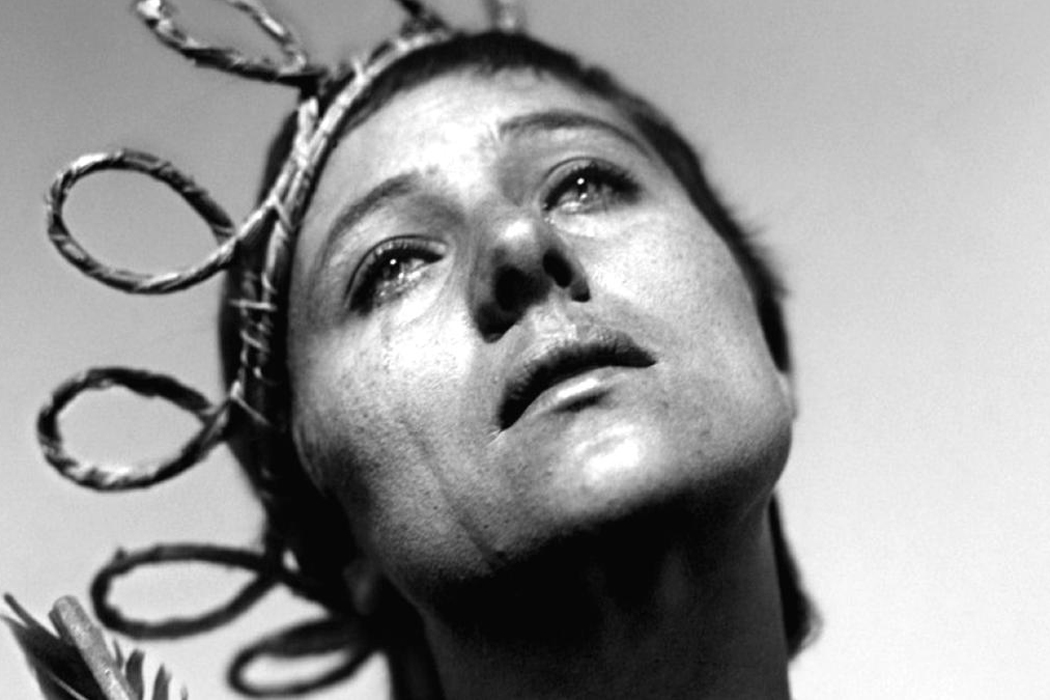
From the age of thirteen, Joan of Arc experienced frequent episodes of auditory and visual hallucinations. Did she suffer from epilepsy?
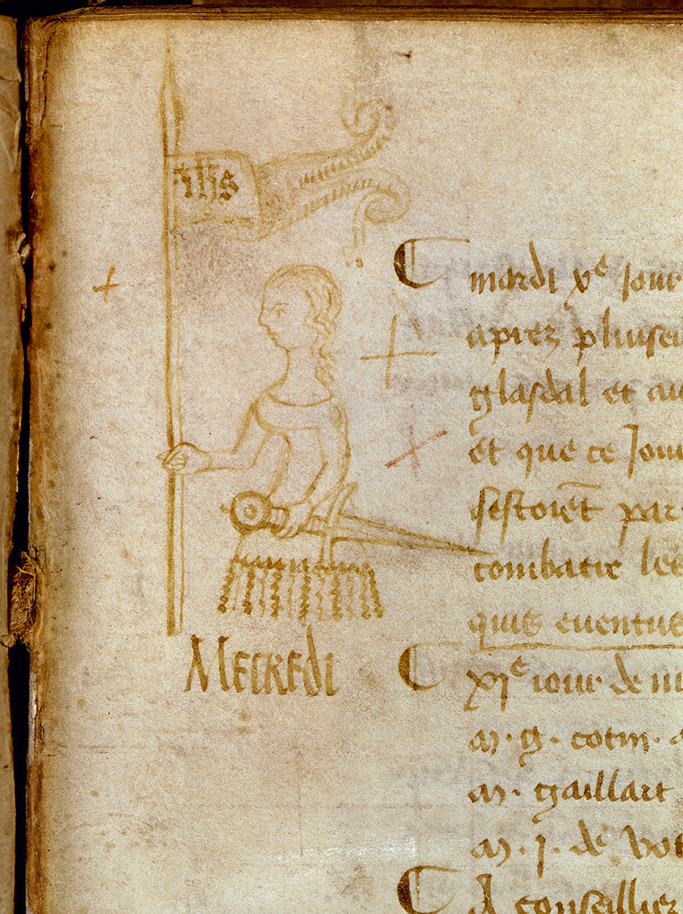
Joan of Arc, Ink sketch by Clement de Fauquembergue from Protocol of the parliament of Paris, 1429, France, 15th century. Source: Wikipedia
From the age of thirteen, Joan of Arc experienced frequent episodes of auditory hallucinations associated with elementary or complex visual hallucinations (e.g., a great light or human faces). These had sudden onset, lasting seconds or minutes at most, and occurred when awake or during sleep, arousing her. Some could be triggered by an auditory stimulus. Thus describes two neurologists the condition of Joan of Arc in a new and very thorough article published in a Special Issue of “Epilepsy and Behavior”entitled “Epilepsy, Art, and Creativity”.
One of the many hypotheses, which have been circulating, was that Joan of Arc suffered from a psychiatric illness, especially schizophrenia. However, most specialists find this explanation dubious, as she had no disorganized thought between the episodes. Also, the fact that she experienced the voices as starting from the outside, points in this direction; schizophrenic patients usually experience the voices as playing out in the inside.
In a recent article, two neurologists claim that the semiology of the episodes is more suggestive of epileptic seizures, which have been considered as ecstatic by some authors or as partial epilepsy with auditory features by others.
The descriptions of her religious experiences as they were rendered in the reports from her trial of condemnation seems to point in this direction; according to these her experiences took place at the borderline between sleep and awakening and were mostly of a positive content.
The authors argue that the auditory and visual hallucinations could have gained a religious content as she was manifestly brought up in a religious environment during her childhood and adolescence. This led her to interpret her hallucinations as sacred communications, which gave her a sense of her divine mission, hence, a real strength to try to accomplish the orders she heard during the episodes. “Being educated in a particular cultural or religious context can modulate or influence the content of hallucinations”, writes Nicastro and Picard, and points to the stories of well-known epileptics like Caesar, St. Paul, and Bonaparte. “It is possible that some political leaders, saints, and artists, who have made great achievements suffered from a medical condition that could have played a major role in the perception of the world they lived in and of the shape they wanted it to take”, they conclude.
As is well known, her role during the Hundred Years’ War and her narration of her strange episodes led her to be burned for heresy at the age of nineteen. 25 years later, she was rehabilitated. In 1920, she was canonized.
The authors are naturally keen to point out that the diagnosis is based on her own description of her symptoms, as these were reported by the Inquisition, and that no firm medical conclusion can be reached.
What they do not discuss in their article are the arguments, which may be raised against their hypothesis, some of which are of a clinical nature. These are outlined in a “comment” written by Joseph Kamtchum-Tatuene and Yannick Fogang in the same issue. They write that the number of auditory “events”, which she recorded were far more frequent than should be expected, if she suffered from epilepsy. Also, she never claimed that they happened during sleep or that they manifested themselves as “incoherent” (which is how such sensations normally present themselves). In a reply Nicastro and Picard debates these comments and brings new evidence to the table.
However, none of the authors debate to what extent the so-called “hallucinations” of Joan of Arc might in fact better be understood as “religious experiences” induced through meditational prayer; a phenomenon which has been heavily studied by psychologists and cognitive scientists and widely published. In a pertinent article (not quoted by Nicastro and Picard) Cottam et al recently compared the experiences of three different voice hearing groups, which comprised: 20 mentally healthy Christians, 15 Christian patients with psychosis, and 14 nonreligious patients with psychosis. According to their review of the phenomena, a number of surveys of the general population indicate that between 10 and 25% have had hallucinatory experiences at least once in their lifetime – without suffering from any psychiatric condition at all.
Perhaps Joan of Arc was after all just a saintly character!
ABOUT THE AUTHORS:
N. Nicastro: Neurology Department, Geneva University Hospitals, 4 Avenue G. Perret-Gentil, 1205 Geneva, Switzerland.
F. Picard: Neurology Department, Geneva University Hospitals, 4 Avenue G. Perret-Gentil, 1205 Geneva, Switzerland.
Joseph Kamtchun-Tatuene, Brain Infections Group, University of Liverpool.
Yannick Fogang, Neurology Department, Fann Teaching Hospital, Dakar, Senegal
SOURCE:
Joan of Arc: Sanctity, Witchcraft or Epilepsy?
By N. Nicastro and F. Picard
In: Epilepsy & Behavior 2016
Comment on “Joan of Arc: Sactity, witchcraft or epilepsy?”
By Joseph Kamtchun-Tatuene and Yannick Fogang
In: Epilepsy & Behavior 2016
Reply to Kamtchum-Tatuene and Fogang
By By N. Nicastro and F. Picard
In: Epilepsy & Behavior 2016
The articles are part of a special issue entitled “Epilepsy, Art, and Creativity”.
READ MORE:
Does religious belief enable positive interpretation of auditory hallucinations? A comparison of religious voice hearers with and without psychosis
S. Cottam, S. N. Paul, O. J. Doughty, L. Carpenter, A. Al-Mousawi, S. Karvounis & D. J. Done
In: Cognitive Neuropsychiatry, Volume 16, Issue 5, 2011 pp. 403-421
FEATURED PHOTO:
The Passion of Joan of Arc. Maria Falconetti in the film of Th. Dreyer