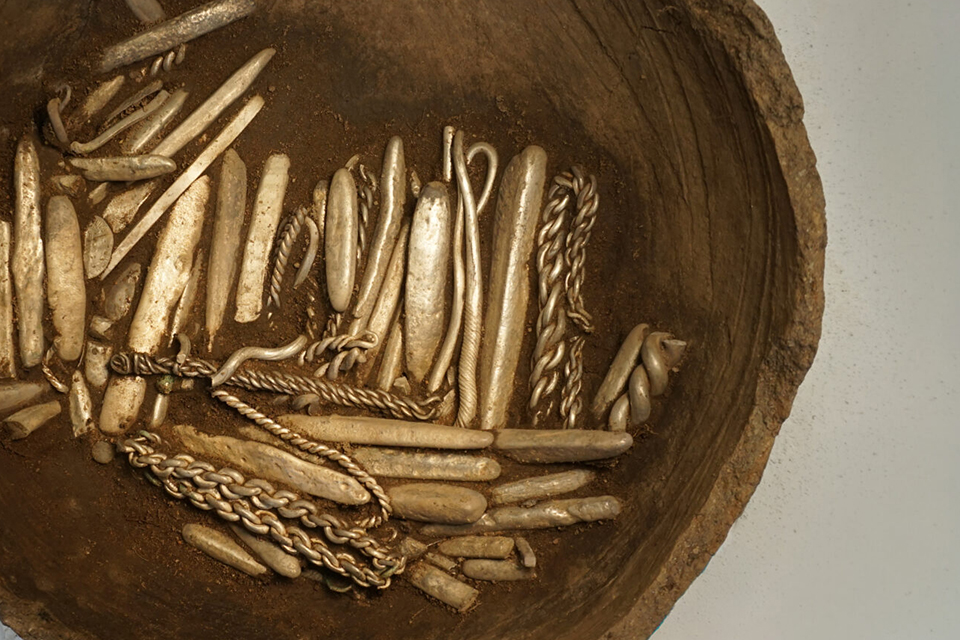
How should we understand the Runic inscription on a silveringot discovered in the spectacular hoard recently discovered at Rebild?
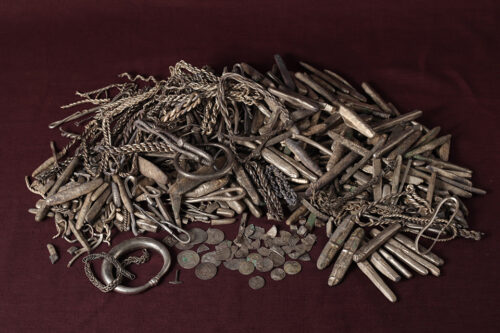
Two months ago, 18.5 kilos of silver were discovered at Rebild in what is the largest known Viking Age silver hoard ever found in Denmark. The hoard is almost three times larger than what was previously Denmark’s largest Viking Age silver hoard, the so-called Terslev Hoard, weighing approximately 6.5 kilos. Although it does not quite reach the 76 kg of the famous Spilling Hoard from Gotland, it is nevertheless mind-boggling.
The newly discovered silver hoard was deposited in a ceramic vessel sometime during the tenth century and consists of around 700 objects and fragments. In addition to numerous silver ingots, it contains arm-rings, 47 complete coins and coin fragments, a small Thor’s hammer, and various pieces of cut-up silver. The find came to light during the construction of a new terrace in a private garden in Rebild.
“It was only supposed to be a couple of hours of hard gardening, removing stubborn grass, stones and gravel in preparation for a new paved terrace, but it turned into the greatest surprise of my life,” says the finder of the silver hoard, who wishes to remain anonymous. “After half an hour of digging, my garden fork struck something that made a strange sound. At first, I thought it was old iron or fencing wire, together with some pottery sherds, but when I began digging with my hands, I suddenly started pulling one metal object after another out of the ground. After a short while of carefully working my way through the soil, I realised that they were jewellery, coins and silver ingots.”
Around 320 objects, with a combined weight of 6.4 kilos, were still inside the original ceramic vessel, while the remainder were found in the soil surrounding the findspot.
The Head of Cultural Heritage and archaeologist at North Jutland Museums, Torben Sarauw, is delighted by the spectacular and entirely exceptional discovery.
“This is a find of major significance for our understanding of the Viking Age in Denmark. Not merely because of its size, but also because the hoard demonstrates so clearly how silver functioned both as wealth and as a means of payment during the Viking Age. It is like finding a Viking Age safe,” says Torben Sarauw.
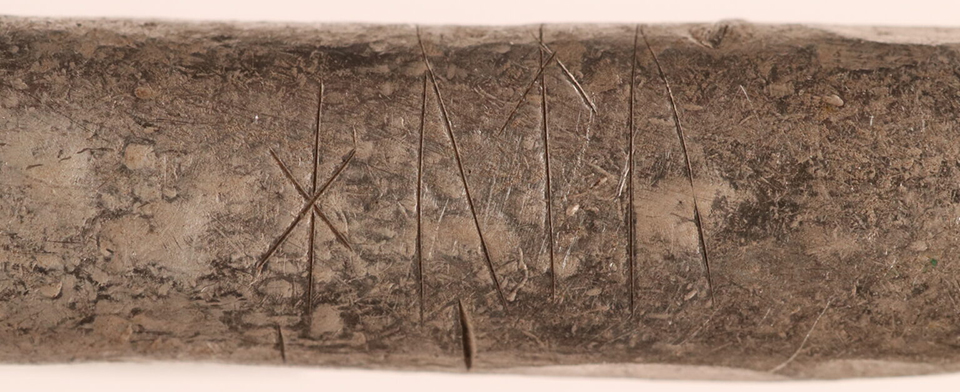
HUTU? Name of the owner, just a marker, or a magical protection formula?
Intriguingly, the hoard contains an enigmatic inscription: runes have been scratched into one of the silver ingots. As it stands, the inscription may be read as HUTU, which could represent a name. On the other hand, it might simply be an ownership mark or some other form of significant marking. Although unlikely, it might even signify “protect” or “threat” (hót), perhaps as some form of magical protective formula. But that is just a guess, especially since we still lack a proper specialist analysis of the inscription and its grammar. Thus, the following comments amount to no more than a tentative sketch of the semantic field to which the word hutu might conceivably belong.
At first glance, the word does not appear as a personal name, or as part of one, in an Old Norse context, nor have I been able to identify the forms Hotu or Hoto. Huto, however, is definitely known as a personal name in a Continental Germanic context. The name appears in the Lorscher Codex, copied from a charter dating from AD 772. It is also known from the Swiss place-name Huttwil, first recorded as Huttiwilare in 841/872.
On the other hand, hut* is known from a number of place-names in a southern Danish context. Thus, hutter occurs frequently in field-names, especially on Funen and in southern Jutland. It is the plural of a word denoting a small lump or mound, such as a clod of earth or a grass tussock: Funen hut, Jutlandic hot, Norwegian hott and Middle English dialectal hut.
However, there is also another intriguing cluster of words associated with enclosure, guarding and protection. Old Danish hytte is associated with Middle High German hüeten and Old High German huoten, “to watch, take care”, cognate with Old Saxon hōdian, Old English hēdan, Dutch hoeden and English heed. In modern Danish, this meaning survives in the expression at hytte sit skind — literally, “to protect one’s skin”. Other Scandinavian words occupy an overlapping semantic field of enclosure, protection and threat: Danish hegn denotes a fence or enclosure, while hegne means to fence in or protect; Old Norse hegna likewise means to hedge or protect, but also to punish or chastise. Swedish hot, meanwhile, means a threat. A fence, after all, may both protect those within it and warn or threaten those outside it.
Whether hutu has anything whatsoever to do with this semantic complex remains entirely uncertain. But the possibility is worth keeping in mind when considering whether the inscription necessarily represents a personal name.
A cursory search of the published collections presenting the massive silver hoards from Gotland has not uncovered a comparable find as the present inscription. For Gotland, the Spillings Hoard buried at the end of the 9th century is especially useful because its bullion has been studied in detail. The hoard contained about 80 silver bars, alongside more than 14,000 coins and hundreds of silver ornaments. Yet the published description specifically states that the bars bear no test cuts, ornament or written signs. In other words, none of the enormous Spillings assemblage provides a parallel for a named or runically inscribed ingot. Other large assemblages such as Burge also contain substantial numbers of rectangular silver ingots, apparently connected with the eastern European bullion economy, but the published museum descriptions do not mention inscriptions or personal names on them. This is significant because Gotland provides an exceptionally large comparative sample. More than 700 Viking-Age silver hoards are known from the island.
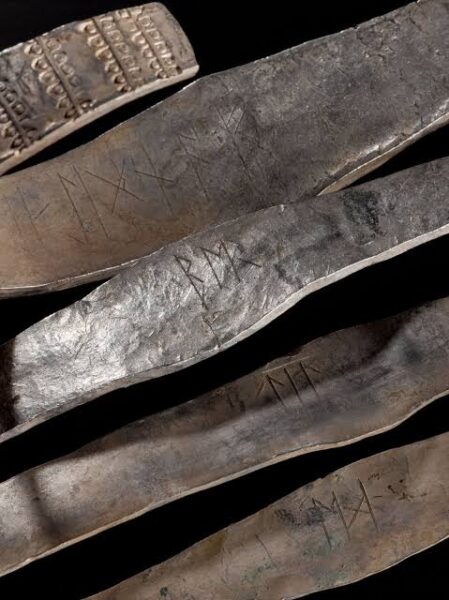
It appears, a better parallel may come from the Irish Sea and Anglo-Scandinavian world. The clearest is the Galloway Hoard, deposited around AD 900. Its lower bullion deposit consisted of 15 silver ingots and 31 arm-rings placed together in a leather bag. Four of the broad-band silver arm-rings carry runic inscriptions. Three probably represent abbreviated personal names, while a fifth inscribed piece found close to the hoard carries the unmistakable Old English personal name Ecgbeorht (Egbert).
The Egbert object is particularly revealing. By this stage, it was no longer really jewellery in any meaningful economic sense: the arm-ring had been hacked at both ends, folded, and then inscribed. National Museums Scotland interprets it as bullion used in commercial transactions. The name therefore seems to have been added after the silver had become a piece of bullion, perhaps indicating a piece of silver held as some form of security or payment.
The other Galloway pieces reinforce this point. According to the information currently available, their inscriptions read:
- ED, possibly ēad, “wealth/prosperity”, or an abbreviated name such as Edwin, Edward or Edgar;
- TIL, possibly “good”, but perhaps an abbreviated personal name such as Tila or Tilred;
- BER, which is not an ordinary Old English word in this context and is probably an abbreviation of a name such as Berwulf or Bercol;
- DIS IS ƗIGNA F[EOH], which did not at first appear to contain a coherent message, but has now been interpreted as “This is the community’s property/wealth”.
Thus, the Galloway treasure contains inscriptions that may be read both as names and as indicators of wider ownership, perhaps even of shares, pledges or other forms of attributed wealth.
Of further interest in connection with the new inscription HUTU is the problematic word ƗIGNA, transcribed by the scholars working on the Galloway Hoard as HIGNA. They interpret this as an Old English word referring to a community, particularly a monastic or religious community, and hence read the complete inscription as “This is the community’s property/wealth”.
The interpretation is intriguing in the present context. Might higna somehow belong within, or have been influenced by, the wider Germanic semantic field of enclosure, guarding and protection represented by Old Norse hegna, “to hedge, protect, punish or chastise”, Danish hegn/hegne, and the complex of words discussed above associated with guarding and taking care? This should not be understood as a proposed etymology: the linguistic relationship would have to be demonstrated. But semantically, enclosure, protection, possession and community form an intriguing constellation of meanings.
This leads to an even more speculative possibility. Might the Galloway treasure represent wealth held collectively by a “community” against some collective financial obligation? About a century later, the laws of the Danelaw provide evidence for involuntary, territorially based collective liability, under which substantial payments could be imposed upon communities rather than individuals. Such penalties belong to the legal world in which the characteristically Danelaw fine known as lahslit operated.
Could the Galloway silver represent an earlier manifestation of some comparable practice of collectively held wealth and collective liability? And might we find a faint trace of the same conceptual world in the enigmatic inscription on the silver ingot from Rebild?
Perhaps. For now, they remain tantalising questions.
Well-organised Bank?
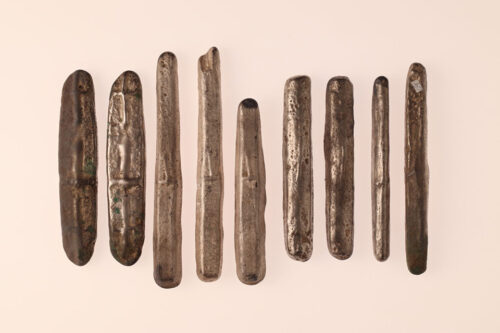
According to Torben Sarauw, the new Rebild hoard is also interesting because it is dominated by ingots, jewellery and hacksilver, while coins account for only a very small proportion of its total weight. It therefore offers a rare insight into how wealth could be stored, organised and concealed in Viking Age Denmark.
“When we analyse the weight of the silver objects, the hoard reveals information about economic practices during the Viking Age. The hoard does not consist simply of attractive objects. Most of the pieces formed part of a structured system of value based on weight,” he says.
Silver ingots, jewellery and hacksilver were used as means of payment and stores of value, with the weight of the silver being the decisive factor. Silver was therefore frequently cut into smaller pieces, divided, or melted down. The unusually large number of silver ingots in the hoard cluster around particular weight groups, and the same applies to parts of the arm-rings and hacksilver. This suggests that the silver was not merely accumulated at random but was organised as a substantial reserve of wealth. (Or as tentatively suggested above, an accumulated fine).
From Distant Lands
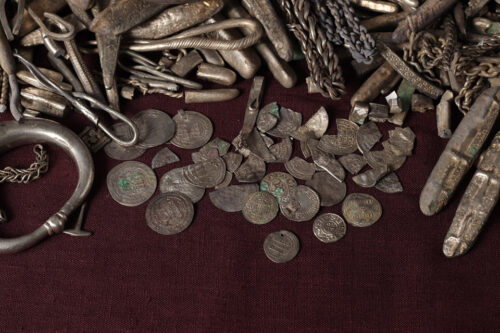
The hoard also contains both Arabic and Anglo-Saxon coins, which, according to Torben Sarauw, testify to how closely Denmark was connected with large parts of Europe and regions far to the east during the Viking Age.
“That is precisely what makes this find so fascinating. The silver was hidden at Rebild, but it points towards a much wider world. The coins reveal connections with the Islamic world to the east and England to the west, and tell us about a Viking Age in which people, goods and wealth moved across enormous distances,” he says.
The coins are also crucial for dating the hoard. The find includes two Anglo-Saxon silver pennies minted during the reign of King Edward the Elder, who ruled from 899 to 924. They provide an important chronological marker, since the hoard cannot have been deposited before these coins entered circulation.
The Arabic silver coins, known as dirhams, bear various inscriptions that can often be associated with particular mints and years. They occur particularly frequently in silver hoards dating from the tenth century and are often cut into smaller pieces, as is also the case in this hoard. Dirhams could be used as a means of payment, and their value was largely determined by the weight and fineness of the silver.
Several major Viking Age hoards found in the same area
The new discovery does not stand alone. In 1971, another large silver hoard, known as the Rebild Hoard, was discovered in the same general area. It also dates from the tenth century and consists of silver ingots, chopped-up jewellery and smaller pieces of silver. Altogether, it contained approximately four kilos of silver, which had been wrapped in an animal hide when it was deposited.
Taken together, the two finds provide unusually strong evidence for the Viking Age silver economy and far-reaching trading connections in the Rebild area.
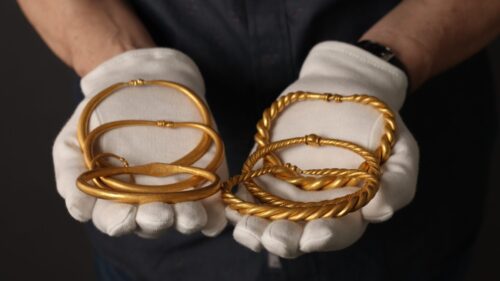
The Rold Hoard, discovered only two months ago, is also relevant in this context. It consists of six intact Viking Age gold arm-rings with a combined weight of 762.5 grams. While the Rebild silver hoards primarily reflect the use of silver as a payment metal valued by weight, the substantial quantity of gold in the Rold Hoard points towards elite status, prestige and power.
“We are dealing with an area that repeatedly produces spectacular finds from the Viking Age. The new silver hoard demonstrates that the Rebild area was not a peripheral region but formed part of the extensive economic and cultural networks that connected Scandinavia with the Baltic region and the Islamic world to the east, as well as the North Sea region, England and Western Europe to the west,” says Torben Sarauw.
The findspot of the new hoard lies within a modern built-up area, making it impossible to undertake a large-scale archaeological excavation of the site. The hoard may have been deposited near a Viking Age settlement, beside one of the period’s routes of communication, or in a more remote and secret location. Without more extensive archaeological investigation, however, its precise context must remain uncertain.
Exhibition at Fyrkat
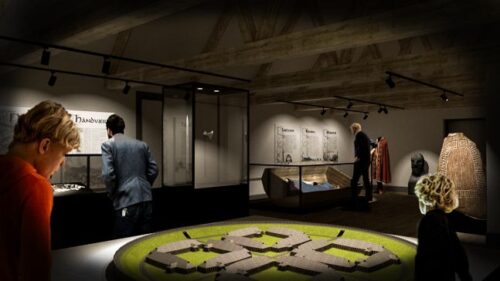
The silver hoard qualifies as danefæ – treasure trove under Danish law – and has been submitted to the National Museum of Denmark for formal assessment.
At the same time, North Jutland Museums is working towards having the hoard permanently exhibited at the Viking Museum Fyrkat, together with the six gold arm-rings from the Rold Hoard. There, it would naturally form part of the story of Harald Bluetooth’s consolidation of the Danish kingdom during the tenth century, the Viking Age more generally, and the central role played by North Jutland.
“When unique and extremely valuable objects such as these are involved, stringent requirements are typically imposed regarding security, surveillance, alarm systems, display cases and the general handling of the objects,” explains Torben Sarauw. Once a find has been declared danefæ, it belongs to the Danish state, and it is therefore the National Museum that determines the security requirements associated with any potential exhibition. “Before we know whether we will be able to exhibit the finds at Fyrkat, we therefore need to establish what requirements must be met and whether we are able to meet them,” concludes Torben Sarauw.
SOURCE:
Press Release from Nordjyske Museer (North Jutland Museums)
VISIT:
FYRKAT. The future home of the Viking Hoards from Rebild, Rold and elsewhere in Himmerland.
READ MORE:
The Spillings Hoard: Gotland´s Role in Viking Age World Trade.
By Pettersson, Ann-Marie, ed.
Visby: Fornsalens Förlag. 2009.
The Galloway Hoard: Viking-age Treasure
by Martin Goldberg and Mary Davis
National Museum of Scotland 2025