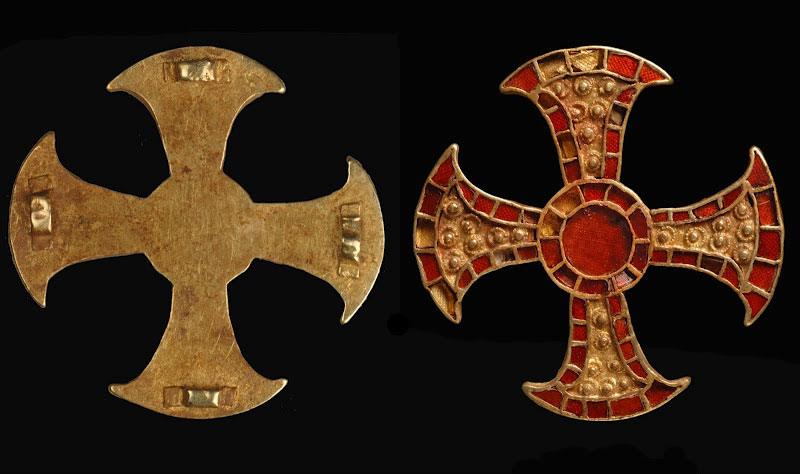
Last year one of the earliest Anglo-Saxon Christian burial sites was discovered in a village outside Cambridge. One of the graves was a so-called bed burial with a young woman around 16. On her dress was sown a rare and stunning Christian cross, made out of gold set with cut garnets. The grave has been dated 650 to 680 AD. According to the archaeologists the cross is only one out of five of its kind. Combined with one of the rare burials in beds, the find is really unique.
Was this teenage girl an early Christian convert, a standard-bearer for the new God? “Christian conversion began at the top and percolated down,” says Dr Sam Lucy, a specialist in Anglo-Saxon burial from Newham College, Cambridge. According to her, to be buried in this elaborate way with such a valuable artefact tells us that this girl was undoubtedly high status, probably nobility or even royalty. The cross is the kind of material culture that was in circulation at the highest level of society. It is akin to the pectoral cross which was found in the coffin of St Cuthbert now in Durham Cathedral, she claims. Another example is the so-called Holderness cross, dated somewhat earlier
However, these other crosses are pendants designed to hang suspended on a necklace, whereas the Trumpington cross (3.5 x 3.5 cm) has a loop on the reverse of each arm, so that it could be stitched directly onto the dress.
The bed consisted of a wooden frame held together by metal brackets, with further pieces of looped metal, fixing the cross-slats to create a suspended bed base, similar to modern beds, but with a straw mattress. The body was then placed on the bed, probably when it was already in the grave.
Dr Richard Dance, an expert on Old English at the University, has pointed out that the Anglo-Saxon word ‘leger’ can mean either ‘bed’ or ‘grave’. “Etymologically, the word means ‘place where one lies’, but there are examples of this meaning both bed and grave in literature of the time,” says Dr Dance to Cambridge University News.
“Bed burials were never widespread, but there is a little cluster around the Cambridge area and another in Wessex, with a solitary very high status example in Teeside” says Dr Lucy. “Where we do find them they seem to be predominantly burials of females, and date to the mid to later 7th century; most have indications of high status such as fine jewellery or burial under a barrow. The Christian girl was in one of a very small group of four graves, along with an unsexed individual in his or her twenties and two other slightly younger women.
The graves are thought to be broadly contemporary with each other, although the team are only at the very beginning of the investigative process. This will include radiocarbon dating of each of the bodies (to establish their date of burial) and isotopic analysis of their bones and teeth, to help determine both their diet and hopefully to establish where they had lived in childhood.
Detailed study of their skeletons will be able to tell, in addition to their sex and age, their stature, health and any visible medical conditions. Analysis of the gold and garnets in the cross will also reveal further details about its place of manufacture; garnets in this period were probably imported from the Black Sea or even further afield, from Asia.
The teenager’s grave also contained other items. An iron knife and a chatelaine (a chain that would have hung from the waist) were found in the girl’s grave, along with some glass beads which seemed to have been kept in a purse on the end of the chain. Preserved textile on the iron knife and chain offers the possibility of reconstructing her burial costume.
Last year one of the earliest Anglo-Saxon Christian burial sites was discovered in a village outside Cambridge. One of the graves was a so-called bed burial with a young woman around 16. On her dress was sown a rare and stunning Christian cross, made out of gold set with cut garnets. The grave has been dated 650 to 680 AD. According to the archaeologists the cross is only one out of five of its kind. Combined with one of the rare burials in beds, the find is really unique.
Was this teenage girl an early Christian convert, a standard-bearer for the new God? “Christian conversion began at the top and percolated down,” says Dr Sam Lucy, a specialist in Anglo-Saxon burial from Newham College, Cambridge. According to her, to be buried in this elaborate way with such a valuable artefact tells us that this girl was undoubtedly high status, probably nobility or even royalty. The cross is the kind of material culture that was in circulation at the highest level of society. It is akin to the pectoral cross which was found in the coffin of St Cuthbert now in Durham Cathedral, she claims. Another example is the so-called Holderness cross, dated somewhat earlier.
However, these other crosses are pendants designed to hang suspended on a necklace, whereas the Trumpington cross (3.5 x 3.5 cm) has a loop on the reverse of each arm, so that it could be stitched directly onto the dress.
The bed consisted of a wooden frame held together by metal brackets, with further pieces of looped metal, fixing the cross-slats to create a suspended bed base, similar to modern beds, but with a straw mattress. The body was then placed on the bed, probably when it was already in the grave.
Dr Richard Dance, an expert on Old English at the University, has pointed out that the Anglo-Saxon word ‘leger’ can mean either ‘bed’ or ‘grave’. “Etymologically, the word means ‘place where one lies’, but there are examples of this meaning both bed and grave in literature of the time,” says Dr Dance.
A small number of structures associated with the burials seem to represent part of a settlement that was in use at the same time. Ana-lysis of the finds from these will help to determine the nature and function of that settlement; initial assessment of the pottery has suggested the presence of some high status imports, of a type usually only associated with high status ecclesiastical centres.
There may even be a possible link to the founding of the first monastery in Ely at around the same time. St Æthelthryth (or Etheldreda), daughter of King Anna of East Anglia, established the female-headed house at Ely in 673 AD. A cemetery found in 2006 also contained a later 7th-century burial of a 10-12 year-old with a delicate gold cross pendant. She was thought to have been associated with the monastery. The parallels between this site and Trumpington app. 36 km away are intriguing.
Loftus in North Yorkshire
An obvious parallel to the grave in Trumpington is from a cemetery at Loftus, where a bed burial of the same order was excavated in 2007. Here another “princess” was found in an elaborate bed measuring 1.8 x 0.80 x 0.30 m with an inclined headboard attached by two stays of twisted iron and held together by a number of decorative iron cleats. The buried female carried a number of precious jewels; amongst those a shield shaped pendant with over fifty cloisonné cells and a scalloped shaped gem in the centre. Furthermore she was buried inside a cemetery, which seems to be holding a number of other graves dating from 650 to 700 making it probable that the burials stemmed from the same incident. Whether the dead belonged to the new Christian church or not, is complicated to assess. The evidence is simply mixed.