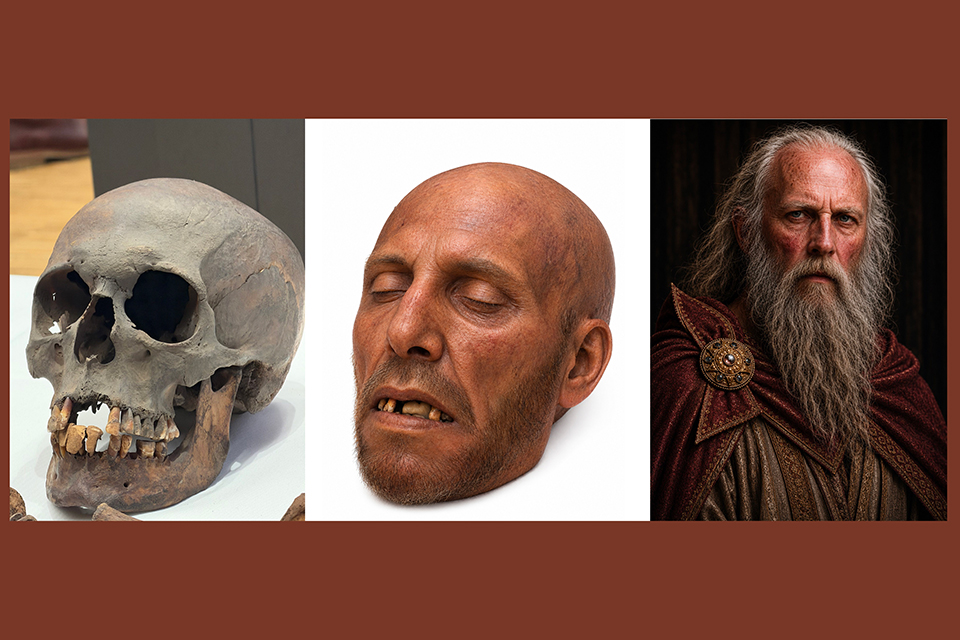
Not only do we possess what is likely an eyewitness account from AD 973 of the death of Emperor Otto the Great, but recent studies of his remains might fit the description.
Recent examinations of Otto the Great’s remains have produced intriguing evidence concerning his death in 973. CT scans revealed unusually enlarged vascular canals on one side of the skull base and upper cervical vertebrae.
In particular, radiologist Mathias Becker has highlighted an enlargement of the canalis caroticus, through which the internal carotid artery passes, while Walter Wohlgemuth likewise reports that the anatomy associated with the arteries supplying the brain offers visible clues to Otto’s possible cause of death.
Some contemporary reports have consequently suggested that the emperor suffered a stroke. Although this remains an interpretation rather than an established diagnosis, the research team has not yet published its scientific assessment of what caused the abnormal enlargement of the vascular canals or what pathological process they represent.
Indeed, in August 2026, the Landesamt explicitly stated that Otto’s cause of death remained unresolved and was still being investigated. For the present, a cerebrovascular event is therefore a plausible hypothesis, but not a demonstrated cause of death. We still await the scientific publication expected in the near future, which is promised to be a full and interdisciplinary study of all the results from the scientific studies. Amon other things, it appears that they also found that he emperor had suffered from a broken nose, a hard hit to the back of his head and a broken arm, while his legs showed deformations caused from constant riding about.
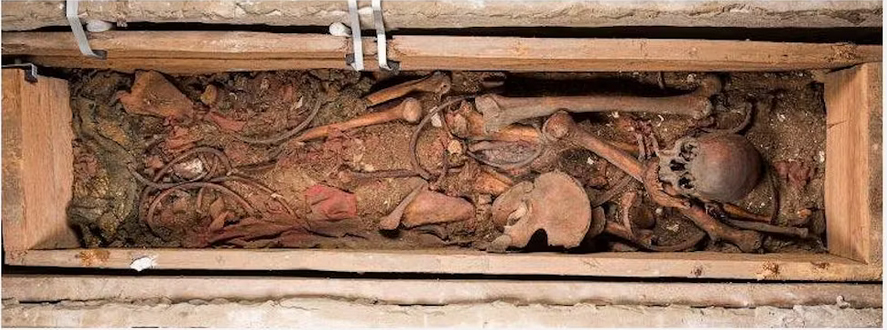
These findings are especially interesting when compared with the historical account of Otto’s sudden collapse at Memleben on 7 May 973, as recorded by Widukind:
Regarding the return of the emperor from Italy, and his death.
When the emperor heard about the death of his mother and his son, and of the other important men, for Gero, that great and powerful man had already died, he decided to break off his campaign against Frainet. Then, after putting affairs in Italy in order, he returned to his fatherland. He was agitated by a report that many of the Saxons wished to rebel. But since it would not serve any purpose, we do not believe it is worthwhile to discuss this further.
So, he departed from Italy with great glory, having captured the king of the Lombards, overcome the Greeks, and defeated the Saracens. He entered Gaul with his victorious forces, and then crossed into Germany where he would celebrate the coming Easter in that famous place, Quedlinburg.
A great multitude of diverse peoples gathered there, and celebrated with great joy the return of the father along with his son. Remaining there for not longer than seventeen days, he then departed to celebrate the Ascension of the Lord at Merseburg. However, his journey through this region was a sad one because of the death of that great man Duke Hermann, who left to his fellow men an eternal memory of his prudence, justice, and remarkable vigilance in internal and external affairs. Thereafter, the king received legates from Africa, who were waiting for him with gifts worthy of his royal status, and had them stay with him. On the Tuesday before Pentecost, he came to a place called Memleben.
The following night, as was his custom, he rose from bed at the break of dawn, and participated in the night and morning prayers.255 After this, he rested for a short time. Then, following the celebration of mass, he made some offerings, as was his custom, to the poor. He then ate a little bit, and again rested in his bed. When it was time, he got up, happy and cheerful, and took his place at the table. He was present through the completion of the office of vespers. But while the canticle of the evangelist was being sung, he began to grow feverish and tired. When the leading men, who were standing near, understood what was happening, they lay him down on a bench. His head was drooping as if he were already dead, but they revived him. After he sought and received the sacrament of the divine body and blood, he gave over his final breath to the mercy of the creator of all things, without a groan and at peace, to the sounds of the divine office.
He was carried into his bed chamber. Although it was now late, his death was announced to the people. The people said a great deal in praise of him and remembered that he had governed his subjects with paternal mercy, and had freed them from their enemies.
He had conquered with arms his arrogant enemies, namely the Avars, Saracens, and Danes. He had subjugated Italy. He had destroyed the shrines to the gods among the neighbouring peoples. He established churches and orders of priests. They recalled many other good things, as they participated in the royal funeral.
How the people chose the son as their ruler in place of his father. When morning came, although he had already been anointed as king, and designated as emperor by the pope, they eagerly gave their hands to the son of the emperor, the unique hope of the entire church, as they had done before, promised their loyalty and support against all of his adversaries, and confirmed this with military oaths.
Thus, Otto II was elected anew by the entire people as their ruler. He transferred his father’s body to the city, which the father, himself, had built, called Magdeburg. So died the emperor of the Romans, the king of peoples, on the seventh of May, the Wednesday before Pentecost. He left behind for posterity a great many glorious monuments in both religious and secular affairs.
Source: Deeds of the Saxons. Translated by Bernard S. Bachrach and David S. Bachrach. Catholic University of America Press 2024
SOURCES:
Official Landesamt report, 18 March 2026:
Official Landesamt update, 19 August 2026
Becker and Wohlgemuth statements:
Deutschlandfunk’s March report, which makes the stronger “stroke” interpretation
Deutschlandfunk Forschung aktuell: “Kaiserliches Grab – Wie gesund war Otto der Große?”. According to this broadcast, the emperor had suffered from a broken nose, a hard hit to the back of his head and a broken arm, while his legs showed deformations caused from constant riding around.