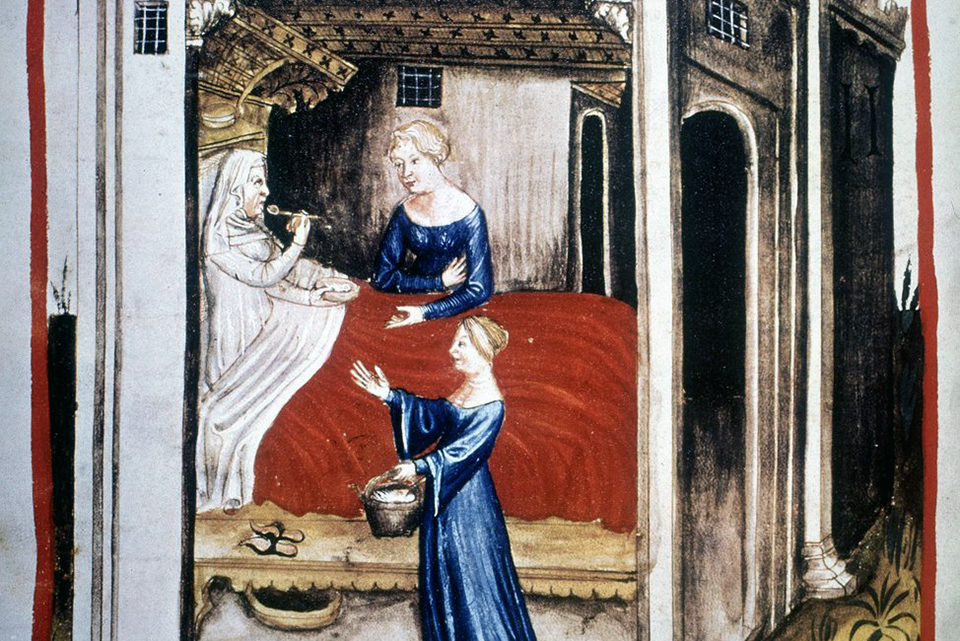
In 1397, Pernelle – the wife of the Parisian bourgeois Nicolas Flamel – lay at death’s door. At this point, she made her last will and testament, sparking a family feud and setting in motion a lengthy process of testamentary execution. Some of her provisions would not be fulfilled until more than twenty years after her death, leaving behind a cache of remarkably illuminating sources.
Nicolas Flamel was a captivating figure in the history of late medieval Paris. A wealthy burgher, he left behind numerous pious foundations as well as the contested legacy of becoming known as the alchemist par excellence. Owing to this curious afterlife, the sources pertaining to his actual existence came to be preserved to an extent that few of his friends and neighbours would ever experience.
We know about all this because Étienne-François Villain chose to publish the story while also editing the relevant sources preserved in the local archive of Saint-Jacques-de-la-Boucherie, the parish church of both Nicolas and Pernelle.
Of special interest are the documents dating from around Pernelle’s death in 1397, which reflect the family feud that subsequently arose between Nicolas and his in-laws. An accompanying essay tells this story, while the relevant documents have been translated and are appended below. Together with the text of Flamel’s testament and a dedicated longread placing the couple’s lives within their wider Parisian context, these translations are offered to anyone who wishes to gain a sense of such family entanglements in 1397 – and the difficulties a wife might encounter in having her last wishes respected.
The cache of documents is presented chronologically and holds the texts to the marriage contract (the mutual donation in various versions) the testament, the revision thereof and finally the texts appertaining to the conflict.
The texts are presented below as a longread, which may be freely downloaded and used for educational purposes. Explaining notes are kept at a minimum. The texts are translated from Villain,Étienne F. (1761) Histoire critique de Nicolas Flamel et de Pernelle sa femme : recueillie d’actes anciens qui justifient l’origine & la médiocrité de leur fortune contre les imputations des alchimistes : on y a joint le testament de Pernelle & plusieurs autres pieces intéressantes. A Paris : Chez G. Desprez, pp. 290-328
I. Mutual donation between Nicolas Flamel and Pernelle 7 April 1372
To all those who shall see these present letters, Hugues Aubriot, Keeper of the Provostship of Paris, sends greetings. Be it known that before Benoît Dufossé and Jehan Taboué, clerks of the King our lord, appointed by him to his Châtelet of Paris, there appeared in person Nicolas Flamel and Pernelle his wife, residing in Paris.
The said Nicolas gave and granted to his wife, who willingly accepted and received, authority, power, permission, and licence to enter into and agree with her said husband all and each of the matters contained and written in these letters.
The said husband and wife, considering the great love and affection, the great and agreeable services, and the great peace, devotion, and concord which each had shown the other since the celebration of their marriage, which they show at present, and which they hope, with the help of Our Lord Jesus Christ, to continue to show one another in the time to come;
Considering also that they had no heirs born of their bodies, and that the movable goods and immovable acquisitions which they had obtained before their marriage and during it had been acquired through great pains and labour, and that, with God’s pleasure and through their own good diligence, they hoped to acquire further property during their marriage;
Wishing and desiring, each on their own behalf, to avoid to the utmost of their power the vice of ingratitude, and to reward one another with their aforesaid movable and immovable goods, for the considerations stated above;
Of their own free will and good intentions, with one consent, agreement, and intention, and especially the said wife, who considered herself to have received good counsel from several of her relatives and associates;
Acknowledged and confessed before the said clerks and sworn notaries, as before us in a court of law, that they had made, concluded, and agreed, and hereby make, conclude, and agree, irrevocably, in good faith and without recall, a mutual grant and equal donation to one another of all their movable and immovable goods, acquired and to be acquired during their said marriage, which they shall have and possess on the day and at the hour when the first of the two shall depart this life, according to what is declared and established hereafter.
That is to say, they wished, consented, and expressly agreed, from this moment, by the tenor of these present letters, that whichever of the two should survive the other should, immediately after the death of the first, have, hold, enjoy, possess, and administer peacefully, alone and in their entirety, for as long as natural life remained in his or her body, whatever their condition or manner of living might then be, all the said movable and immovable goods, acquired and to be acquired as aforesaid.
This should be without any disturbance or impediment from the heirs or those claiming through the person who died first, whether they might seek to raise such obstacles or otherwise.
Nor should the survivor be required to provide any security or surety, or to make any inventory, notwithstanding the laws, usages, and customs of the city of Paris, which laws, usages, and customs they wished, from this moment and for that future time, to be held null and of no value, force, virtue, or effect.
Nor should the said heirs or those claiming through them have, demand, or claim any right whatsoever in the said goods, whether by succession or otherwise.
They further wished and expressly agreed that the survivor might, in his or her last will, dispose according to his or her full pleasure of all their movable goods and acquired property, both present and future, and of those which the survivor possessed in his or her own right or otherwise, as seemed good to him or her.
Always reserving, however, to the person dying first the right to take from the said movable goods and immovable acquisitions, and to dispose of in his or her last will, such portion as might justly be taken for the purposes of a testament and funeral observances.
And if any of their heirs or those claiming through them should attempt in any way to act against this present mutual grant and equal donation, or against any of the provisions contained in these present letters, they hereby deprived and deprive each of them, according to the extent of his or her interest or claim, forever and perpetually of all right to such inheritance and succession.
For the performance and complete fulfilment of all and each of the matters aforesaid, the said husband and wife made, constituted, named, and appointed each other as executor and commissioner in this matter.
They further wished and expressly agreed that, should this grant not be valid as a mutual grant and equal donation, it should nevertheless stand and be valid in whatever other way and manner it could and ought most effectively to be valid, notwithstanding any contrary laws, usages, customs, or establishments of towns, places, or countries.
Neither of the said husband and wife, nor either of them individually, should be able in any manner to revoke or annul the matters contained, written, and set out above, unless this were done with the common consent, intention, and agreement of them both, each in the presence of the other.
Furthermore, each of the said spouses, insofar as it concerned him or her, swore upon the Holy Gospels of God, and pledged their bodily faith by placing their hands in those of the said sworn notaries, as upon their souls, to hold and maintain forever firm, stable, and acceptable all and each of the matters aforesaid and contained in these letters, without acting or speaking against them.
For this purpose, they bound and declared bound to one another themselves, their heirs, all their own goods, and the goods of their heirs, movable and immovable, present and future.
They submitted all these goods to the authority of justice, before us and our successors as Provosts of Paris, and before all other judges within whose jurisdiction they might be found.
In witness whereof, upon the report of the said sworn notaries, we have affixed to these letters the seal of the Provostship of Paris.
These letters were made and executed in duplicate in the year of grace 1372, on Wednesday, 7 April, before Easter.
Jehan Taboué. Benoît Dufossé.
2. Renewal of the mutual donation — 10 September 1386
To all those who shall see these present letters, Audoin Chauveron, knight, councillor of the King our lord, and Keeper of the Provostship of Paris, sends greetings.
Be it known that before Giles Chaon and Guillaume Predur, sworn clerks of the King our lord, appointed by him to the Châtelet of Paris, there appeared Nicolas Flamel, writer, residing in Paris, and Pernelle his wife.
At the request of the said Pernelle, Nicolas her husband gave and granted to her, and she willingly accepted and received, power, authority, permission, and licence to conclude and agree, both on her own behalf and together with him, the following provisions.
The said husband and wife, being in good bodily health, thanks be to God, considering and reflecting upon the great benefits, friendships, courtesies, and services which they had shown one another for a long time, which they still show one another continually from day to day, and which, with God’s pleasure, they will show one another even more fully for as long as they remain together and live in marriage;
Considering also the great pains and labours, the good care and diligence, which each of them had undertaken and exercised in order to obtain and acquire certain movable goods and immovable acquisitions which Our Lord Jesus Christ, by his grace, had granted them in this mortal life;
Desiring, through good affection, to provide for and assist one another so that each, for as long as he or she should live in this world, might the better maintain an honourable livelihood appropriate to his or her estate;
For these reasons, the said husband and wife, of their own free will, good intentions, proper initiative, certain knowledge, and mutual agreement, acknowledged and confessed, without any fraudulent inducement or deception, that they had made, and hereby make, between themselves and to one another, a mutual grant and equal donation of all their movable goods and immovable acquisitions which they had made and acquired together during their marriage, and which they should acquire during the remainder of their marriage.
They wished and ordained by these present letters that the survivor, being the last of the two to die, should have and hold peacefully and without contradiction, throughout his or her lifetime, the entire share and portion of the first to die in all the said movable goods and immovable acquisitions.
This should be without being obliged to provide security or surety to the heirs of the person dying first, and without making any inventory, notwithstanding any laws or customs to the contrary.
Always saving and reserving, however, to the person dying first the right to take from his or her share and portion of the said goods such part of the property and such sum of money as might seem good to him or her for the making of a testament or ordinance of last will, according to his or her estate.
Furthermore, the said husband and wife wished, ordained, and agreed with one another that the survivor and last to die might give, bestow as alms, and distribute, whether healthy or sick, by testament or otherwise during his or her lifetime, as he or she pleased, the entire share and portion of the first to die in all the said movable goods and immovable acquisitions.
Such gifts might be made to any persons, religious communities, churches, poor and unfortunate persons, jointly or separately; or the property might be devoted to the celebration of Masses or other charitable alms, as seemed good to the survivor, according to his or her conscience alone.
For the accomplishment of all the matters aforesaid, the said spouses made and appointed each other as executor and commissioner in conscience, for the salvation and benefit of the soul of the person dying first, from that moment and for the future, notwithstanding any contrary laws, customs, or other provisions.
The said husband and wife wished that this mutual grant should take effect and have its full force from that moment, without ever being recalled or revoked, unless by common agreement they should both wish to recall and annul it together.
For the maintenance and accomplishment of the aforesaid matters, and never to act against them, the said husband and wife bound and hereby bind to one another all their goods, their [heirs – the transcription is uncertain at this point], and the goods of their heirs, movable and immovable, present and future.
They submitted them to the authority of justice, to be taken and administered by us or our successors as Provosts of Paris, and by all other judges within whose jurisdiction they might be found. They expressly renounced, by their oaths and pledges given into the hands of the said sworn notaries, everything that might be alleged against these letters.
In witness whereof, upon the report of the said sworn notaries, we have affixed to these letters the seal of the said Provostship of Paris. This was made and executed in the year of grace 1386, on Monday, 10 September.
Guillaume Predur. Giles Chaon.
3. Ratifications of the mutual donation — 1388 and again 5 August 1396
In 1388 the couple sought a new confirmation of their agreement. Villain followed the 1386 document with this editorial explanation, rather than printing another complete instrument:
Villain wrote: “Flamel and Pernelle made a third deed of mutual donation on Friday, 18 September 1388, before Delanoe and Maugier, notaries. It has not been inserted here because, apart from certain phrases quoted in the book, it is entirely similar to the deed of 1386 reproduced above.
The important qualification is that the 1388 deed was not identical in every respect. In his earlier discussion (pp. 50–51), Villain specifically drew attention to strengthened renunciations, including an oath upon the Gospels and provisions intended to prevent either spouse from challenging the arrangement.
Finally in 1396, Villain records, the couple once more sought to have their mutual agreement ratified. Again Villain does not give us the full text but just the gist. He writes: “Nicolas Flamel and Pernelle his wife, authorised in this matter by the said Nicolas, etc., acknowledged, ratified, and declared themselves entirely satisfied with all and each of the letters and ordinances, promises, agreements, mutual grants, donations, alms, transfers, and other matters which might have been made and concluded by their common agreement and consent, in whatever manner this might have been done, without any exception, according to their form and tenor. And they wished that these matters, grants, and ordinances should, from this moment for that future time, and from that future time for this present moment, be held valid and fulfilled, without acting or causing anything to be said against them, whether by testament, last will, or otherwise. They excluded, and wished to be fully excluded, all heirs and other persons who might wish to act against them, etc. Notwithstanding any laws, customs, or other provisions to the contrary, especially since they considered themselves strongly bound in conscience to have done this for certain reasons, etc. Each promised on his or her own behalf, etc., for the whole, etc., bound themselves, etc., and their goods, etc., renounced, etc., guaranteed if necessary, etc., swore, wished, etc.”
The three instruments make it possible to trace an evolution in the couple’s arrangements. The original donation of 1373 was concerned principally with protecting the survivor against claims by collateral heirs. The renewed agreement of 1386 went further in explicitly allowing the survivor to devote the deceased spouse’s share to religious and charitable purposes. The 1388 renewal reinforced this arrangement with additional legal safeguards. Finally, the ratification of 1396 sought to establish beyond doubt that the previous agreements remained binding.
Yet in August 1397, only a year after this emphatic ratification, Pernelle made a testament revoking the mutual donation. Ten days later, by her codicil of 4 September, she restored it.
4. The Testament of Pernelle, Wife of Nicolas Flamel
To all those who shall see these present letters, Jean, Lord of Folleville, knight, counsellor to the King our lord and keeper of the Provostship of Paris, greetings.
Be it known that before Guillaume Delaporte and Jean Béguinot, clerks and sworn notaries of the King our said lord, appointed by him in his Châtelet of Paris, there appeared in person Pernelle, wife of Nicolas Flamel, writer and bourgeois of Paris, being infirm in body but nevertheless sound in mind and of good and true understanding. Considering and wisely reflecting that nothing is more certain than death, nor anything less certain than the hour thereof, and wishing not to be found unprepared at her end, nor to pass from this world into the next intestate, but while sense and reason still governed her thoughts, contemplating heavenly things and desiring to provide for the salvation and welfare of her soul, she made and ordained, in the name of the Father, the Son and the Blessed Holy Spirit. Amen.
Her testament, or ordinance of last will, in the form and manner following.
Her soul and burial
First, she, as a good and true Catholic, devoutly commended and commends her soul, when it shall depart from her body, to the Blessed Trinity of Paradise, the glorious Virgin Mary, my lord Saint Michael the Archangel, my lord Saint Peter, Saint Paul, Saint James, my lady Saint Catherine, and all the saints, male and female, of the blessed and heavenly court of Paradise. And thereafter she ordained that her body should be committed to burial by Holy Church, choosing her burial place in the Cemetery of the Holy Innocents in Paris.Debts and funeral arrangements
Item. She willed, ordained and expressly commanded that all her debts whatsoever, of which proof should appear to her executors named below, should be paid, and that any wrongs committed by her should be made amends for by those executors.
Item. She willed and ordained that the candles and lights for the day of her funeral should be made from thirty-two pounds of wax.
Item. She bequeathed to the four mendicant orders in Paris, namely the Franciscans, Dominicans, Carmelites and Augustinians, six Parisian sous to each of these four orders, to recite vigils for her soul.
Item. To the religious of the Hôtel-Dieu of Paris, for the recitation of vigils, eight Parisian sous.
Item. To the sick of the said Hôtel-Dieu, eight Parisian sous.
Item. To the Hospital of the Holy Spirit in the Place de Grève, for the recitation of vigils for her, eight Parisian sous.
Item. To the orphans of the said institution of the Holy Spirit, five Parisian sous.
Item. To the Quinze-Vingts blind people of Paris, for the recitation of vigils for her, eight Parisian sous.
Item. She willed and ordained that four livres and sixteen Parisian sous should be given and applied towards the cost of the dinner to be held on the day of her funeral.
Item. She willed and ordained that, on the day of her death, the sum of eight livres tournois should be given and distributed as alms, for the love of God, to various poor people by her said executors.
Masses and gifts to Saint-Jacques-de-la-Boucherie
Item. She willed and ordained that thirteen Requiem Masses should be said and celebrated on the day of her funeral in the Church of Saint-Jacques-de-la-Boucherie in Paris.
Item. She willed and ordained that, on the day following her funeral, two sung Requiem Masses, with deacon, subdeacon, bread and wine, should be sung and celebrated: one in the said Church of Saint-Jacques-de-la-Boucherie and the other in the Church of the Holy Innocents in Paris.
Item. She bequeathed to the fabric fund of the said Church of Saint-Jacques, of which she was a parishioner, eleven livres tournois, as a single payment.
Item. To the parish priest of the said church, forty sous tournois.
Item. To each of the four chaplains of the said church, ten sous tournois.
Item. She bequeathed to Master Jean Adam, her confessor, one of the four chaplains mentioned above, an additional twenty sous tournois.
Item. To each of the two clerks of the said church, five sous tournois.
Item. She bequeathed to the lights of Our Lady in the said church, ten sous tournois.
Item. To the Confraternity of Saint James and Saint Christopher in the said church, ten sous tournois.
Item. She bequeathed to the Confraternity of Saint Anne, founded in that church, ten sous tournois.
Item. To the fabric fund of the Church of the Holy Innocents, ten sous tournois.
Masses for two years and for the deceased
Item. She willed and ordained that two annual cycles of Masses should be performed and celebrated, namely, during the two consecutive years following her death, one Requiem Mass every day in the Church of Saint-Jacques-de-la-Boucherie in Paris, with bread, wine and candle.
She willed and ordained that these annual cycles and Masses should be performed and celebrated by the aforementioned Master Jean Adam and by Master Jean Baillet, priests, namely by one of them during the first year and by the other during the second year.
Item. She willed and ordained that six Requiem Masses should be said and celebrated on one occasion for the deceased Pernelle Dehanigues.
Item. She willed and ordained that six other Requiem Masses should be said and celebrated on one occasion for the deceased Clément Dehanigues.
Item. She willed and ordained that four Requiem Masses should be said and celebrated on one occasion, according to the arrangement and wishes of her executors, for the deceased Guillaume de Laigny, her cousin.
Item. She bequeathed to the fabric fund of Notre-Dame of Paris ten sous tournois.
Item. She willed and ordained that the sum of thirty-five livres tournois should be employed and distributed according to the directions of her said executors, both for the celebration of Requiem Masses on one occasion for the deceased Raoul Lethus, formerly her husband, and for distribution as alms, for the love of God, to poor people, girls requiring marriage portions and other charitable works. These Masses were to be celebrated in the said Church of Saint-Jacques-de-la-Boucherie.
Pilgrimage to Boulogne-sur-Mer
Item. She willed and ordained that a journey should be made once, on foot, by a male pilgrim to Our Lady of Boulogne-sur-Mer. To this pilgrim, for undertaking the journey, she willed that four livres tournois should be delivered and paid by her said executors. The pilgrim was to arrange for two Masses to be sung and celebrated in the Church of Our Lady at that place, namely one of the Holy Spirit and the other of Our Lady. He was also to offer a wax candle weighing twelve pounds and to pay one Parisian sou for each Mass.
Bequests to the poor, relatives and other individuals
Item. She bequeathed to the girl Jeannette la Paquote, towards increasing her marriage portion, six livres tournois.
Item. To Martin, who was accustomed to distribute holy water in the Church of Saint-Jacques, five sous tournois.
Item. To each of the five poor persons who were accustomed to sit and beg for alms at the doorway where marriages were celebrated in the said Church of Saint-Jacques, one sou and six deniers tournois.
Item. To each of the other poor persons who were accustomed to sit near the pulpit from which sermons were preached in the said church, one sou and six deniers tournois.
Item. To the poor of Sainte-Avoye in Paris, ten sous tournois.
Item. To the poor of the chapel founded by Étienne Haudry, ten sous tournois.
Item. To Jean, son of the late Clément de Hanigues, formerly her husband, should he be found, ten livres tournois as a single payment. And should he not be found, she willed and ordained that these ten livres tournois should be given and distributed as alms, for the love of God, according to the wishes and consciences of her said executors.
Item. To the son of the late Jean le Maire, as an act of charity and almsgiving, four livres tournois.
Item. To Guillaume, Oudin and Colin, children of the late Guillaume Lucas, her nephews, to each of these children, eight livres tournois.
Item. To Perrinet, son of Master Jean François, her godson, four livres tournois.
Bequests of clothing and personal possessions
Item. To Jeannette Lalarge, her best chaperon.
Item. To Jeannette la Flaminge, wax-chandler selling at Saint-Jacques, her other violet chaperon.
Item. To Jeannette la Paquote, a reddish marbled gown and a chaperon which she wore every day.
Item. Five of her gowns lined with white fur to five poor persons whom her said executors, according to their consciences, should consider suitable recipients.
Item. She further bequeathed to the aforementioned Jeannette la Paquote a reddish marbled gown.
Item. To Avelot la Charonne, both for the love of God and in recompense for certain agreeable services which she had rendered her, ten sous tournois and a cote hardie which she wore every day.
Item. To Jacquelot de Senlis, her good cote hardie.
Item. To the Hospital of Hautpas, five sous tournois.
Item. To Perrette Dubreuil, twenty-two sous and six deniers tournois.
Item. To Maline and Tassine Desfresne, to each of them towards increasing her marriage portion, sixty sous tournois.
Item. To Mengin, a young clerk, her servant, for the love of God, one livre and five sous tournois.
Item. To Pierre Lesannier, living in her household, for the love of God and as alms, one livre tournois.
Item. To Gautier, her servant, for the same reason, one livre tournois.
Item. She willed and ordained that all her shifts, stockings, head coverings and small personal belongings associated with her dress should be given away for the love of God wherever her said executors considered it appropriate and well bestowed.
Appointment of executors
For the fulfilment and execution of all and each of the things stated above, the said testatrix appointed, chose, named and ordained as her executors her beloved and faithful: The venerable and discreet Master Hervé Rousseau, Doctor of Canon Law and parish priest of Saint-Jacques-de-la-Boucherie in Paris; The honourable Master Jean François, apostolic and imperial notary; Roger Closier; And Jean Harangier.
To each of these, for diligently attending to and undertaking the execution of her said testament, she bequeathed four livres tournois. To her said executors, or to two of them, she gave and granted full power, authority and special mandate to pay, fulfil and accomplish properly and faithfully this present testament or ordinance of last will.
And for this purpose she relinquished and divested herself, into the hands of the said notaries, of all her movable and immovable property, and by these presents invested her said executors with possession thereof.
She submitted the execution of her present testament or ordinance, together with the examination and rendering of the accounts relating thereto and everything dependent upon them, to the Court of the Provostship of Paris. And the said testatrix revoked, recalled and annulled all other testaments, codicils and ordinances of last will previously made by her before this present testament, upon which she now settled. She willed that it should take full effect and be valid by right of testament, codicil, ordinance of last will, and otherwise by every lawful means and manner whereby it might and ought to be valid, whether by law, reason or custom.
Revocation of the mutual gifts to Nicolas Flamel
Item. The said testatrix, of her own motion and without having been improperly influenced in this matter, as she declared, recalled and entirely revoked, from that moment, all letters and instruments, whether of mutual and equal gift or otherwise, which before the day of her said testament she might have made, granted and executed in favour of Nicolas Flamel, her husband, or jointly with him.
She willed that no faith or credit should be given to those letters and instruments, and by these presents annulled and rendered them entirely void.
In witness whereof, we, upon the report of the said notaries, have affixed the seal of the said Provostship of Paris to these letters, which were made and executed in the year of grace one thousand three hundred and ninety-seven, on Saturday, the twenty-fifth day of August.
Beéguinot. Delaporte.
5. Codicil of Pernelle
To all who shall see these present letters, Jehan, Lord of Folleville, knight, councillor of the King our lord, and Keeper of the Provostship of Paris, makes known that before Mile Dubreuil and Jehan Maugier, clerks and sworn notaries of the King our lord, established at the Châtelet of Paris, there appeared in person Pernelle, wife of Nicolas Flamel, writer, residing in Paris in the Rue aux Écrivains, in the parish of Saint-Jacques-de-la-Boucherie. Although infirm in body, she was sound in thought and understanding, as was apparent.
She declared that she had made her testament and ordinance of last will, to which these present letters were annexed, and that, diminishing and adding to that testament, she had wished and ordained, and by this present codicil wished and ordained, the following provisions, for the salvation and benefit of her own soul and those of all her relatives, friends, and benefactors.
First, the said Pernelle wished and ordained that the mutual favour and equal and reciprocal donation formerly made between Nicolas, her dear and good friend, companion, and husband, and herself, which she had revoked and annulled by her testament, should stand, remain valid, and have its full effect, force, and virtue in all its terms, clauses, and provisions, without any diminution whatsoever. And that her said husband should enjoy its benefits according to its provisions, notwithstanding the aforesaid revocation or anything else whatsoever.
Furthermore, the said Pernelle wished and ordained that her testament could not be accomplished except by the executors named therein together with Nicolas, her lord and husband, whom she named and appointed as her true friend, executor, and commissioner, alongside the other executors mentioned in her testament, or by three of them alone, notwithstanding that she had previously provided in her testament that two of her executors might perform and accomplish it.
Item. The said Pernelle bequeathed, as a single payment, to Isabelle her sister, wife of Jehan Perrier, who was her nearest relative entitled to inherit, the sum of 300 livres tournois, in the currency now current, to be taken from all her movable goods and hereditary property after her death, through the hands of her said executors. This sum was to satisfy all rights of succession and inheritance which Isabelle might have or claim in any of the movable goods, debts, credits, or hereditary property remaining at Pernelle’s death.
Thereafter, the said Pernelle wished and ordained, and wishes and ordains, that Nicolas her husband should enjoy and receive, fully and throughout his lifetime, the fruits, profits, and revenues of all the residue of her movable goods, debts, credits, hereditary property, and possessions whatsoever, after her testament had been paid and accomplished, and the aforesaid 300 livres tournois had been paid once to her sister.
And after his death, all that residue should be converted and employed, according to the ordinance of her said executors, both for the establishment of four low Masses of Requiem, which the said Pernelle wished and ordained by this codicil to be celebrated perpetually every week in the church of Saint-Jacques-de-la-Boucherie, of which she was a parishioner, for the salvation and benefit of the souls of Pernelle herself and of her relatives, friends, and benefactors, and also for certain pious and charitable works to be performed for God’s sake and as alms, according to the ordinance and wishes of her said executors.
Item. She wished that her said executors and Nicolas, or three of them, should accomplish this codicil together with her testament, giving them full power, authority, and special mandate to do so.
She ordained that these present letters and her testament, excepting what had been expressly provided above, should stand and have their full effect and force in all their provisions and clauses; that the aforesaid revocation should be set aside and annulled; and that everything should stand and be valid in the best form and manner in which it might and ought to be valid according to the law of testaments, codicils, last wills, or otherwise.
Into the hands of her said executors, her husband, or three of them acting for the whole, she ceded and transferred all her movable goods, debts, hereditary property, and possessions, binding them to accomplish everything herein provided and submitting them, in this respect, to the jurisdiction, coercion, and authority of the Provostship of Paris.
She divested herself of these goods until the full accomplishment and execution of the aforesaid provisions, and likewise submitted the execution and rendering of accounts to the jurisdiction of the said Provostship of Paris.
In witness whereof, at the report of the aforesaid notaries, we have placed the seal of the said Provostship of Paris upon these letters, which were made on Tuesday, 4 September 1397.
Jehan Maugier. Mile Dubreuil.
6. Receipt and discharge from Jean Périer and Isabelle — 15 January 1398
Jehan Périer and Isabelle his wife, duly authorised, acknowledged that they had received from the executors of the testament and codicil of the last will of the late Pernelle, formerly wife of Nicolas Flamel, through the hands of the said Nicolas, one of those executors, the sum of 200 livres tournois, in the presence of the notaries, in blancs valued at ten deniers tournois each.
This payment constituted the remainder and final settlement of the sum of 300 livres tournois owed to them by the said executors, acting in the name of and on behalf of the execution of the testament, according to the ordinance made by the deceased in her codicil and according to a judicial agreement made between the said executors on the one part and the said husband and wife on the other, dated 30 October last past, which had been sufficiently exhibited to the notaries.
The said 200 livres tournois were the balance remaining after an earlier payment of 100 livres tournois, together making the full sum of 300 livres tournois.
The said Jehan Périer and his wife declared themselves satisfied, fully paid, and content, and thereby discharged the said executors, the property of the said estate, Nicolas himself, and all others.
They promised to acquit, guarantee, and indemnify the said Nicolas, the said executors, and the property of the said estate against all persons.
[thereafter follows a series of abbreviated legal formulae concerning appointment, obligation, ratification, and related provisions.]
The document was executed in duplicate: one receipt was delivered to Nicolas, and another to the other executors of the testament, both relating to the same sum and collated against each other by the said notaries, with the agreement of Périer and his wife, Nicolas, Master Jehan François, and Jehan Harangier, all executors of the said testament.
All were present before the said notaries on Tuesday, 15 January 1398 [1397 in the original Easter-style dating].
Nicolas. Béguinot.
7. The Châtelet agreement — 29 January 1398
(Sentence of the Châtelet of Paris, by which the executors of Pernelle’s testament charge Flamel with taking the necessary care for the accomplishment of the said testament.)
To all who shall see these present letters, Jehan, Lord of Folleville, knight, councillor of the King our lord, and Keeper of the Provostship of Paris, etc.
[The parties], for the great, clear, and very evident benefit of the said execution of the testament, as they declared, acknowledged and confessed that they had together made the following treaties, agreements, promises, etc., concerning its execution.
That is to say, considering the good, cordial love and affection which Nicolas had borne towards his late wife during her lifetime, and which he still bore towards her salvation and the benefit of her soul, and the desire of the parties for her salvation, and seeing how burdensome and costly it would be otherwise, they agreed that Nicolas, who knew the nature of the matters hereinafter written, should take upon himself the burden, charge, care, and diligence of accomplishing the testament and the other duties which the executors were bound to perform, although these were not his individual responsibility. The said Nicolas willingly accepted this, as he declared.
Likewise, in order that the executors might be compensated to some extent for certain costs and expenses which they had incurred through the obstacles raised by Jehan Périer and Isabelle his wife, sister of the deceased, who claimed to be heirs through the said Isabelle, and for numerous meetings, fees of advocates, procurators, and notaries, inventories, and other expenses incurred and sustained in the Parlement, the Châtelet of Paris, and elsewhere, the said executors charged and entrusted Nicolas with the care, diligence, and accomplishment of the testament.
Excepted and reserved was the matter of the four Masses which, according to the codicil, were to be said and celebrated perpetually every week in the church of Saint-Jacques-de-la-Boucherie. The said Nicolas, having considered and accepted the aforesaid matters, undertook and assumed upon himself the care and diligence of their accomplishment. Accordingly, in fulfilment of his good intention, Nicolas promised by these letters to pay at his own expense all the legacies and ordinances contained in the testament and codicil, except the four perpetual Masses.
He likewise undertook to pay all debts, funeral and burial expenses, costs, fees, lawsuits, and other matters arising from the death of the deceased which the executors had incurred or were still obliged to incur, subject to the aforesaid exception.
All these matters, including the inventories, loans made by Nicolas to the King our lord, several debts owing by Nicolas at the time of the deceased’s death, and certain small debts judged uncollectable and therefore deducted after due deliberation, amounted altogether to 761 livres and 12 deniers parisis, [according to the available transcription]
Nicolas further undertook to obtain at his expense all necessary documents and receipts and to pay all lawsuits, debts, obligations, pecuniary and otherwise, known and unknown, incurred during his marriage to the deceased.
And whereas, according to the inventory made of the movable and immovable property and other goods held in common by Nicolas and his late wife at the time of her death, the share belonging to the execution was insufficient to meet even a fifth part of what was required to accomplish the testament and codicil, especially since the executors were obliged under the codicil to pay promptly the sum of 300 livres tournois to Isabelle, sister of the deceased;
And whereas the movable goods remaining at the death of the deceased, together with credits and arrears of various rents and rentals due, amounted to only 168 livres 4 sols 8 deniers parisis, the said executors proceeded as follows.
After the executors had personally inspected, together with several sworn experts and knowledgeable persons, certain rents belonging jointly to Nicolas Flamel and the estate, more fully described in letters of transfer issued that day, including rents from houses previously let out by Nicolas and others arising from small buildings and properties of little value, amounting to 78 livres 9 sols 8 deniers and one maille, they transferred and relinquished those rents perpetually to Nicolas Flamel, his heirs, and successors.
In consideration of the aforesaid undertaking, the executors also transferred to Nicolas all movable goods, credits, and arrears belonging to the estate, amounting to the said 168 livres 4 sols 8 deniers parisis, of which he was to discharge the estate by producing sufficient receipts and acknowledgements.
Furthermore, Nicolas promised that he would not, during his lifetime, sell, cede, or alienate the ownership of the estate’s half of the rents remaining to it and recorded in the inventory, apart from those now sold and transferred to him. These included the house in which he presently resided, situated at the corner of the Rue de Marivaux; certain writers’ workshops adjoining the church of Saint-Jacques-de-la-Boucherie; and a rent of one setier of wheat, all of which remained undivided between himself and the estate, together with the surplus rents. The property thus remaining undivided was reserved for the establishment and fulfilment of the four perpetual Masses ordained by the deceased in the church of Saint-Jacques, and was not included in the present agreement. The executors were to apply it to that purpose as advantageously and expeditiously as possible. And by these presents, the executors agreed that the sum due under the transfer of the movable goods, small rents, and arrears, for which Nicolas was bound by letters of obligation issued by the Châtelet of Paris, might be employed by him towards the payments and discharge of the obligations which he had assumed under the present agreement. The sum of that obligation is given as 592 livres 16 sols 4 deniers parisis [in one passage of the transcription]. Nicolas promised to employ it properly and faithfully.
Furthermore, the executors promised that whenever Nicolas requested it, they would grant him sufficient deductions and discharges for all payments which he could prove, by receipts or otherwise, to have made towards the accomplishment of the testament.
And as soon as he had duly expended the sum for which he was bound, they would return the obligation to him as satisfied and paid, and release him entirely from it. Under these arrangements, all the movable goods and other property transferred to Nicolas, including arrears of rents, house rentals, small debts found owing to Nicolas and the deceased, and the rents and their ownership transferred by the executors, would remain for his individual benefit and that of his heirs in perpetuity.
The executors declared themselves satisfied with the obligation which Nicolas had entered into before the Châtelet. Nicolas was thereby empowered to collect for his own benefit the said credits and arrears. He would also enjoy, as usufructuary during his lifetime only, by virtue of the mutual donation formerly made between himself and the deceased, all the profits, revenues, and proceeds arising from the remaining rents held undivided by the estate, and likewise from the house, workshops, setier of wheat, and other rents remaining undivided as aforesaid. As regards the house and workshops, insofar as they concerned the estate, he was obliged to maintain them in the manner appropriate to a lifetime usufructuary. Furthermore, all life rents, whether payable in wheat, wine, or otherwise, acquired by himself and the deceased would belong to Nicolas for his own benefit, to dispose of as he wished, without ever being required to render an account to the executors or any other persons on behalf of the estate.
The parties promised upon their oaths and faith to observe the said treaties, promises, and agreements, etc., and renounced all objections in the matter, etc.
In witness whereof, at the report of the aforesaid notaries, we have affixed the seal, etc., in the year of grace 1397 [1398 according to modern reckoning], on Tuesday, 29 January.
Dujardin. Béguinot.
8. Account of the final execution of Pernelle’s testament dated 29. June 1399
Account of the execution of Pernelle’s testament, rendered to Miles de Rouvoy, commissioner, by Flamel and the other executors.
To the noble and wise Master Jehan, Lord of Folleville, councillor of the King our lord and Keeper of the Provostship of Paris: Miles de Rouvoy, examiner appointed by the King our said lord in his Châtelet of Paris, offers honour, reverence, and all obedience.
My very dear lord, may it please you to know that, by virtue of your letters of commission addressed to me, the tenor of which follows:
“Jehan, Lord of Folleville, knight, councillor of the King our lord, and Keeper of the Provostship of Paris, to our beloved Master Miles de Rouvoy, examiner appointed by the King our lord at the Châtelet of Paris, greetings. At the request of Jehan Harangier and Rogier Closier, executors of the testament and last will of the late Pernelle, recently the wife of Nicolas Flamel, who have today submitted to our jurisdiction, on behalf of the King our lord, cognisance of the said testament, its execution, and all matters dependent upon it, asking us to give and appoint them a commissioner to hear and examine in our stead the account of that testament and of everything relating to it, the cognisance of which, and of all that does or may depend upon it, we have reserved and do reserve to ourselves as having first come before us on behalf of the King our lord, and having been sufficiently informed of what may arise from it, so that, once the said account has been made and rendered, the said executors may be discharged, as reason and the circumstances of the case shall require. We command all those to whom it pertains, and request all others besides you, to obey and assist diligently in this matter. Given under the seal of the Provostship of Paris on Wednesday, 17 September 1397.”
I, [Rouvoy] on Monday, 16 June 1399, and on several subsequent days in the same year, caused to come and appear before me the executors named in your said letters of commission, together with the discreet and wise Master Hervé Roussel, parish priest of the church of Saint-Jacques-de-la-Boucherie; Master Jehan François, apostolic and imperial notary; and Nicolas Flamel, writer, residing opposite Saint-Jacques, all executors of the testament and codicil of the late Pernelle, formerly wife of the said Nicolas. I required them to bring me the said testament and codicil, together with all letters, receipts, and evidences in their possession serving towards the rendering of the account and the fulfilment of the testament and codicil, in the manner directed and entrusted to me by you and by your said letters.
The executors brought, exhibited, and showed before me various letters and receipts bearing the signatures of several notaries of the Châtelet and others, and sealed with various seals of several courts, religious houses, and other persons, of which sufficient proof was given to me. All of these, each individually, together with the testament and codicil, I have, in your name and on your behalf, held and diligently read, one after another, and have examined all that required examination concerning them as shown by these documents and by the several headings of receipts, expenses, sales, and redemptions written and declared below, namely:
This is the account which the venerable and discreet Master Hervé Roussel, Doctor of Canon Law and parish priest of Saint-Jacques-de-la-Boucherie in Paris; Master Jehan François, apostolic and imperial notary; Rogier le Closier; Jehan Harangier; and Nicolas Flamel, writer and bourgeois of Paris, executors of the testament and codicil of the last will of the late Pernelle, recently wife of the said Nicolas Flamel, make and render before the wise and discreet Master Miles de Rouvroy, examiner appointed by the King our lord in his Châtelet of Paris, commissioned for this by the Provost of Paris.
It concerns both what the said executors have received from the goods of the late Pernelle and what they have expended in paying her claims and debts; in paying the legacies of her testament and codicil, her obsequies and funeral expenses, and the other expenses they have incurred in executing the testament and codicil. They reserve the right to add or subtract items and to explain more fully [here ellipsis in text] the entries declared here, should it be necessary, before the said Master Miles de Rouvroy.
First, the said executors declare that it is true that the late Pernelle made her testament or last will, by which she made and ordained several particular legacies, and appointed her beloved and faithful Master Hervé Roussel, Master Jehan le François, Rogier le Closier, and Jehan Harangier as her executors. To them jointly, or to two of them, she gave power to execute the testament, and revoked and annulled all other testaments, codicils, and ordinances of last will previously made by her. The said testament was made and executed on Saturday, 25 August 1397.
Item. The executors declare that after making her testament, Pernelle made a codicil by which she subtracted from the testament and added the following provisions.
First, she wished and ordained that the mutual favour and equal and reciprocal gift previously made between Nicolas, her husband, and herself should stand and be valid, and should have its full effect and force.
Furthermore, Pernelle wished and ordained that her testament should be carried out only by the executors named therein together with Nicolas, her husband, whom she named and chose as executor and commissioner alongside the other executors named in the testament, or by three of them, notwithstanding that in her testament she had provided that two executors could fulfil it.
Item. Pernelle left to Isabelle, her sister, wife of Jehan Périer, a single payment of 300 livres tournois, in satisfaction of all rights of succession and inheritance which Isabelle might have or claim in the goods remaining at Pernelle’s death.
After this, Pernelle wished and ordained that Nicolas, her husband, should enjoy fully, throughout his lifetime, the fruits, profits, and revenues of all the residue of her movable goods and inherited property after the testament had been fulfilled and the 300 livres tournois had been paid once to her sister. After Nicolas’s death, the whole residue should be employed as her executors should ordain, both for the establishment of the four low Requiem Masses which Pernelle wished and ordained to be said and celebrated in perpetuity every week of the year in the church of Saint-Jacques-de-la-Boucherie in Paris, of which she was a parishioner, for the salvation and benefit of the souls of Pernelle and of her friends, relatives, and benefactors, and for certain other pious and charitable works to be performed for God and as alms according to the ordinance and wishes of her executors.
She submitted all her movable and immovable goods, in this respect, to the jurisdiction, coercion, and authority of the Provostship of Paris, together with the execution and rendering of the account of the testament and codicil. The said codicil was made and executed on Tuesday, 4 September 1397. Pernelle departed this world on the following Tuesday, 11 September 1397.
Item. The executors declare that after Pernelle’s death an inventory was made at the request of Nicolas Flamel, for himself and in his own name on the one part, and of Nicolas together with the other executors named above, in their capacity as executors of the testament and codicil, and of Jehan Périer, tavern keeper, and Isabelle his wife, who considered themselves entitled, through Isabelle, to call themselves heirs of the late Pernelle, formerly Isabelle’s sister, if they wished to do so, on the other part.
InventoryThis inventory was made by Pierre Paris and Guillaume de la Porte, clerks and notaries of the King our lord at his Châtelet of Paris, of all the movable and immovable goods, debts, and credits held in common by Nicolas Flamel and the late Pernelle his wife at the day and hour of her death, situated and found in a house belonging to the said married couple, in Paris opposite Saint-Jacques-de-la-Boucherie, where the sign of the Fleur-de-Lys hung. The movable goods were valued by Nicolas Quatrebaut, sworn appraiser of the King our lord in the city of Paris. It appears from the inventory that the said household movable goods amounted to 168 livres 19 sols parisis.
Item. It appears from the inventory that Nicolas Flamel and Pernelle his wife, at the day and hour of her death, held and possessed, as property they had acquired, annual perpetual rents situated both in Paris and outside the city amounting to 294 livres 2 sols parisis.
Item. It appears from the inventory that Nicolas Flamel and Pernelle his wife had acquired one setier of wheat as a perpetual rent.
Item. It appears from the inventory that Nicolas Flamel and Pernelle his wife had acquired two sites for workshops adjoining the walls of the church of Saint-Jacques-de-la-Boucherie, upon which they subsequently caused buildings to be erected, namely the two small writers’ workshops now standing there.
Item. It appears from the inventory that Nicolas Flamel and Pernelle his wife had acquired a vacant plot at the corner of Rue de Marivaux opposite the said church of Saint-Jacques-de-la-Boucherie, upon which they subsequently caused the house now standing there to be built, bearing the sign of the Fleur-de-Lys.
Item. It appears from the inventory that Nicolas Flamel and Pernelle his wife, at the day and hour of her death, held and possessed, as property they had acquired, life rents situated both in Paris and beyond, amounting to 59 livres 8 sols parisis. The execution of her testament had no right to these by reason of the mutual donation made between the married couple and their agreement; Nicolas would enjoy them peacefully and for his own benefit by virtue of that donation and agreement.
Item. It appears from the inventory that the said couple had acquired nine poinçons of wine as a life rent, as declared in the inventory, which Nicolas was to enjoy by virtue of the mutual donation and agreement, as aforesaid.
Item. It appears from the inventory that the married couple had acquired four queues of wine as a life rent, as declared in the inventory, which Nicolas would enjoy by reason of the said mutual donation and agreement. The execution had no rights over the life rents, whether in wheat, wine, or money, declared in the inventory. The executors relinquished them to Nicolas for his own benefit, under the agreement and by virtue of the mutual donation, as aforesaid.
Item. It appears from the inventory that certain debts due to the married couple had been improperly entered in it because, when the inventory was being made, the matter was highly contentious between the said heiress and the executors. Owing to their disagreement, the parties caused to be entered into the inventory all the notes, memoranda, bonds, and old debts which had expired or already been paid, together with those recorded in Nicolas’s old papers. The executors made proper enquiries concerning these claims and found that the married couple had already been paid the greater part of them, and that several entries represented losses. Of all those claims which remained unpaid, only approximately 6 livres parisis could be recovered.
Item. It appears from the inventory that arrears owing to the married couple, whether from the aforesaid rents, from the letting of houses, or otherwise, amounted to 155 livres 4 sols 4 deniers parisis.
Item. It appears from the inventory that debts owing to the married couple, arising partly from children who came and went to school and boarded in the household of the said couple, and partly from other matters, totalled 28 livres 7 sols.
These debts were not all owed to the married couple for the same reasons as those set out in the ninth item above. In particular, the couple had already received payment and satisfaction of more than three-quarters of these debts. Of what remained payable, most of the debtors had died, others had gone abroad, and some were persons connected with the courts from whom nothing could be recovered. The executors declare that, following their investigation, only about 6 livres parisis could be recovered from all these outstanding debts.
Item. It appears from the inventory that Nicolas and his wife, at the day and hour of her death, owed various sums of money to various persons for various causes, totalling 388 livres 14 sols parisis. Half this amount was chargeable to the execution, namely 194 livres 7 sols parisis.
Item. It appears from the inventory that Nicolas Flamel had affirmed, when the inventory was made, that various perpetual and life rents were redeemable and could be redeemed by those who had sold them, whether by promises made in good faith, by instruments of the Châtelet, or by notes in Nicolas’s own hand, and that the rights of redemption were still in force.
Item. It appears from the inventory that the King our lord owed Nicolas Flamel, upon a written acknowledgement of a straightforward loan, the sum of 100 francs.
Item. It appears from the inventory that Nicolas Flamel had received, as part of the arrears owed to himself and his late wife in respect of certain rents payable to them by various persons since her death, the sum of 17 livres 4 sols parisis.
Total of the movable assets mentioned above: 433 livres 7 sols 4 deniers parisis, of which half belonged to the execution, namely 216 livres 13 sols 8 deniers.
Item. The executors declare that, having viewed and diligently examined all the aforementioned movable and immovable property belonging to the execution, and considered the heavy burdens resting upon it—including debts, substantial expenses already incurred in its administration, the defence of lawsuits and proceedings brought against the executors by the heirs in the Parlement and the court of the Châtelet of Paris, in which the heirs sought to challenge the testament and codicil, the expenses to be incurred for Pernelle’s obsequies and funeral, and the legacies under her testament and codicil as well as other costs and charges already incurred or still to be incurred, including the cost of the inventory and other matters, the total amounted to 800 livres and more. It was therefore necessary for them to sell and alienate several rents belonging to the execution. Accordingly, they sold rents belonging to the execution, amounting to 78 livres 10 sols 8 deniers and one obole parisis, for a price of approximately 600 livres parisis. The said executors received that sum: 600 livres.
Total of the aforementioned movable assets belonging to the execution: 816 livres 13 sols 8 deniers parisis.
This is the declaration which the executors make concerning the perpetual rents contained in the inventory. These are divided into four parts. First, they declare that some of the rents had been lost before the late Pernelle died, for various reasons.
Item. The executors declare that they sold another portion of the rents in order to undertake and fulfil the execution, for the sum declared below.
Item. The executors declare that another portion of the rents had been redeemed, after the inventory was made and completed and after the greater part of the execution had been carried out, by those who had formerly sold them and who had the right of redemption through Nicolas’s earlier consent.
Item. The executors declare that the remaining portion of the rents continued to be held undivided between Nicolas and the execution the amounts being declared below: first, rents lost; second, rents sold; third, rents redeemed; and fourth, rents remaining undivided.
First, the rents which had been lost and were uncollectable before Pernelle’s death, but had nevertheless been included with other rents in the inventory without justification, amounted to 13 livres 1 sol 8 deniers.
The rents sold for the fulfilment of the execution amounted to 78 livres 10 sols 8 deniers and one maille.
Item. The rents which Nicolas took in exchange for the rents sold amounted to 78 livres 10 sols 8 deniers and one maille.
Total of the rents sold and those which Nicolas took in exchange: 157 livres [following words/numerals defective or abbreviated in Villain’s printing].
The rents redeemed after the inventory had been made and completed, and after the greater part of the execution had been accomplished, amounted to 17 livres 12 sols.
The money received for these redeemed rents amounted to 232 livres 5 sols tournois, equivalent in Paris to 185 livres 16 sols parisis, half of which belonged to the execution, namely 92 livres 18 sols parisis.
Total of the lost, sold, and redeemed rents: 187 livres 15 sols 1 denier.
These are the rents of which half, held undivided, belongs to the execution, the whole amounting to 106 livres 6 sols 11 deniers and one poitevine of which the half belonging to the execution amounts to 53 livres 3 sols 5 deniers, one maille, and half a poitevine.
Total of all the aforementioned perpetual rents, whether lost, sold, redeemed, or remaining undivided: 294 livres 2 sols parisis.
The expenses incurred in paying the common claims and debts owed by Nicolas and Pernelle at the time of her death, paid jointly by Nicolas and the executors, amounted to 388 livres 14 sols. The execution was responsible for half this sum, namely 194 livres 7 sols parisis.
Other expenses, both for preparing the testament and codicil and for defending the rights of the execution before the Parlement and the Châtelet of Paris against Jehan Périer and Isabelle his wife, sister of the late Pernelle, who sought to claim the inheritance and obstruct the execution of the testament and codicil over a long period, amounted to 30 livres and 12 deniers.
Other expenses incurred by the executors, including various costs of drawing up the inventory of the aforementioned goods and the writing of the inventory, amounted to 31 livres 4 sols parisis.
Expenses incurred by the executors for the obsequies and funeral of Pernelle amounted to 18 livres and 10 deniers parisis.
Expenditure for the legacies contained in the testament and codicil amounted to 514 livres 15 sols 2 deniers parisis.
Other expenditure incurred by the executors on the anniversary of Pernelle’s death, for the service on that day, amounted to 8 livres 17 sols.
Other expenditure incurred by the executors, including the preparation of this account, the commission and remuneration of the commissioner hearing it, and the remuneration of the executors, amounted to 31 livres 18 sols 6 deniers parisis.
Total of all expenses incurred by the executors: 829 livres 3 sols 6 deniers parisis.
Thus the executors had spent 12 livres 9 sols 10 deniers parisis more than they had received.
Item. The executors declare that, having properly fulfilled everything they could and ought to do at present in executing the testament and codicil and all that depended upon them—that is, having paid the claims and debts, all necessary costs, expenses, obsequies, funeral charges, legacies, and other matters, thereby fully discharging the execution of the aforementioned liabilities—and knowing that Nicolas Flamel enjoyed the residue by virtue of the mutual donation made between himself and the late Pernelle, and that after his death this residue must be employed in the form and manner specified in the codicil, they have made a declaration of the residue as follows.
This is the declaration of all the residue of the movable and immovable property remaining after the death of Pernelle and belonging to the execution.
First, half of the perpetual rents remaining undivided, as detailed in the separate account, the full amount being 106 livres 6 sols 11 deniers and one poitevine, and the half amounting to 53 livres 3 sols 5 deniers, one maille, and half a poitevine. Nicolas shall enjoy this half during his lifetime. Several of these rents are redeemable, whether by promises made in good faith, by letters of the Châtelet, or by writings in Nicolas’s own hand, as he affirmed upon oath.
Item. An undivided half of one setier of wheat held as a perpetual rent, declared above.
Item. Half of two small writers’ workshops adjoining the walls of the church of Saint-Jacques-de-la-Boucherie.
Item. Half of a house situated opposite the church of Saint-Jacques, at the corner of Rue de Marivaux. The house has two frontages and two entrances, one in Rue des Écrivains and the other in Rue de Marivaux, and bears the sign of the Fleur-de-Lys.
Item. Half of 185 livres 16 sols parisis arising from the price of the redeemed rents, as declared above, belongs to the execution, namely 92 livres 18 sols parisis. This half is in Nicolas’s possession, and he shall enjoy it during his lifetime under the mutual donation.
It has sufficiently appeared to me, and it is clearly established from what is written above, that the said executors have properly and faithfully paid all the debts, legacies, and provisions declared and ordained in the testament and codicil of the deceased, and have fulfilled the testament and codicil in all their clauses so far as anything is at present payable or capable of fulfilment, except for 12 livres tournois which the late Pernelle, as appears from her testament, left to three girls to increase their marriage portions: namely, 6 livres tournois to the girl Jeannette la Pasquotte, and 60 sols tournois each to Ameline and Tassine de Fresnes.
And this, my very dear lord, I certify to you by these present letters and report, upon which, in witness thereof, I have placed the seal which I use in exercising my office. Done in the year and on the day stated above.
(This is the complete text of the account printed by Villain, not a reconstruction of the full medieval archive record. Villain’s own ellipsis or defective printing is marked above.)
Conclusion
Later at the death of Nicolas Flamel in 1418, reverberations from Pernelle’s death and last testament continued to make waves. Thus the judicial settlement from 1398 distinguished Isabelle’s 300 livres from the legacies to her three sons, Guillaume, Oudin, and Colin. Accordingly, the Châtelet increased the nephews’ original legacies of 8 livres tournois each to a combined 40 gold écus, explicitly described as alms. But payment was postponed until the mutual donation had run its course – that is, until Nicolas died.
Also, Pernelle’s foundation regarding perpetual masses was not established until Nicolas’s death twenty years after. It therefore appears that following Nicolas’s death in 1418, the executors of the two estates divided the remaining property. The arrangement was settled through proceedings culminating in December 1419. According to Villain, the two writing stalls adjoining Saint-Jacques were divided by lot: the stall towards Rue des Arcis went to Nicolas’s estate, while the other, towards the pierre au lait, went to Pernelle’s executors.The executors then arranged her perpetual Masses through the confraternity of the saddlers and lorimers, dedicated to Saints Leu and Gilles. The confraternity appointed representatives, and according to Villain, an agreement followed in April 1420 under modern dating. Now, four low Masses were organised every week, to be celebrated at the altar of Saints Peter and Paul at a payment of 2 sols parisis for each Mass. A chaplain selected by the confraternity, who was to be a priest studying at the University of Paris, was required to celebrate. To pay for this, an endowment calculated at 32 livres parisis in annual income was established. Also, a copper memorial tablet recording the foundation, should be fixed to the church wall near the altar. Villain also describes how the endowment subsequently suffered as the underlying rents lost their value.