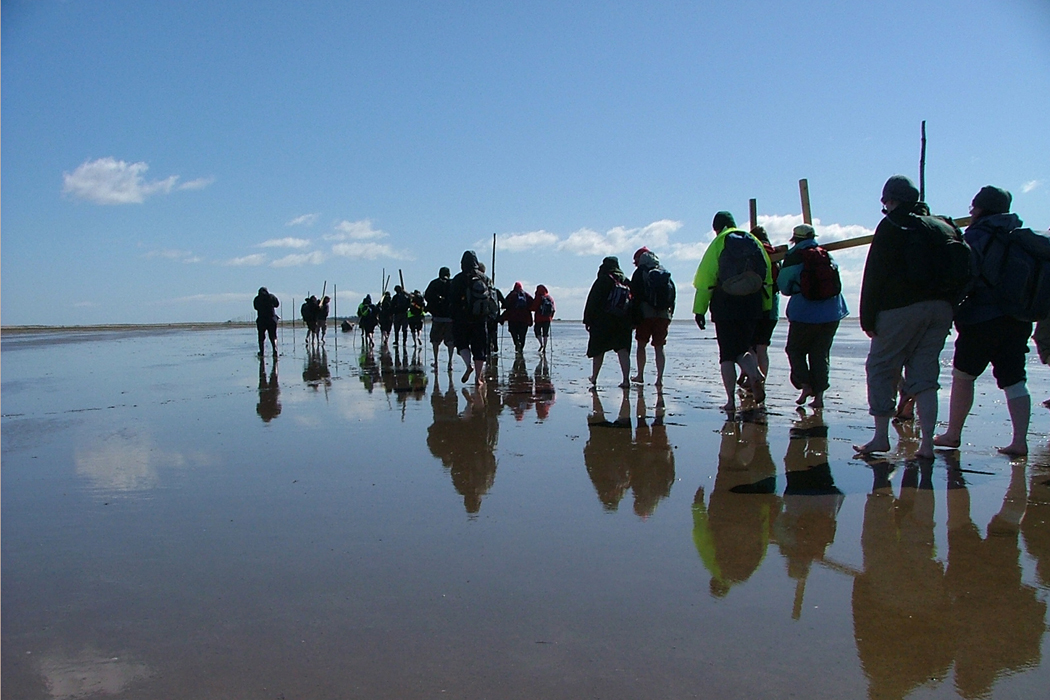
The ancient monastery at Lindisfarne has never been properly located. But now, new evidence has come to light and a dig will be undertaken in June 2016
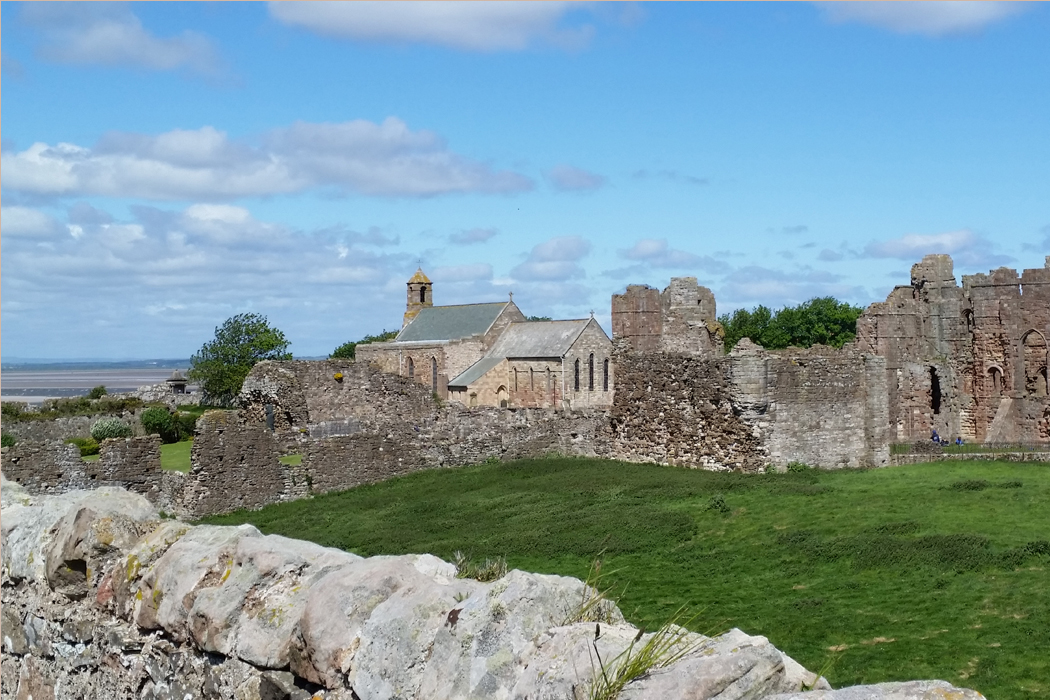
The ruined church and monastic buildings that still stand on the island of Lindisfarne today are not Anglo-Saxon; they are the remains of the new priory built on the island in the late 11th century by the monks of Durham. So where is the original monastery? And what happened to it after the attack in AD 793 by the Vikings?
All that is known to survive are some carved stone monuments of Anglo-Saxon date, which were found by archaeologists clearing away some of the collapsed rubble from the priory ruins in the late 19th and early 20th century.
These sculptures include burial markers and stone crosses, including the iconic ‘Battle Stone’ which many believe depicts the Viking attack. Their presence near the later ruins suggest that the monastery of Oswald and Cuthbert must lie nearby, and over the last hundred years archaeologists and antiquarians have tried to home in on its remains. As yet, little has been found.
Perhaps then, much of it lies not below the later ruins, but beneath the modern village. Hints of Anglo-Saxon buildings have indeed been found in several places across the village. Frustratingly, these have mainly shown up in small-scale excavations carried out in advance of construction work. The small size of these excavations has allowed us only tiny glimpses into the world of early medieval Lindisfarne.
Nevertheless, they do tell us that there was some kind of early medieval activity beyond the boundaries of the later medieval Priory. This is not surprising, since early monasteries were spread over a much larger area than the later ones we are more familiar with.
But there are also other places on the island that may have been the site of activity by the early monks. The first is a series of slight earthworks that lie on the rocky crag overlooking the Priory, known as the Heugh. One of these was excavated by the pioneering excavator, Brian Hope-Taylor. Although the excavation produced no finds, Hope-Taylor suggested it might be a church, although we cannot be sure unless we re-excavate it.
Elsewhere, there are other indicators of an early presence – on a boulder just to the north of Lindisfarne castle is a small stone cross, carved into the living rock. This is covered with lichen and hard to see, but almost certainly dates to the Anglo-Saxon period and may mark the location of a small shrine or holy place.
The only early medieval site that has been properly excavated on Lindisfarne is the small farm at Green Shiel on the north side of the island. In the 1990s, archaeologists uncovered the remains of several stone long-houses which probably housed the men and women who worked this part of Lindisfarne. Amongst the finds were lots of calf bones. Calf skin was used to for early books and manuscripts; does this show that the monastery was making its own parchment? The researchers also found a spear and several coins, which helped to date the settlement.
The new evidence
It’s surprising to think that such an important site has yet to be found. However, over the last few years, archaeologists from the University of Durham funded by the National Geographic set out to do a geophysical survey of the fields surrounding the village.
As it happens, this survey has identified a range of features that may relate to the Anglo-Saxon monastery, flagging up two possible locations; one to the east of the ruined priory church, and one to the west of the village in a field overlooking the mainland. It is now time to investigate these features and attempt to home in on what survives of Cuthbert’s monastery.
Come June 2016, archaeologists will be returning to the Holy Island of Lindisfarne for a major excavation that will try and discover the location of the elusive first monastery founded by King Oswald in 635. This excavation is being backed by DigVentures, the crowdfunding archaeological social enterprise and follows new research by Dr David Petts, Lecturer in the Archaeology of Northern England at Durham University.
“The centrality of the first Lindisfarne monastery in the history of history of early medieval Britain and its – until now – elusive nature gives this dig the potential to be one of the most important archaeological discoveries in the UK in recent years,” he said to Culture24 and continues: “Working with DigVentures allows us to open up the process of research and scientific excavation – it’s the future of discovering the past.”
The project has been launched for crowdfunding on the DigVentures website, allowing anyone interested in discovering the past to pledge support.
In return, supporters become part of the dig team – through exclusive digital access to project data, and receiving the training and tools needed to participate in the expedition this summer, which takes place 13-26 June.
SOURCE:
READ MORE:
SEE MORE: