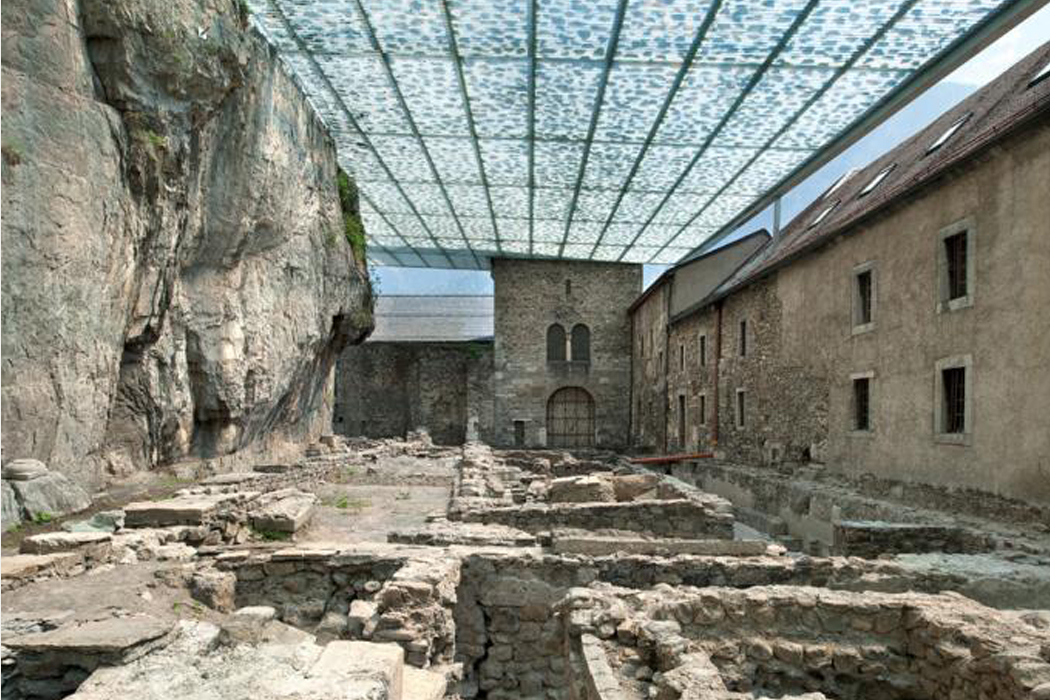
Archaeologist have been digging at the abbey of Saint-Maurice d’Agaune since 1896. Very recent excavations have uncovered parts of a huge and fascinating royal-episcopal complex
During 1500 years layer upon layer of destroyed, restored and rebuilt buildings have constituted the material fabric of the Abbey of Saint-Maurice d’Agaune. No wonder a very recent coloured map of the different layers and layouts of the site tells a confusing story.
Nevertheless new excavations seem to give a hint of what the building complex was all about.
The first phase initiated in the beginning of the 5th century resulted in a monastic complex, which was probably dual sex and perhaps filled with ‘vulgar crowds’ [1]
When Sigismund in 515 after his conversion from Arianism to Catholicism undertook to reorganise the cult and the place according to episcopal designs this original layout was seemingly suppressed. Later, when Sigismund became the first royal saint in the West, the new abbey (where his bones were translated) par excellence became the role model for a series of later monasteries.
This was – as Barbara H. Rosenwein – wrote precisely, “the start of an orthodox (i.e. Catholic) royal-episcopal alliance”, whereby Sigismund tried to surpass his other relatives intent on singling out the Theban Martyrs.
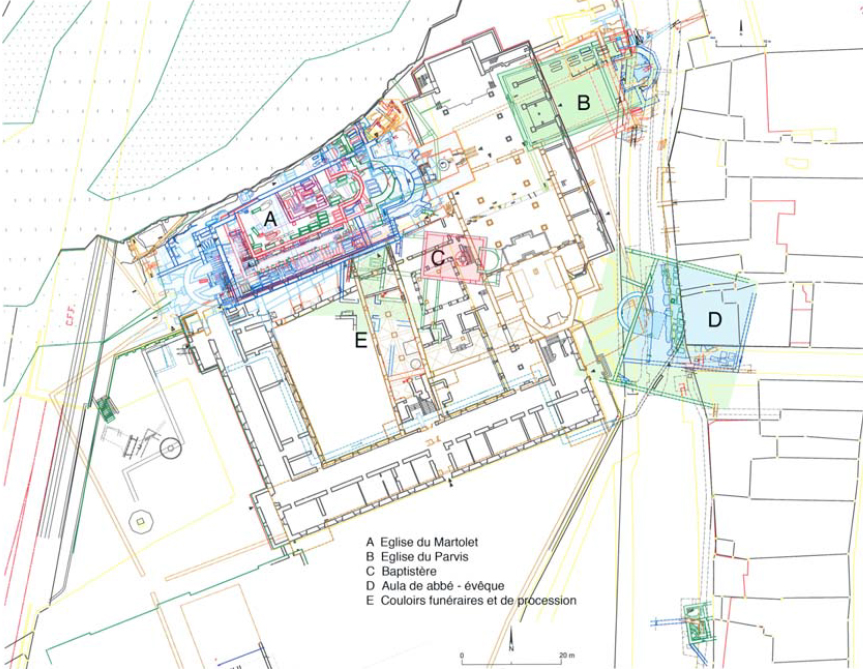
This was done by inventing or adopting a new liturgy – Laus Perennis or day-and-knight psalmody – and by building a complex, which we now know was much larger, than what was uncovered by excavations in the 1940s. This larger complex was hinted at by later excavations in 1995-96. Now it has essentially been uncovered.
Today we thus have to complement the layout with two whole new buildings – a hitherto unknown ‘new’ church with a series of important tombs. This church was aligned with the martyrial sanctuary at the site of Martelot and had the same dimensions. And a large ‘aula’ 20 x 25 meters, probably the place for public representation with either the prince, the bishop or the abbot in residence on a podium, which later was framed by an apsidal reconstruction and an arch over the presider of the community.
According to the press release the extent and topography of the new layout of the complex is still preliminary. What is known though is, that the whole architectural programme was organised with the baptistery from the 5th century AD at its centre and with a series of walkways and porticos connecting the different parts.
Whether the Abbey will turn out to be as huge as the episcopal complex at Poreč remains to be seen. However the very recent excavations are able to validate some of the reflections of Barbara Rosenwein, when she wrote about Saint-Maurice d’Aagune as a place of Power in 2001. What we on the other hand do not know is whether the complex with several churches implied that the laus perennis actually was primarily located in the new abbey-church from Sigismund’s time. Or whether it involved a series of complicated liturgical processions as was later the case at the Carolingian Sainte Riquier near the Baie de Somme, famous for drawing inspiration from the liturgical tradition of Saint-Maurice d’Agaune.
Notes:
[1] Rosenwein 2001: 272 – 275
Sources:
Fouilles archéologiques de l’Avenue d’Agaune
Les origins du monastère de Saint-Maurice d’Agaune – un heritage à étudier et protéger.
By: Alessandra Antonini, Archéologue, Sion.
In: Mauritius und die thebäische Legion/ saint Maurice et la legion Thébane. Actes du colloque, 17 – 20 sept. 2003, Fribourg, Saint-Maurice, Martigny. Textes réunis par Otto Wermelinger et al. Acadamic Press Friebourg 2005, pp. 331 – 342
One Site, Many Meanings: Saint-Maurice d’Agaune as a place of Power in the Early Middle Ages.
By Barbara H. Rosenwein
In: Topographies of Power in the Early Middle Ages. Ed. by Mayke de Jong et al. (Vol. 6. In the series: The transformation of the Roman World)
Brill 2001, pp. 271 – 290
Perennial Prayer at Agaune.
In: Monks and Nuns, saints and outcasts: religion in medieval Society. Ed by S. Farmer and B. H. Rosenwein, Itahca, Ny.Y. 2000, pp. 37 – 56.
By Barbara H. Rosenwein