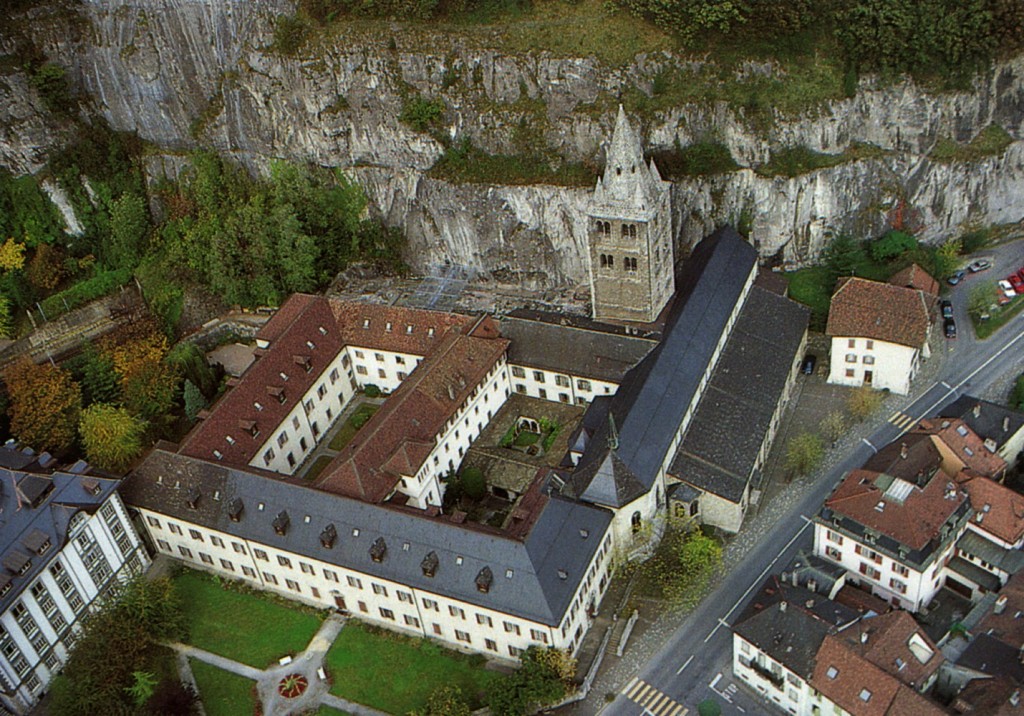
Saint-Maurice d’Agaune is one of the oldest monasteries in Western Europe and can trace its history back to the 5th century
From ancient times people moved back and forth through the upper Rhone valley and into the alps to transcend the high mountains at the Simplon Pass. Halfway through this luscious valley beneath a rocky promontory, where the valley narrows to a gorge lies an abbey with more than 1500 years of history behind it, Saint-Maurice d’Agaune.
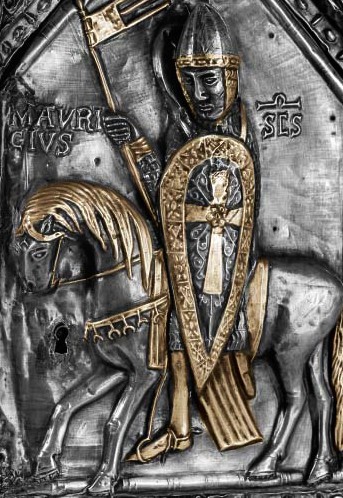
As always there is a history, which reaches further back. Early on the Romans organised the place as a staging post, Aquanum or Aguanum. The present abbey is thus built on top of the ruins of a Roman shrine from the 1st century BC, consecrated to the God Mercury and some Celtic nymphs, caretakers of the running waters and springs. Nearby was also a Roman garrison. Around AD 285, the story [1] has it that a contingent of Theban legionaries led by Mauritius, Candidus, Innocent and Exuperius sacrificed their lives refusing to terrorise the Christian rebels living in the wider area. From app. AD 442 – 450 there exists an account of this story written by Eucherius from Lyon (as well as another anonymous text). According to these texts, Theodulus, bishop of Octodurum († 391) discovered the 6600 bodies of the legionaries after a vision.
Theodulos built the first basilica on the site, later supplanted by a new church in AD 515. This was located at the periphery of what became a large religious complex, catering both for the religious community of monks plus the constantly growing numbers of pilgrims and travelers, who were passing through to and from Italy. This basilica plus abbey was built on land donated by the Burgundian King Sigismund, who was later killed by the Franks in the aftermath of a battle together with his wife and two sons. In AD 535 his remains were recovered from a well in present Coulmiers and translated to Saint-Maurice d’Augune. Later Sigismund was canonized, becoming the first royal saint in Europe. About Sigismund and the consecration of the new basilica and abbey in AD 515 we are rather well informed, as there exists a lively correspondence between Avitus of Vienne and the king, who under the direction off the bishop converted from Arianism to Catholicism. The sermon or speech given by Avitus in September 515 at the inauguration still exists. Today the abbey is home to a group of Augustinian Canons, taking care of the still living pilgrimage centre as well as the surrounding catholic congregations. It likes to present itself as the oldest – and still existing – monastery in Western Europe (Leríns on the islands of Saint-Honorat, is for instance older!) From 2014 – 15 Saint-Maurice will celebrate its 1500th anniversary [2], marking the jubilee year with a number of events:
- 14.03 – 16.06.2014 An exhibition of the treasury at Louvre in Paris. Later this will reopen at Saint-Maurice where the exhibition space is under renovation. In connection with this exhibition, the treasury has been meticulously studied and a formal catalogue has been published in both French and German.
- 22.09.2014 Grand Opening of the Jubilee Year
- 24.12.2014 Midnight Mass in Eurovision
- 22.09.2015 The Abbey’s 1500th anniversary
In connection with the celebrations the Abbey is currently finishing a series of recent archaeological excavations as well as reorganising its grand archive. Further, a renewed presentation of its invaluable treasury is under work. To mark this special anniversary and while renovation work has been underway the chapter has agreed to allow the Louvre (14.03.2014 – 16.06.2014) to display major pieces from the treasury, which has miraculously withstood ordeals and centuries. In connection with this exhibition a complete new guide to the treasures have been published by art-historians. The festivities are planned in unison with UNESCO, since the Abbey is listed as World Heritage.
Follow the plans for the 1500th Anniversary
Read other articles about
READ MORE:
 Avitus of Vienne: Selected Letters and Prose
by Danuta Shanzer and Ian Wood
Series: Liverpool University Press – Translated Texts for Historians (Book 38) Liverpool University Press 2002 ISBN-10: 0853235880
ISBN-13: 978-0853235880
 Catalogue: Le Trésor de l’abbaye de Saint-Maurice d’Agaune
By Élisabeth Antoine-König (ed)
Louvre et Somogy 2014
ISBN French 978-2-75720-781-9
ISBN German 978-2-75720-800-7
NOTES:
[1] The story is generally regarded as a legend invented 100 years later, see
The Origin of the Cult of St. Maurice
By David Woods
(A revised edition of “The Origin of the Legend of Maurice and the Theban Legion,” Journal of Ecclesiastical History 45 (1994), 385-95.)
[2] As with all such anniversaries the date has to be disputed. In the title to the homily of Avitus of Vienne no. 24 it specifically claims to have been held at the “innovatione” = revival.
________