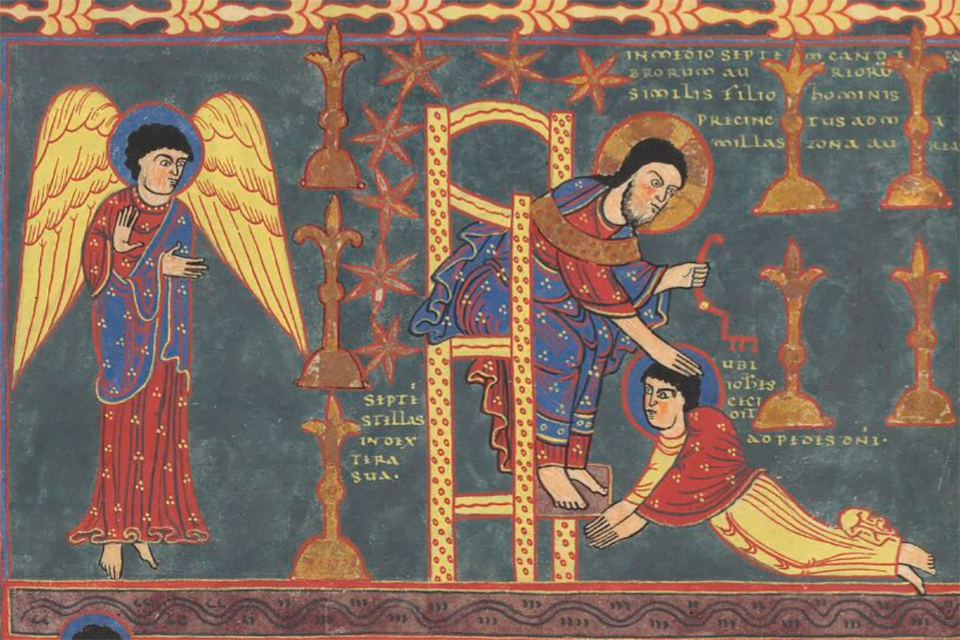
In the late 8th century, Beatus from Southern Spain found refuge in the Picos de Europa at one of the royal outposts in the fragile Asturian kingdom. He is famous for his artistic legacy, the Beatus’ Apcalypses.
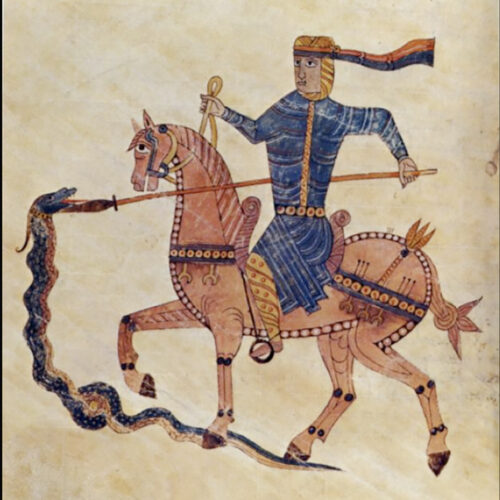
Beatus of Liébana was an 8th-century monk, theologian, and scholar from the Kingdom of Asturias in northern Spain.
He is best known for his Commentary on the Apocalypse (Commentaria in Apocalypsin), a monumental and richly symbolic exegetical work on the Book of Revelation. This text, usually referred to simply as the Beatus, became one of the most influential Christian commentaries on the Apocalypse during the Middle Ages and gave rise to a celebrated tradition of illuminated manuscripts known collectively as the Beatus Manuscripts.
Historical Background
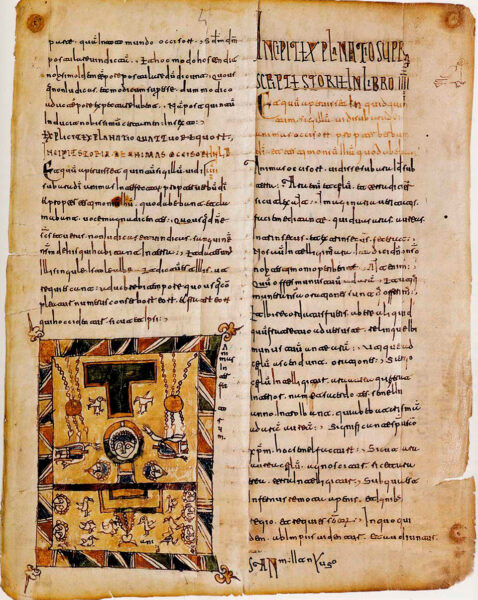
Beatus lived and wrote during a time of great political and religious tension. Following the Muslim conquest of most of the Iberian Peninsula in the early 8th century, the Christian Kingdom of Asturias emerged as a stronghold of resistance in the north. One of the more accessible inroads into the coastal lowlands of the Bay of Biscay went through the valley of Liébana. Here the monastery of Santo Toribio de Liébana became a central and richly endowed royal bullwark.
In this context, Beatus’s writings had both a theological and political dimension. His Apocalypse, completed around 776 and later revised, emphasised divine justice, the eventual triumph of good over evil, and the vindication of the faithful—ideas that resonated deeply with a Christian audience surrounded by what they viewed as hostile Islamic rule. Also, the text might have reflected the approaching year, AD 800, which was widely believed to augur the dramatic last millennium.
Beatus was also involved in the theological debates of his day. He opposed the heresy of Adoptionism (a belief that Christ was the adopted, not natural, Son of God in his human nature), a doctrine propagated by Bishop Elipandus of Toledo.
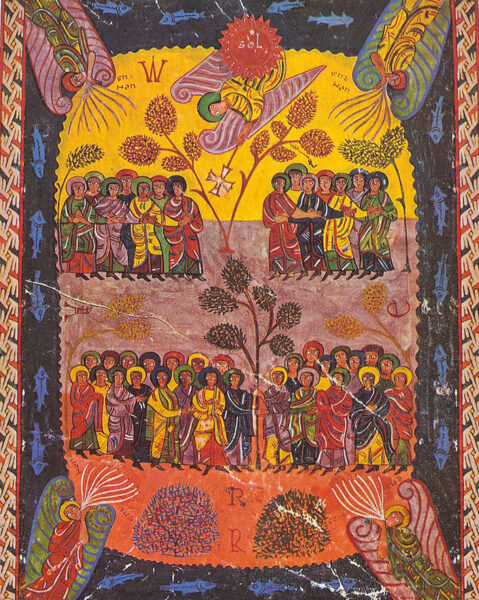
Beatus and his ally, Eterius of Osma, wrote treatises condemning this heresy and defending Nicene orthodoxy. Their writings, which aligned with the Carolingian elite, gave occasion to a vicious and vile epistolary feud. In the letters from Bishop Elipandus to Alcuin and Felix. In these and other letters, Beatus was called a wicked babbling liar with a fetid and filthy mouth, given to the lust of flesh while spewing pest-bearing dogma and sulphuric vapour: in short a heretic, an anti-prophet and Antichrist. (Gil 1973, Vol 1, p 80-81)
Finally, he is also remembered for his role in establishing St. James as the patron saint of Spain and the royal cult at Santiago de Compostela. He also wrote the
The Beatus Commentary
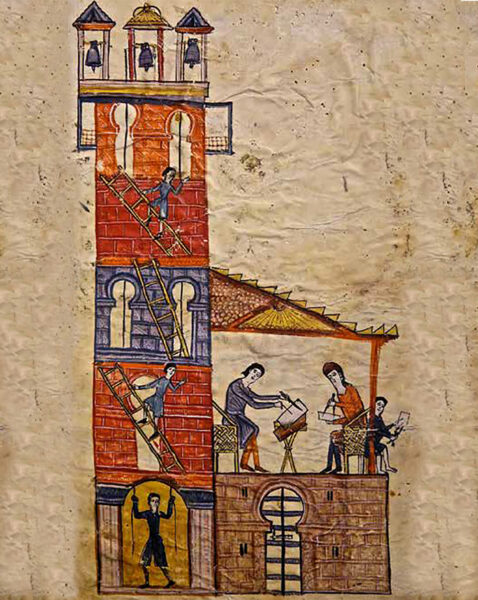
Beatus’ Commentary on the Apocalypse was not entirely original. It’s text was a compilation of earlier patristic sources, especially drawing from the works of Tyconius, Augustine, Jerome, and Isidore of Seville. However, Beatus’s vision and theological insight shaped his presentation of these texts. He organised his Commentary into twelve books, mirroring the twelve tribes of Israel and the twelve apostles, creating a structured and eschatologically loaded narrative.
The text also blends scriptural exegesis with apocalyptic expectation, typological analysis, and vivid symbolic interpretations. It was not only a spiritual and theological work but also a call for moral vigilance and ecclesial purity.
Beatus Manuscripts: Artistic Legacy
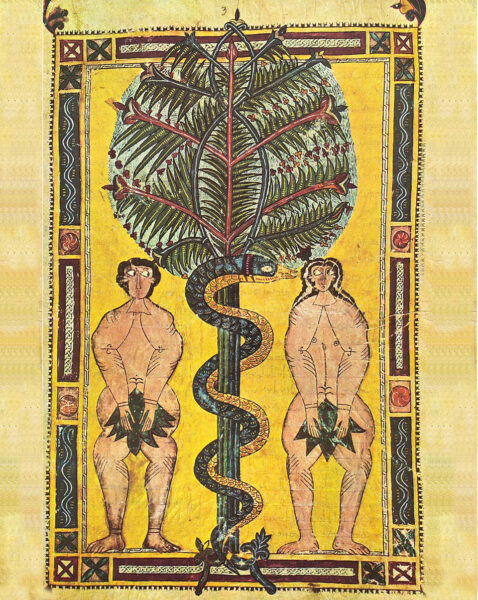
The Beatus Commentary was copied and transmitted in monasteries throughout Spain over the following centuries. What makes it particularly notable is the tradition of lavishly illustrated versions of the text, produced primarily between the 9th and 13th centuries. These illuminated manuscripts, often referred to collectively as the Beatus Manuscripts, are considered among the most important artefacts of medieval Iberian art.
Beatus composed his work by dividing the text of the Apocalypse or Revelation, the final book of the Bible, into sixty-eight sections, termed stories. Each of these vignettes was then followed by a series of exegetical passages or “explanations”, which shed allegorical and anagogical light on the text. More revolutionary, though, was the insertion of pertinent illustrations between the vignettes and their interpretation copied from a variety of sources. Whether or not Beatus was responsible for this pictorial programme is not known. However, recent scholarly studies suggest the tradition was adopted soon after might have been the case (Williams 2017).
As it is, the Beatus apocalypses appear to constitute some of the first illuminated manuscripts in Iberia, with the oldest fragment dated to ca. 850.
 Perhaps, the artistic form developed in the wake of the Carolingian iconoclastic controversies, which raged at the end of the 8th century and which ended with the ruling by Charlemagne in Frankfurt AD 794 and the publication of the Opus Caroli, a Western treatise by Theodulf of Orleans concerning the role of images as a acceptable illustrations.
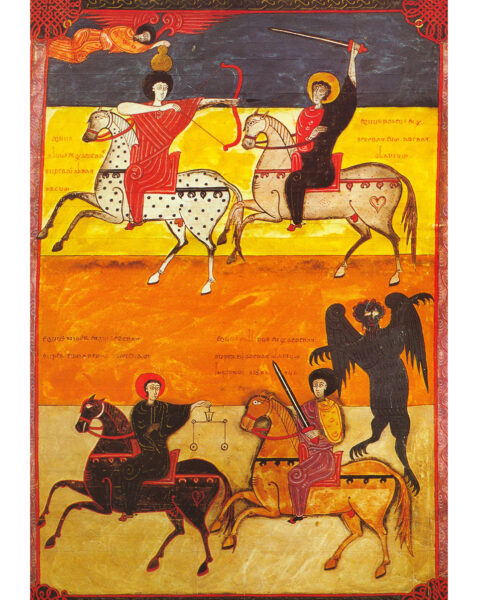
The manuscripts are richly decorated with vivid, sometimes surreal illustrations depicting apocalyptic visions: the Four Horsemen, the Beast, the Woman clothed with the Sun, angels, dragons, and the New Jerusalem. Most manuscripts also hold a Mappa Mundi, outlining the location of Paradise. The iconography is often symbolic and stylised, incorporating elements of Mozarabic, Visigothic, Islamic, and early Romanesque art. Many illustrations show a unique approach to space, colour, and form, with a powerful sense of narrative and drama.
Most Prominent Beatus Manuscripts
There are at present 41 known surviving manuscripts or fragments thereof of the Beatus Commentary, of which 27 hold illuminations. Each represent a unique artistic style and variations in content. Some of the most prominent include:
- The Silos Fragment (c.850-875).
Housed in Silos, Biblioteca del Monasterio de Santo Domingo, frag. 4 (1. folio) - Morgan Beatus (c. 940)
Originated at the monastery of San Salvador de Tábara
Known for its vibrant colors and abstract forms.
Held in the Morgan Library & Museum, New York (MS M.644). - Girona Beatus (975)
Created in the scriptorium of the monastery of Tábara or Valeránica.
Attributed to the scribe Senior and the artist Ende (a rare named female artist).
Contains some of the most spectacular illustrations of all Beatus manuscripts.
Located in Museu de la Catedral de Girona, Num. Inv. 7(11) - Beatus of Facundus (1047)
Commissioned by King Ferdinand I and Queen Sancha of León.
Known for its refined Romanesque style and exceptional preservation.
Now housed in the Biblioteca Nacional de España, Vitrina 14-2 . - Silos Beatus (c. 1109)
Produced at the Monastery of Santo Domingo de Silos.
Contains over 100 miniatures and is highly valued for its narrative clarity.
Held in the British Library, London, Add. MS 11695. - Escorial Beatus (c. 1000)
From the Monastery of San Millán de la Cogolla.
Now in the Escorial Library, Real Biblioteca de San Lorenzo de El Escorial, &.II.5 - Saint-Sever Beatus (11th century)
Unusual among Beatus manuscripts for being produced in France, not Spain.
Commissioned by Abbot Gregory of Saint-Sever Abbey.
A key example of the cross-cultural transmission of Beatus’s work.
Preserved in the Paris, Bibliothèque nationale de France, MS lat. 8878 - Las Huelgas Beatus (1220)
One of the latest examples, produced in the Cistercian monastery of Las Huelgas, Burgos.
Combines Romanesque and Gothic styles.
New York, The Morgan Library & Museum, MS M.429
Cultural and Religious Significance
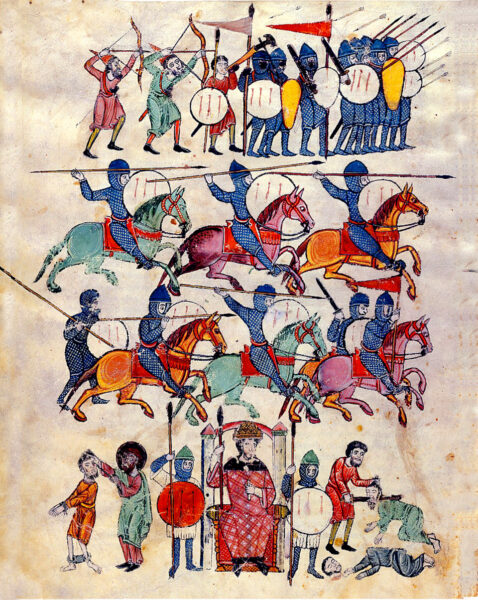
The Beatus manuscripts were not merely aesthetic objects; they were also tools for contemplation, catechesis, and resistance. Marginal notes indicate that the texts were used to read in the refectories during meals.
In a region often defined by the Reconquista, these manuscripts symbolised a Christian vision of cosmic justice and spiritual victory. Their striking imagery served to educate and inspire monastic communities, affirming the Christian worldview in a time of cultural and religious plurality.
In modern scholarship, the Beatus tradition is invaluable for the study of medieval theology, apocalypticism, manuscript illumination, and the complex cultural interactions in medieval Iberia. Art historians, theologians, and medievalists continue to analyse their iconography and stylistic development, while conservators and digital humanities scholars work to preserve and digitise these fragile treasures.
FEATURED PHOTO:
Saint-Sever Beatus (11th century)
Unusual among Beatus manuscripts for being produced in France, not Spain.
Commissioned by Abbot Gregory of Saint-Sever Abbey. A key example of the cross-cultural transmission of Beatus’s work. Served as inspiration for Picasso’s Guernica.
Preserved in the Paris, Bibliothèque nationale de France, MS lat. 8878
SOURCES:
Corpus Scriptorium Muzarabicorum Vol 1-2
Ed. By Ioannes Gil
Madrid 1973
Illuminated Manuscripts of Medieval Spain
By Mireille Mentré
Thames and Hudson 1994
Visions of the End in Medieval Spain
By John Williams
Amsterdam University Press 2017