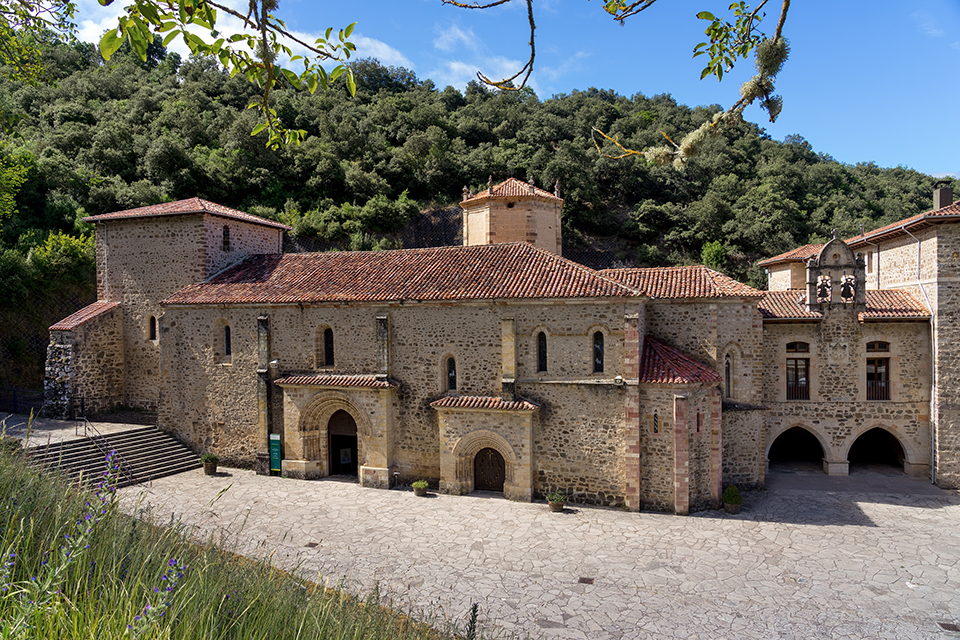
The monastery of Santo Toribio de Liébana, dating back to the 6th century, stands as one of the most significant religious sites in Northern Spain, nestled within the dramatic landscape of the Picos de Europa mountains.
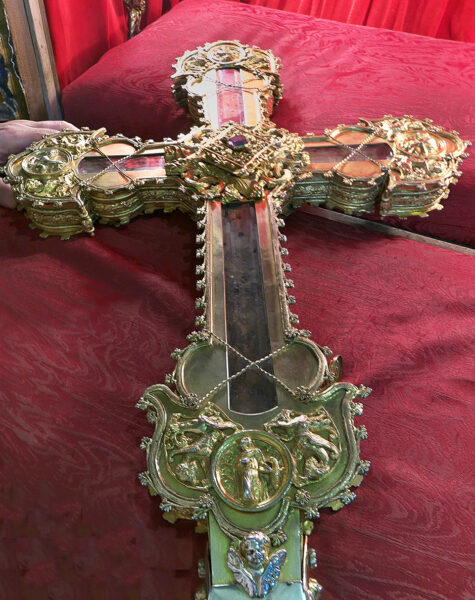
With a view to the Picos de Europa lies a small village, Liébana. Nestled into the hillside resides an ancient monastery, Santo Toribio de Liébana. Although rebuilt through the centuries, it still possesses a distinct privilege. Together with only four other religious institutions – Rome, Jerusalem, Santiago de Compostela and Caravaca de la Cruz near Murcia ¬– perpetual indulgencies are offered. This privilege from 1515 is directly linked to its famous relic, the Lignum Crucis, which is believed to be the largest surviving piece of the True Cross, the left arm. Brought in the mid-5th century to Astorga, it was transferred to Liébana in the 9th century and is now kept in a gilded silver cross-formed reliquary. Pilgrims on their way to Santiago might indulge themselves in venerating this precious relic. Hence, the monastery is often called The Little Jerusalem. Although located between the Northern and Southern Caminoes, a detour to Liébana attracts pilgrims and tourists alike.
The monastery was founded before the 6th century, and was initially dedicated to St. Martin of Tours, and functioned as a kind of hermitage, sheltering St. Turibius of Líebana from Tuerino and some of his companions in the 6th century. However, when Alfonso I of Asturias withdrew from the south in the mid-8th century, it became one of the Christian strongholds in the mountains. Somewhat later, it was renamed at this time honouring another St. Turibius (of Astorga), the person responsible for bringing the famous relic first to Astorga from where it was brought to Liébana in the 8th century. Later, the two saints merged into one.
At this time, Beatus of Liébana might have been the abbot. Beatus – likely a fugitive from al-Andalus – wrote his famous apocalyptic commentary, dated to AD 776. The Apocalypse is preserved in 41 fragments and manuscripts, of which 29 are renowned for their dazzling illuminations.
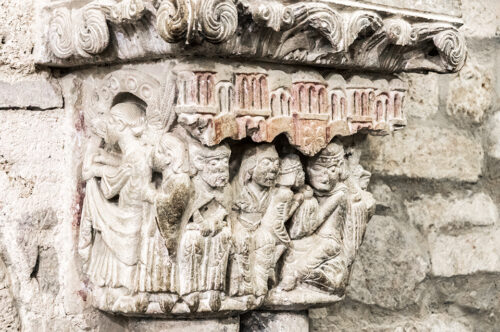
In his commentary, Beatus launched the “idea” that St. James had been responsible for the evangelisation of Iberia, giving impetus to his veneration as Spain’s patron and royal saint. Beatus is generally believed to have taken part in the discovery of the Saint’s tomb, thus fostering the tradition of the pilgrimage. One of Beatus’s last works was the hymn “O Dei Verbum,” which celebrated this event, as well as James’ role as patron of the Iberian Peninsula.
As mentioned, the monastery is not directly passed by the pilgrims who have to make a detour following the Camino Lebaniego. A short pilgrimage, it takes you from San Vicente de la Barquera, on the coast of Cantabria, to the monastery of Santo Toribio de Liébana at the foot of the Picos de Europa in three to four stages (72 km). If you do not have time to go all the way to Santiago, get to Santo Toribio! There you can also obtain eternal forgiveness.
The monastery is located on the road through the mountains, which are littered with hotels. Another option is the camping site nearby, Camping La Viorna Picos de Europa.
The Royal Affiliation
Beatus arrived in Liéba at the time when the first Emir, Abd al-Rahman I (r. 756– 88) established the Umayyad dynasty in al-Andalus and made Córdoba his capital while being responsible for the conversion of the Visigothic Cathedral into the Mesquita. At this time a series of short-lived kings ruled Asturias. Beatus is known to have been present in Pravia, c. 200 km west of Liébana, when the widow of King Silo, Adosinda, took her wows as a nun in AD 786. The monastery remained a crucial royal institution during the Early and High Middle Ages.
Economy
A crucial source for understanding the monastery’s economic dealings during the Early and High Middle Ages is the “Cartulario del Monasterio de Santo Toribio de Liébana. Though the original is lost, this medieval codex survives through a 1309 copy housed in the Archivo Histórico Nacional. It comprises 250 documents from 790 to 1309, detailing church foundations, privileges, rents, taxes, and genealogies, and offering a window into the monastery’s economic and social interactions. Of special importance was the economy derived from growing wine and accommodating pilgrims. The first charter in this collection is dated to AD 790 and outlines how a a monastery was founded. The cartulary documents a local population not interested in providing titled signatures. Compared to the rest of Southern Europe, the Comarca appears bereft of a distinct social landscape. So far, archaeology has not provided documentation for the existence of elite residences in the valley (Portass 2017).
Early Medieval Heritage in the Liébana region
The monastery of Santo Toribio de Liébana has, as said, ancient origins dating back to the 6th century. Nevertheless, the monastery gained particular importance during the mid-8th century when the Asturian kings actively sought to repopulate the Liébana area during the early Reconquest period. The numerous renovations throughout its history witness this, having created a complex of buildings dated to the early Gothic transition period.
Perhaps the most significant early medieval remains near the monastery are the Cueva Santa de Liébana, a semi-cave hermitage nearby (Don’t miss the view!). According to historical records, construction elements were added to this structure in the 8th century. This hermitage is particularly notable as St. Toribio reportedly chose it as his cenobitic retreat, linking it directly to the alleged founder of the monastery.
During this period of high religious fervour in the 8th century, several other chapels and hermitages arose around the main monastery as monks sought solitude for their religious practice. Many of these religious enclaves were established on the northern slope of La Viorna hill, which later became a pilgrimage site for the people of Liébana. Worth a visit are
- The Mozarabic Church of St. Maria of Lebeña. This 10th-century church represents a significant example of Mozarabic architecture in the region.
- The Romanesque Monastery of Piasca. This 11th-century monastery is another significant medieval religious structure in the area. The founding charter from AD 790 is preserved.
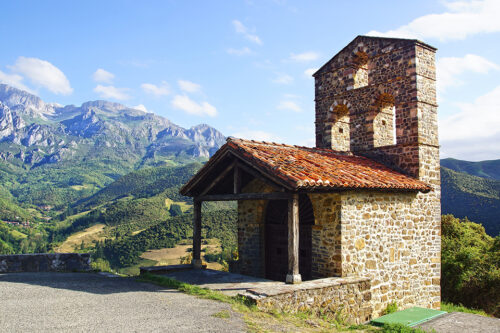
- The Ermita de San Miguel – Located just 500 meters past the main monastery, this small 13th-century hermitage dedicated to St. Michael the Archangel offers impressive panoramic mountain views.
Also, driving through the valley, you may occasionally spot an early medieval fortification dating to the 9th-11th centuries, and situated on daring cliffs and in high-altitude locations throughout the region. These fortified sites witness the local need to patrol the access to the valley by establishing intervisibility. In general, they are characterised as small fortified sites placed at high altitudes and with no agricultural possibilities. The location for the garrisons was chosen to patrol the entry into the valley, patrol the roads along the main rivers, and beacon the territory. A garrison has been estimated to hold max. 20 persons. (Jaafar 2021).
Region and Landscape of Liébana
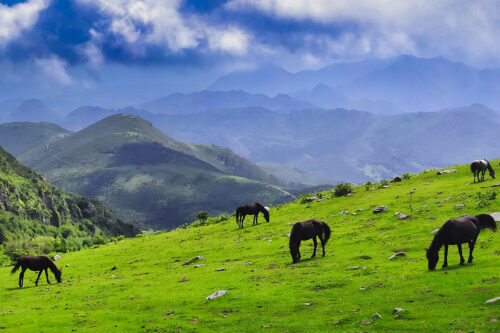
Liébana is a comarca in Cantabria, Spain. A comarca is an area defined as a natural and geographical entity. Surrounded by mountain ranges, the valley is well demarcated by three water catchments feeding the river Deva, and its tributaries, Bullón and Quiviesa.
The comarca covers part of the spectacular Picos de Europa National Park, one of Spain’s most dramatic natural areas. This national park spans 647km² and begins just 15km from the ocean.
The park is characterised by:
- Deep vertical gorges
- Rocky mountains that peak at 2,5 km above sea level
- Sprawling forests
- Glistening lakes
The Picos de Europa is home to diverse wildlife, including several endangered species. Of particular note are the rare and protected Asturcón wild horses that roam the mountains. The Asturcón is an ancient Spanish breed of small horse or pony from the autonomous region of Asturias in the northern part of the country. It has been documented since Roman times. It has an unusual ambling gait, which was described by Pliny the Elder in his Naturalis Historia. It is of Celtic type and shows similarity to the Pottok and Losino of Spain, the Garrano of Portugal, and the Dartmoor, Exmoor, Fell, Highland, Shetland and Welsh breeds of the British Isles. This small horse’s ambling gait is natural and gives a comfortable ride. As a result, these horses become popular as ladies’ mounts. Known as palfreys in England, they were called haubini in France, a word that later became hobbye and eventually hobby horse. Likely, the Astorcón developed as a cross between the Garrano pony of northern Portugal and Spain – a direct descendant of the Celtic pony – and the Sorraia, the original saddle horse of Iberia, which gave the breed its calm temperament. Some other genes must be present in the Astorcón’s lineage because this ambling gait is absent in the Sorraia or Garrano. There is a narrow but clear trail of ambling horses to be found in Turkey, China, Mongolia, and Siberia, tracing the route of the prehistoric European horse to the now-submerged land bridge at the Bering Straits. It is estimated that approximately 1500 feral Asturcón live in the Picos National Park.
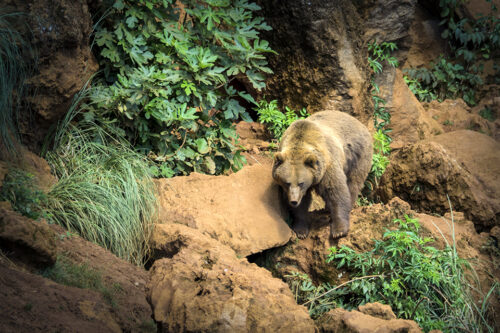
Other notable wildlife in the park includes:
- The Cantabrian brown bears
- Iberian wolves
- Wild boars
- The Cantabrian chamois
- Golden eagles
- Peregrine falcons
- Short-toed eagles
- Grouse
The area also features predominant oak, holm oak, and beech tree woods, creating a rich ecosystem for diverse wildlife. More than 1500 rare and protected flower plants may be experienced.
Other natural parks in the region include the Oyambre Natural Park, which features beaches, rivers, marshes, dunes, and cliffs bordering the Cantabrian Sea, and the Collados del Asón Natural Park
Local Culinary Specialties
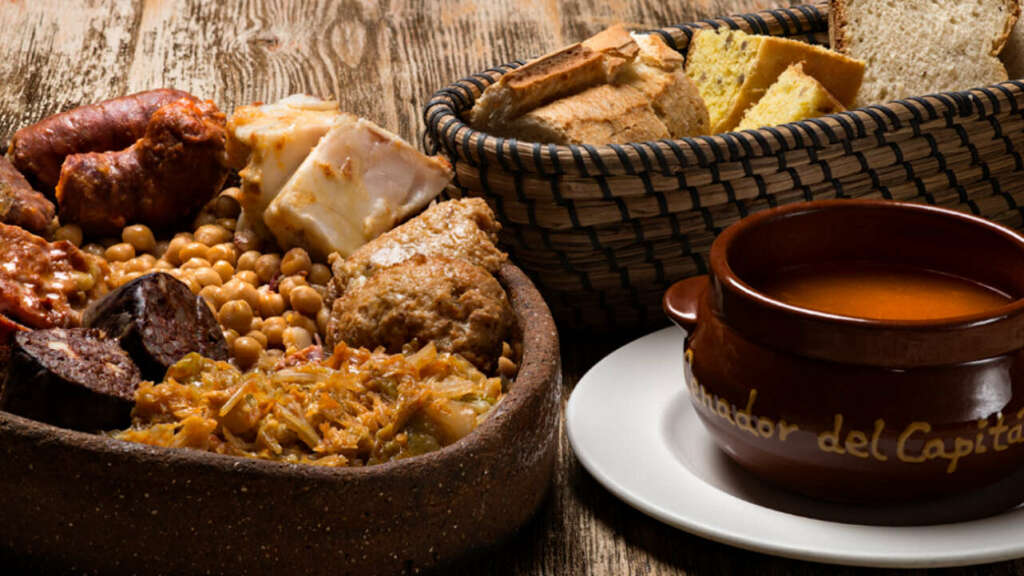
Don’t miss the local version of the Cocido Lebaniego, basically, a pot au feu consisting of a mixture of broiled and smoked meat from pigs mixed with boiled cabbage and chickpeas. Traditionally, the cocido is served with broth mixed with fideos (thin pasta), followed by the meat, chickpeas, and cabbage arranged on a large platter. Some prefer to eat it all together, as the broth lends a lovely moistness to the other elements.
SOURCES:
Ad modum Iubilei Sancti Jacobi… Santo Toribio de Liébana in the origin of the cult of Santiago and the Lignum Crucis relic
By JJP Sánchez
In: La città, il viaggio, il turismo 2018
Fortifications in Liébana, Northern Spain
By Tamir Jaafar (2021)
Bachelor thesis | Archeologie (BA), Leiden University
The Village World of Early Medieval Northern Spain: Local Community and the Land Market
By Robert Portass
Boydell and Brewer, Royal Historical Society 2017
The contours and contexts of public power in the tenth-century Liébana
Robert Portass
In: Journal of Medieval History 2012, pp 389-407
Peasants, Market Exchange and Economic Agency in North-Western Iberia, c.850–c.1050
Robert Portass Author Notes
Past & Present, Volume 255, Issue 1, May 2022, Pages 5–37,
Text and Textuality in Early Medieval Iberia: The Written and the World, 711-1031
By Graham Barrett
Oxford University Press, 2023