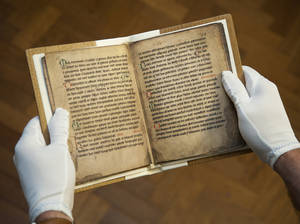
The Book of Aneirin which contains the unique text of the earliest Welsh poem, Y Gododdin, has been digitized
Aneirin was a contemporary of Taliesin and Myrddin and lived around 600 AD. He was mentioned by Nennius under the name “Neirin” from the alternate spelling “Aneirin” in the 9th century in Historia Britonum.
Aneirin was a poet at Urien’s court and was present ca. 600 AD at the battle of Cattraith (probably Catterick in Yorkshire). On this which he wrote his epic poem Y Gododdin, about the defeat of the Britons against the Saxons. The series of short stanzas in Welsh do not describe the battle per se, but rather praise the heroic Brythonic warriors, who died faithful to their lord. The name of the tribe became the title of the poem, “the Gododdin”. In some places Aneirin is critical of the rash behaviour of the soldiers; in other places, he mentions knights familiar to us from Arthur’s court: Peredur (from the Mabinogion, the Welsh name of Perceval), Owain (Chretien’s Yvain), and Taliesin are all named in the poem. In fact, there is a reference to Arthur as a mighty warrior of the recent past.
The Manuscript
Llyfr Aneirin (‘The Book of Aneirin’) is one of the Four Ancient Books of Wales. It is a relatively small medieval manuscript of 38 pages containing the unique text of what may be the earliest surviving Welsh literature, Y Gododdin. Historically, it may testify to the former existence of Welsh-speaking peoples beyond the territory that we recognise today as Wales, during the post-Roman period.
The incomplete parchment book was written in Wales around 1250-1300. Welsh manuscripts of the time were written in monasteries, and the two individuals who wrote this work were probably monks. One was copying an archaic text written between the late 8th and the late 11th centuries, and the second copied a later version, adding four additional poems. The handwriting of the first monk can also be seen in two other manuscripts (Peniarth MSS 14 and 17), now at the National Library of Wales. Decoration in the manuscript is largely confined to red and blue-green initial letters.
It is possible that the work was undertaken at the Cistercian abbey of Aberconwy, North Wales. The monks were writing against the backdrop of strife and warfare during the turbulent last decades of Welsh independence. Appropriately, they turned their attention to the long poem or series of stanzas, apparently commemorating the heroic attempt by warriors sponsored by the Gododdin tribe to re-capture the strategic site of Catraeth (Catterick, Yorkshire), around the year 600.
Later history of the manuscript
Welsh poets Dafydd Nanmor and Gwilym Tew owned the Book of Aneirin during the 15th century, by which time it had reached Glamorgan. A century later, it was back in North Wales, and eventually found a home in the library of Robert Vaughan of Hengwrt, alongside treasures such as the Black Book of Carmarthen, and the Book of Taliesin. During the 1780s, the Book of Aneirin was stolen from the Hengwrt library, and returned to South Wales. It eventually came into the hands of historian Thomas Price (‘Carnhuanawc’), after whose death it was sold in 1861 to the eccentric collector of manuscripts, Sir Thomas Phillipps of Middle Hill, Worcestershire. After a sojourn in England, the Book of Aneirin was purchased by Cardiff Free Library in 1896. It was repaired and re-bound at the National Library of Wales in 1986, and since 2011, the original manuscript has been deposited at Aberystwyth.
In a ground-breaking edition, published in 1938, the Welsh scholar, Ifor Williams interpreted the poem as follows: following the 5th century Roman withdrawal from Britain, the north of ‘England’ became a collection of Brythonic- or Welsh-speaking kingdoms, gradually losing territory to the advancing Angles, or English-speaking warriors. Around 590-600, Mynyddawg Mwynfawr, the Brythonic king of Manaw Gododdin (based at present day Edinburgh), sent a choice band of 300 mounted warriors to repel the Angles at the strategic site of Catraeth. However, they were vastly outnumbered, and nearly all perished in battle.
SOURCE:
LINK:
The Book of Aneirin, NLW, Llyfr Aneirin, Cardiff MS 2.81
TEXT:
Aneirin: Battle of Cattraeth ca 600