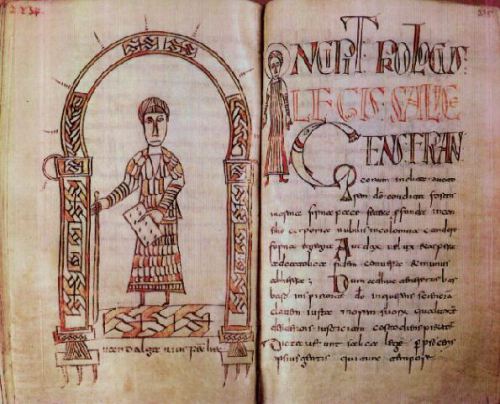
Carolingian kings and the leges barbarorum
Thomas Faulkner, Cambridge University
In: Historical Research, Volume 86, Issue 233, pages 394–407, August 2013
DOI: 10.1111/1468-2281.12027
ABSTRACT:
This article examines various texts attributed to Charlemagne and Louis the Pious, associated with a reform of the Merovingian-era leges barbarorum. It argues that in some cases their attribution to a king is not secure, and proposes they be seen instead as derived from local meetings, independent of direct royal influence. If approached in this way, the contents allow some insight into how the leges were read in the Carolingian period, which is otherwise difficult to derive from surviving sources. They suggest that the leges were used broadly, practically and flexibly in disputes, and were not seen as official, royally endorsed law. This conclusion is reached through a careful analysis of texts like e.g. the so-called Lex Francorum Chamavorum. But also a series of other texts are being reconsidered by Thomas Faulkner. The article presents us with a fresh introduction to some of the major debates in the scholarly circles treating these diverse and to some extent enigmatic texts.
The article is part of a collection of papers presented at a conference in Copenhagen in 2011 organised in collaboration between three digitisation projects: “Early English Law“, “Nordic Medieval Laws” and “Relmin”.
READ MORE:
Read also about the context of the article in “Medieval Law”