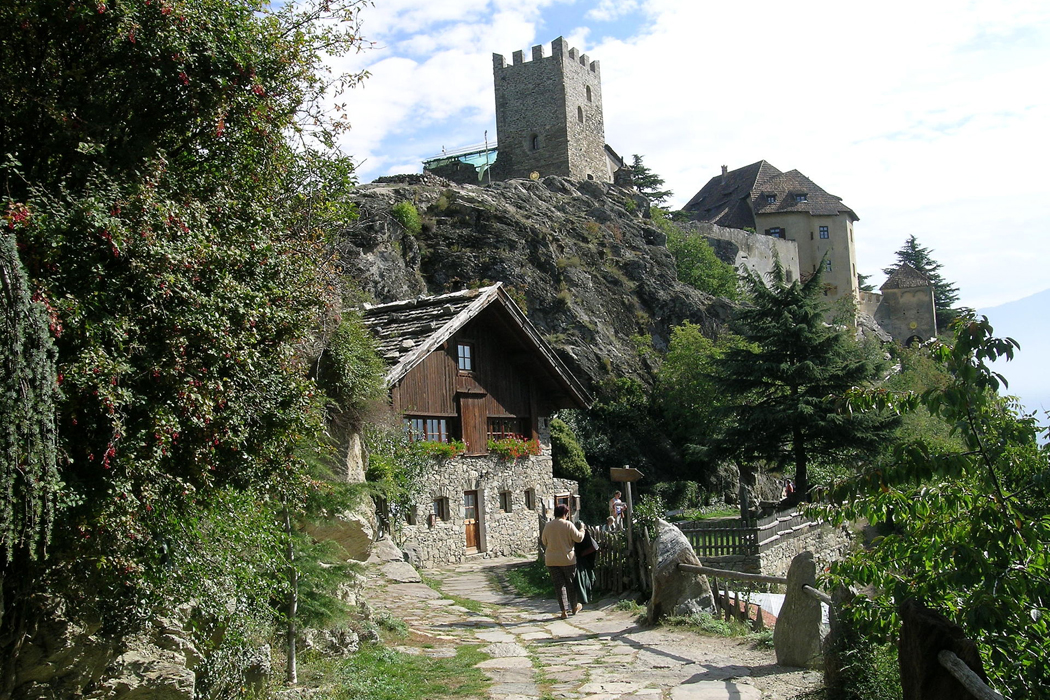
The Castle of Juval lies on an outcrop at the entrance of the Valley of Schnals in South Tyrol.
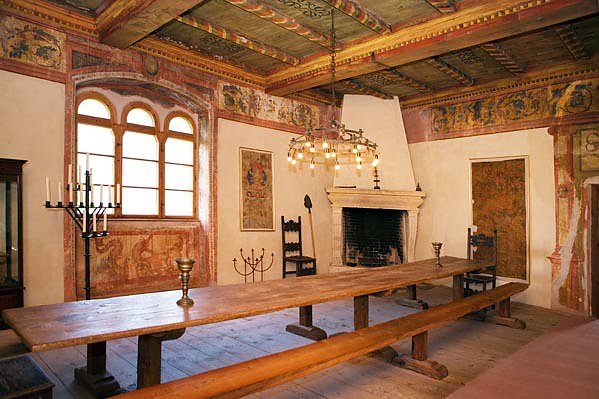 The castle of Juval is first mentioned in 1278 when Hugo von Montalbin is named as lord of the castle. However, a Carolingian cross cut into the wall and other Carolingian carvings suggests that the castle had an earlier medieval predecessor. The Montalbins were local lords belonging to the alliance of the Welfs and governed half a dozen of castles in the neighbourhood – Montalbin, Kastelbell, Schlandersberf, Galsaun and Schnals. Nevetheless, the family soon lost its powerful position and in 1293, Juval belonged to Meinhard II, count of Tirol. After this period the castle lost its importance and slowly fell into a ruin. However, in 1540, Hans Sinkmoser from Hall, acquired the castle and rebuilt it into the renaissance castle, which – albeit extensively restored in the 1920s – is still standing. Today, it is owned by the mountaineer, Reinhold Messner.
The museum in Juval Castle in Vinschgau is dedicated to the Magic of the Mountain and houses several fine art collections: a Tibetica collection, a gallery of paintings of the world’s holy mountains, a collection of masks from five continents, a unique Gesar of Ling exhibition, a Tantra Room and the Expedition Cellar. Trained guides are available to explain all the exhibits. There is also a small mountain zoo, home-grown produce at the Schlosswirt tavern, excellent wines in Unterortl and, at the foot of the hill, a farmhouse shop. The mid 1990s saw the last phase of reconstruction: In order to prevent the further decay of the desolate north wing, it was covered with a glass roof designed by the German architect Robert Danz. The roof provides protection for the old walls while the historical phases of construction are still visible to visitors thanks to the transparent glass and steel design of the roof.
The castle lies at 1000 m asl. The name Juval probably reflects the fact that this is where the valley may be entered (from Latin: Iugum altum, Iugum valis and Rhaeto-Romance: ju-val.
Oberortlhofs
At the feet of Castle Juval lies the farm, which used to supply the castle with victuals. In the beginning of the 20th century the farm had a stock of 8 – 10 cows, 35 – 40 pigs and sheep, 600 – 700 hens and possessed a fruit-yard and an extensive kitchen garden. Today the castle runs a local shop with culinary specialties. One of the specialties is medieval “Spätzlen” made of local buckwheat and mixed in a sauce made of onions, dried tomatoes and walnuts cooked in white wine.
Recipe for Spätzle
-
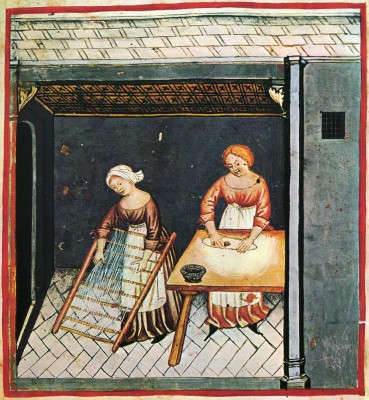
Making noodles. From: Tacuinum Sanitatis, 14th century. 6 eggs
- 300 g flour (buckwheat or spelt)
- pinch of salt
- 5 l water mixed with three tablespoons of salt
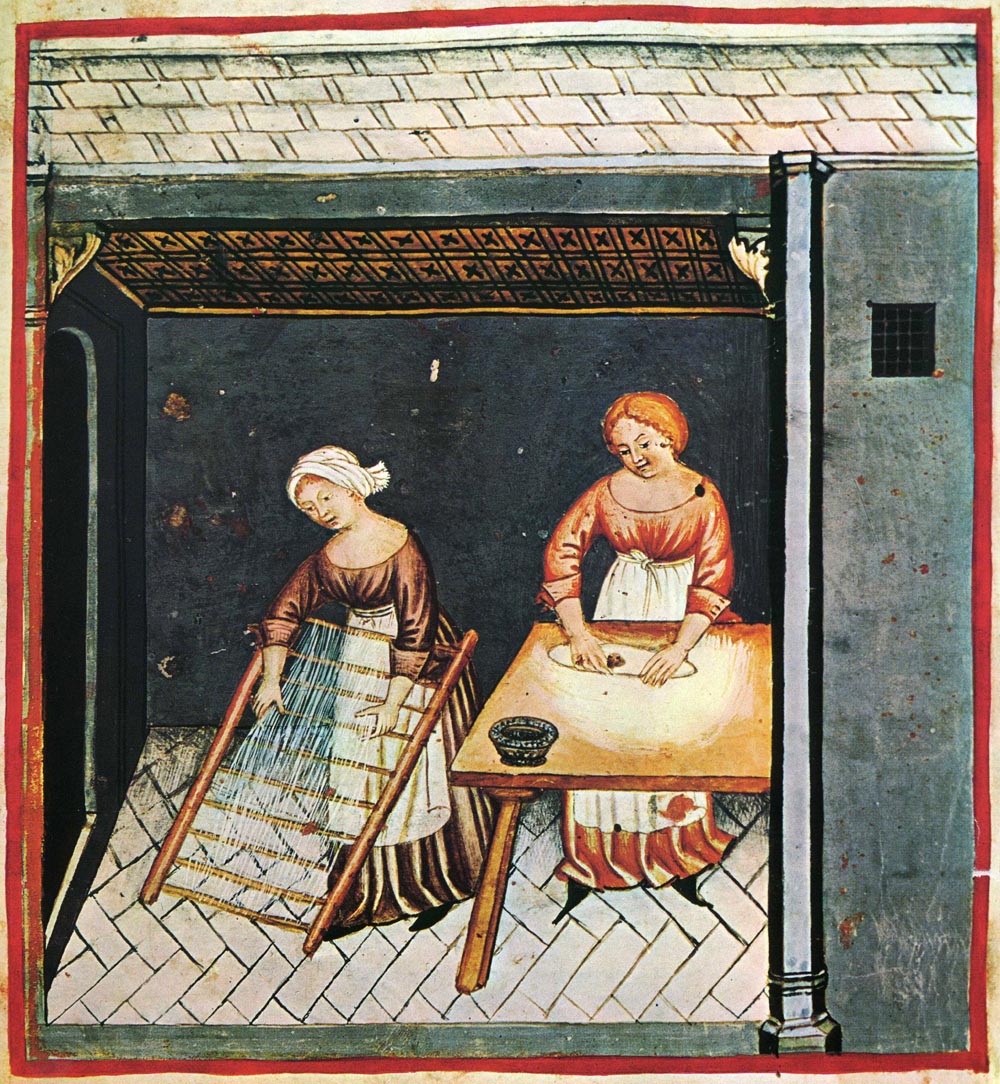
Mix the flour with the eggs and salt and work it until smooth and bubbly.
Roll it into a long and flat string and cut small lumps off – the size of piece of pasta or “small button” (Knöpfle).
Heave the “Spätzle” into 5 l of boiling water into which three tablespoon of salt has been dissolved. As soon as they float up to the top, they are cooked. Serve them either soaked in butter and with grated cheese on top. Or mix it in a nutritious sauce like the one cooked at the Castle of Juval.
Spätzle or Knöpfle was originally an Arabic and/or Jewish specialty, which entered Italy from Sicily in the 10th century. From here it was introduced to the rest of Europe. It is variously known as lukshen (Yiddish) nudel (German), itriyot (Hebrew), Metelt (Hungarian), frimsel (Western Yiddish), Knöpfle or Spätzle (German).
Visit:
FEATURED PHOTO:
Castle of Juval with the entrance from the valley. Source: wikipedia/Hajotthu