
The Valley of Schnals lies in the upper part of the Alpines. Recent archaeological research documents the different human activities in the Middle Ages
The Development of Human Activity in the High Altitudes of the Schnals Valley (South Tyrol/Italy) from the Mesolithic to Modern Periods
By Andreas Putzer, Daniela Festi, Sophie Edlmair and Klaus Oeggl
In: Journal of Archaeological Science, Vol 6, April 2016, pp. 136 – 147
In 1991 the famous Ötzi-man was discovered in the glacier running down in the Tisen Pass accessible from the Schnalstal in Southern Tyrol. Broader research into the development of human activities has not only yielded information about life in the Bronze Age; to this should be added knowledge about human exploitation of the higher Alps in the Middle Ages.
The research project involved paleoenvironmental and archaeological studies in order to disentangle the change from a natural to a cultural habitat and landscape. Apart from extensive fieldwork uncovering flint scatters, ceramics, calcined bones, charcoals an d much more this involved so-called palynological analyses aimed at reconstructing the onset and development of alpine pastures and the transhumance routes, which were used from at least the Late Middle Ages. In connection with this samples of fosil pollen were collected at three different locations at different altitudes.
Conclusion is that the valley was home to human activity from shortly after the end of the last Ice Age and up until our time and that hunting parties must have passed across the Tisen pass from the earliest time. In the Bronze Age human activity grew, resulting in an increased number of settlements. A number of indicators show an organised pastoral economy involving transhumance and the opening of forests accompanied by the establishment of larch meadows. This took place app. a 1000 years the the Ötzi man hunted in the valley up to the pass. However, from around 500 BC the ratio between arboreal pollen and other pollens indicate a reduction in pastures. A general shift of human activity from higher altitudes to lower. This development took place in the cold period between the 6th and the 8th centuries. Thus, it is obvious that a downward shift in the pastoral economy took place signalling a climatic shift. (However, this is not discussed in the article and probably awaits further clarification).
The Later Middle Ages
 Such was the pattern of exploitation until the formation of the first farmsteads around the 12th to 13th centuries. This was caused by a marked increase in the size of the population. “The historical settlement of the valley followed the prehistoric transit routes into the valley, when the noble families of Montalban and Wanga founded the so-called “Schwaighöfe”, which focused on animal husbandry and the sale of wool, which was used in the fabrication of Loden cloth. From 1581, 66 farmsteds are mentioned in historical documents, which nearly corresponds to the number of farmsteads today, writes the authors.
The “Schwaighöfe” on Alpine pastures were located at altitudes ranging up to 2000 meters. All of the land on which these settlements were built was owned by noblemen and rented out for cultivation. The farmers used to provide the land-owners with cheese, livestock and wool, in return for which they were provided with grains and salt.
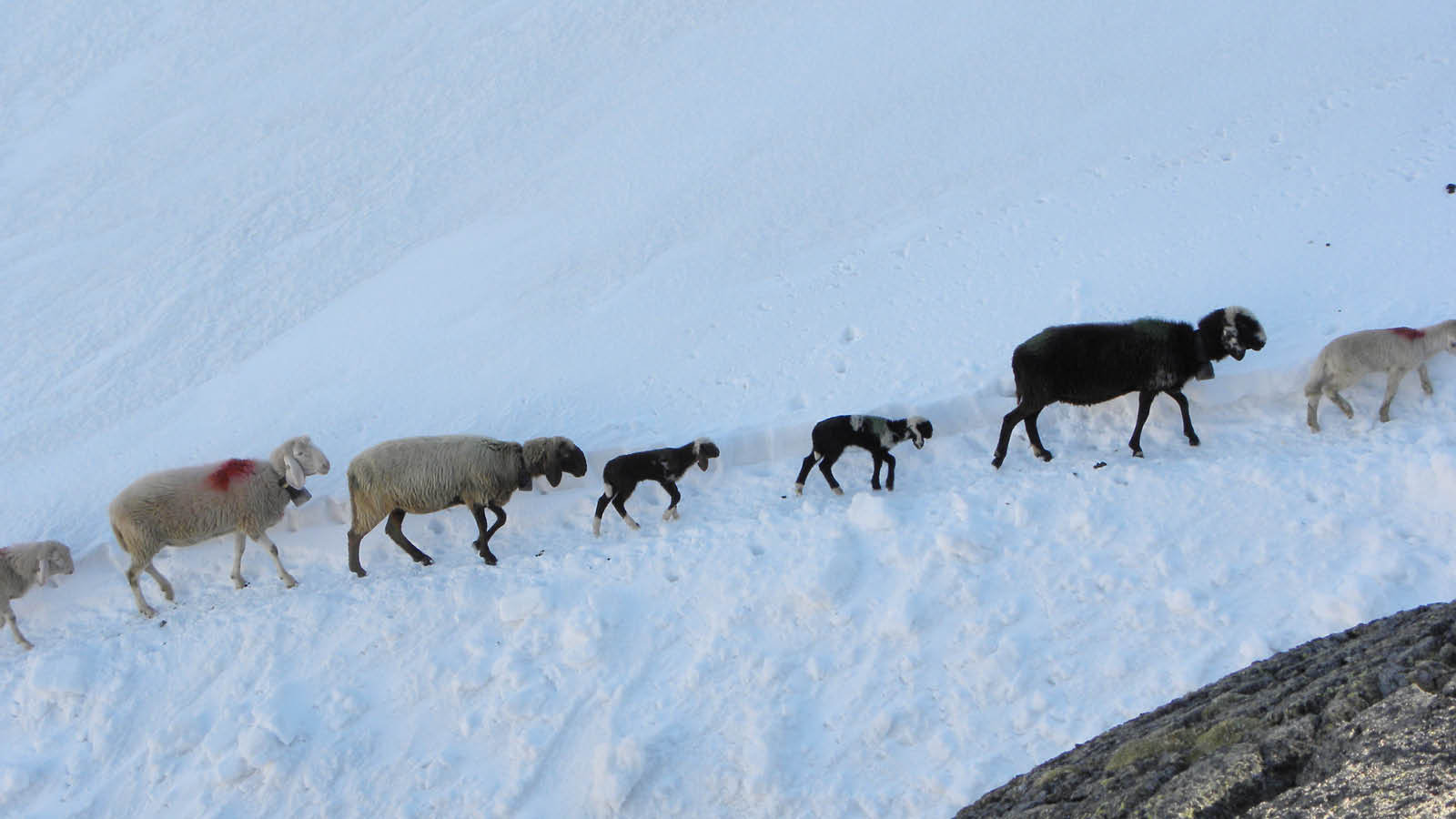
Animal husbandry, hay-making and pastoral activity thus remained the economic basis until the tourism- and skiing-industry began to make inroads. Nevertheless, the Valley of Schnals is one of the Alpine locations where traditional pastoral economy may be witnessed even today” writes the authors in their conclusion. Even today the valley has the largest number of sheep in all of South Tyrol. It is a unique, almost primal experience to witness, in late June, the seemingly endless procession of over 3000 sheep being driven through snowfields and glaciers across Hochjoch / Giogo Alto (2,875 m), Niederjoch / Giogo Basso (3,019 m) and Gurgler Eisjoch / Giogo Gurgl (3,152 m) to the summer pastures of Ötztal.
The article reports results from the research project on: The Neolithic Agricultural Regime in the Inner Alps”, financed by the Austrian Science Fund plus results from “Prähistorische Besiedlung und ôkonomie inneralpiner Hochtäler im Falle der Schnalstals, financed by the South Tyrolean Science Fund.
ABOUT THE AUTHORS
Andreas Putzer works at the South Tyrol Museum of Archaeology, Museumstr. 43, 39100 Bolzano, Italy. Daniela Festi, Sophie Edlmair and Klaus Oeggl works at the Institute of Botany, Sternwarterstr. 15, University of Innsbruck, 6020 Innsbruck, Austria
FEATURED PHOTO:
Photo shows the valley with its endpoint – the mountains raising up to the Similaun to the North East, 3597 m.