The throne of Charlemagne may still be seen in the Cathedral in present-day Aachen. New research presents an overview of other Carolingian thrones and argues the existence of a parallel in a Carolingian palace in Mainz
‘Medieval Histories’ offers medievalists all the news about exhibitions, books, research, archaeology, travel-tips and much more from the Medieval World
The throne of Charlemagne may still be seen in the Cathedral in present-day Aachen. New research presents an overview of other Carolingian thrones and argues the existence of a parallel in a Carolingian palace in Mainz
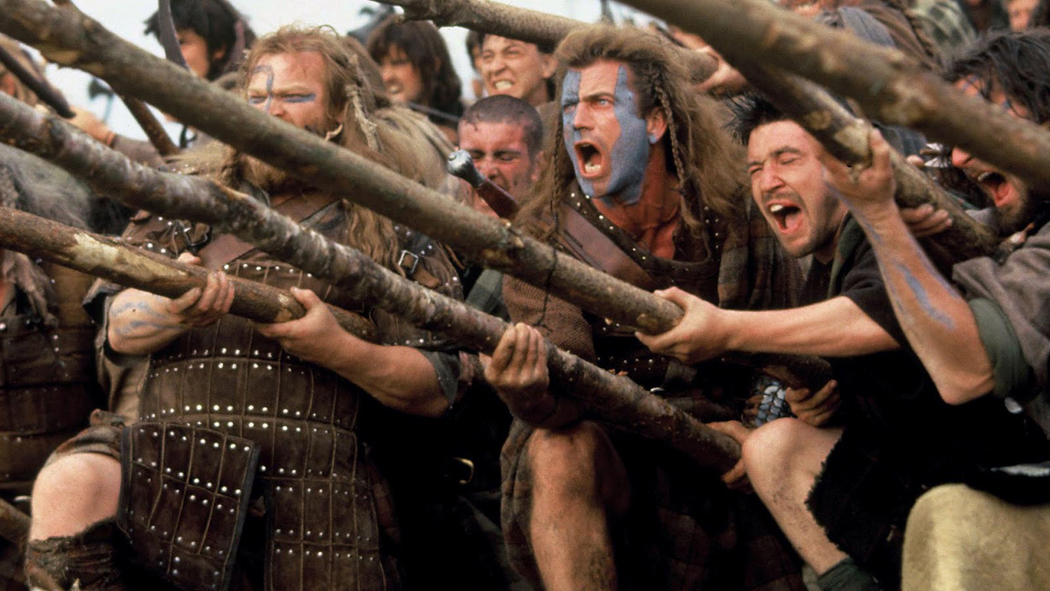
“…ignorant, barbarous, thoughtless, irreclaimable and unsociable foreigners” (Cogadh Gáedhel re Gallaibh, 12th century)
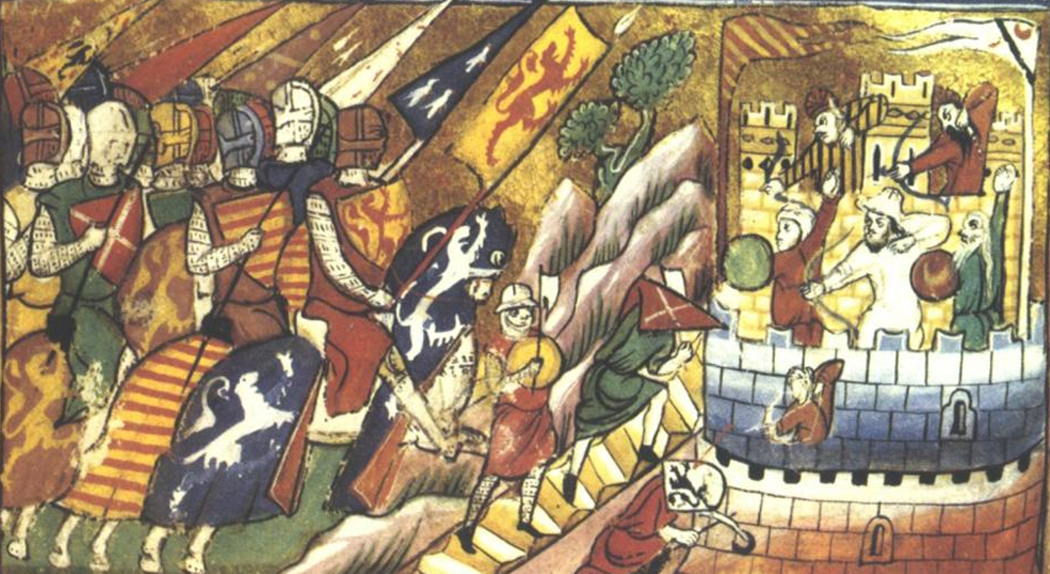
On Good Friday 1014 the battle of Clontarf on the East Coast of Ireland took place between the High King of Ireland, Brian Boru of Munster and Máel Mórda mac Murchada, king of Leinster, whose party was swollen by Norsemen led by Sigtrygg Silkbeard from Dublin and contingents of Vikings from Orkney (led by Sigurðr) and the Isle of Mann
The background of the battle was the on-going strife between the Irish warlords, Brian Boru from Munster and Máel Mórda mac Murchada from Leinster, but also the interest amongst the Norsemen to consolidate and expand their holding of Dublin and South Eastern Ireland.
The battle is said to have lasted a whole day from sunrise to sunset. It is estimated between 7 – 10.000 men were killed, amongst whom were the chief protagonists. The battle of Clontarf is often commemorated as a ground-breaking event, which in the end (post 1052) secured the independence of the Irish from the Norsemen, who had carved out an existence in Dublin and elsewhere during the preceding two centuries.
In fact, it was probably more complicated. It seems to have been a very bloody affair, which weakened both the Irish and the Norsemen (who anyway at this point were heavily interrelated). Another distinguishing factor was that so many of the leaders of the two factions and their sons and family members seem to have perished in the battle.
Commemorating the battle this year is a temporary exhibition at The National Museum of Ireland in Dublin, which aims to “explode” the myths and present the evidence. Viking and Irish weapons, typical of those used in the battle, features alongside hoards of precious silver objects and religious treasures. Much more recent artefacts will bring the story of Brian Boru and Clontarf right into modern times.
In April this exhibition was accompanied by a Battle of Clontarf Conference designed to – once and for all –
“establish the truth of what really happened at Clontarf for a twenty-first century audience, to re-evaluate the role of Brian Boru in the light of the latest cutting-edge research, and to bring recent investigations of the subject of the high-kingship of Ireland and of the role of the Vikings in medieval Ireland into the realm of public discourse, dispelling (or perhaps reconfirming) myths, shedding new light, raising public awareness, and promoting new synergetic fields of research by adopting a methodology that is explicitly interdisciplinary.”
We eagerly await the publication of the proceedings. Until then students at The University have very kindly provided a website with short introductions and links to the relevant sources.
READ MORE:
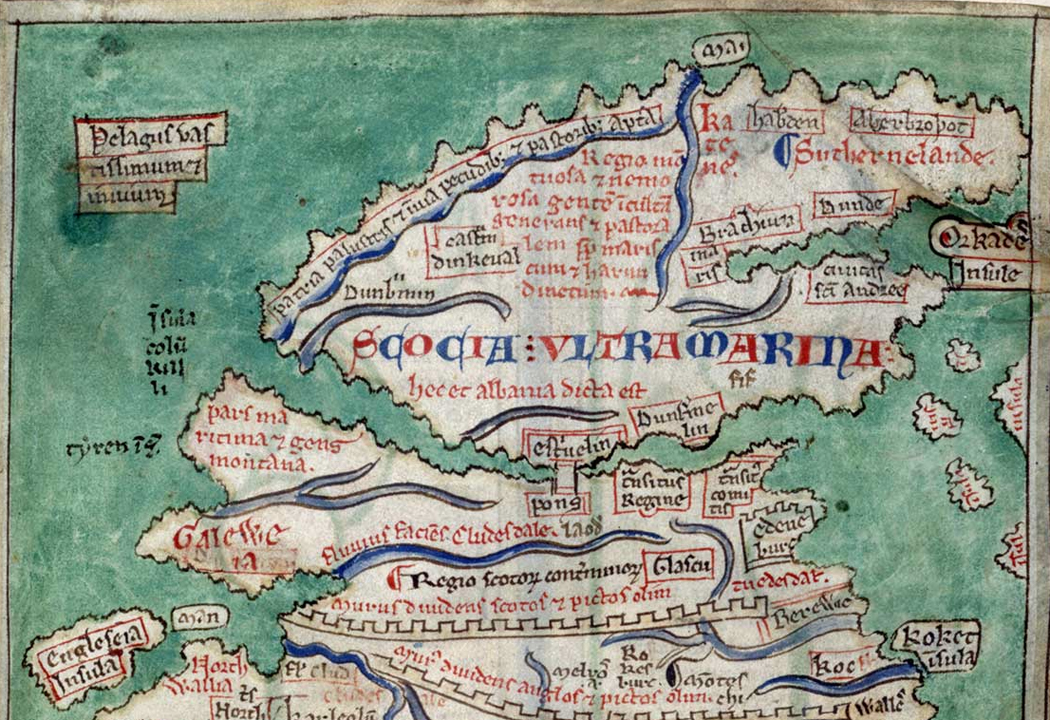
…ignorant, barbarous, thoughtless, irreclaimable, unsociable foreigners of the Orc Islands.”
Normally it is kept in Kremsmünster, in upper Austria half between Munich and Vienna. Thus it is a very good example of the hassle, which serious medievalists have to endure in order to sample such treasures.
At present (summer 2014), though, it is one of the highlights in Aachen.
The chalice is made of bronze chalice gilded with silver and gold and decorated with niello and chip-carving. It stands 25.5 cm high and weighs 3 kg.
Around the cup five oval medallions show Christ and the four evangelists. Round the base are icons of Mary, John the Baptist and perhaps – the Lombard Queen Theodelinda. The portraits are interlaced with plants and animals. Around the foot is an inscription: Tassilo Dux Fortis + LiVTPIRG VIRGA REGALIS.
The chalice might have been made in Northumbria, but it might also be the work of a craftsman working in missionary contexts on the continent. The decoration is in the Hiberno-Saxon style, but it is also inspired by Italian (Lombard ) style
The chalice is nowadays used when mass is celebrated in the abbey of Kremsmünster on the memorial day for the death of the founder, Duke Tassilo, the 11th of December, 777 and on Maundy Thursday. The wine used at the Abbey has been continuously grown in the same fields since the 8th century.
The celebration takes the form of a mass for the dead. Apart from the use of the chalice, two other treasures are brought forth from the museum: the Tassilo-chandeliers and the Codex Millenarius Maior, also from the 8th century. This is not on show in Aachen, but a manuscript from the same scriptorium, the Mondsee or Tassilo Psalter is.
READ MORE
Charlemagne and his entourage were constantly moving about. And needed horses and and saddles.
According to a research paper published in The Lancet, Richard III’s severe scoliosis would not have been obvious during his lifetime, and ‘a good tailor and custom-made armour could have minimised the visual impact of his condition’. The verdict on Richard III’s appearance is that he was a short man, but not visibly disabled
This conclusion follows an analysis of the remains of Richard’s spine by a research team made up of osteologists from Leicester, Cambridge and Loughborough universities and the University Hospitals of Leicester NHS Trust. Using CT scans to make 3D polymer replicas of each vertebra, they re-created the shape of Richard’s spine during his life, leading to the conclusion that the king’s disfigurement was probably slight because a ‘well-balanced’ sideways curvature in the spine would have meant his head and neck were straight, not tilted to one side.
The researchers established that Richard would have been about 5ft 8in (1.7m) tall without his scoliosis; the condition meant he appeared several inches shorter. His torso was short relative to the length of his arms and legs, and his right shoulder was a little higher than his left, but there was no evidence that Richard walked with an obvious limp — his leg bones were symmetrical and well formed — and the condition would not have reduced his ability to exercise or to fight on the battlefield.
The researchers were also able to establish that the condition developed after his 10th birthday.
Phil Stone, Chairman of the Richard III Society, which helped fund the Leicester excavation, said that: ‘the Shakespearean description of a “bunch-backed toad” is a complete fabrication. History tells us Richard III was a great warrior. Clearly, he was little inconvenienced by his spinal problem and accounts of his appearance, written when he was alive, tell that he was “of person and bodily shape comely enough” and “the most handsome man in the room after his brother, Edward IV”.’
The Scoliosis of Richard III, last Plantagenet King of England: diagnosis and clinical significance
By Jo Appleby, Piers d. Mitchell, Calire Robinson, Alison Brough, Guy Rutty, Russell A. Harris, Davis Thompson, Bruno Morgan.
In: The Lancet 2014, Vol 383: p1944
Richard Crookback
Sarah Knight and Mary Ann Lund
TLS: 6 February 2013
Read more about the studies of the mortal remains of Richard III
Archaeologist have been digging at the abbey of Saint-Maurice d’Agaune since 1896. Very recent excavations have uncovered parts of a huge and fascinating royal-episcopal complex
Saint-Maurice d'Agaune is one of the oldest monasteries in Western Europe and can trace its history back to the 5th century AD
Bad is that land and not well graced, A wilderness it is and waste: Skywards its crags and peaks do soar, It snows and hails for evermore; A fearful and repulsive place. Its men both weird and wild of face. No peace they know, no quarter give. They pay no heed to how they live: They feed on fish, their meat is raw, Like wolves they tear at it and paw… They dress in untanned hides as well As if they come straight out of Hell. [1]
Fish deteriorates very quickly. Therefore, the best way to eat it is grilled on the beach (John 21: 9) or even raw, freshly fished. Even today, Danish connoisseurs may be seen walking the mussel banks in wintertime, enjoying raw mussels and oysters on the spot.
Jesus was of course the fisherman par excellence and the Apostles (his crew); and early on Jesus became symbolized by the sign of a fish (Ikhthus). Nevertheless the eating of fish gradually attained a somewhat dubious character after the year 1000, when the pattern of fish consumption changed dramatically. Fish was good – but not all fish and not everywhere.
One illustration of this comes from William of Malmesbury (ca. 1095–1143), when he recalled his great contemporary, the Archbishop Anselm of Canterbury (1033 –1109):
“Right up to the end of Anselm’s life his bodily strength and fervent piety continued unimpaired… he surpassed all the men we have ever seen in wisdom and piety. Sin was completely foreign to him. He once told a close friend of mine, whom I believe implicitly, that after he became a monk, he had never been so goaded by anger as to hurl an insult at anybody – well, this had happened to him just once. He had never except once spoken a word, of which the memory made his conscience sore. At supper one day, realizing that he had eaten raw herring, he struck his breast and lamented his sin, that against the rule he had eaten raw flesh. But Eadmer, who was sitting next to him, said that the salt had drawn out the rawness of the herring. Anselm replied: “You have cured me of being tormented by the memory of my sin”. [2]
Whether the fish, Anselm partook of, was pickled or just salted, we do not know. But even today it is a great delicatessen to eat “raw herrings” at the harbour at Rotterdam and the cook in the monastery may have had the opportunity to serve something less distasteful as herring directly from the barrel. And apparently got slapped for it!
Raw fish was simply uncivilized – probably considered either a sign of gluttony, because the partaker have not waited to cook the fish; or it was considered a delicatessen in view of the challenges of getting fresh fish on the table.
Fresh fish could be transported no more than up to 150 km in barrels; accordingly fresh fish was either a luxurious delicatessen or something, which should be regarded as gifted by God and eaten on the spot. Proper fish was dried, salted, smoked (or nowadays frozen), in which case it turned into a proper communal food.
Just about the same time, Bernard of Clairvaux (1090 -1153) reflected on the proper way of fasting. Born a younger son into a family of minor nobility in Burgundy, Bernard entered Cîteaux as a young man in 1112. Gifted as a charismatic person he devoted his life to reforming the monastic movement, which at that time overwhelmingly was characterised by the praxis of the Benedictines at Cluny. One issue, which especially enflamed Bernard had to do with food. In a number of letters and writings it is possible to follow the harsh critique, which was pointed at the sybarites down the road. One of the central texts is the Apologia for Abbot William. In this he writes about how course after course is brought in a mealtimes. And because the Benedictines would not break the taboo and eat meat, these dishes were doubled and made from fish of all sorts of varieties. “You only have to begin sampling the second dish to imagine that you have never tasted fish before”, he wrote. Bernard was especially critical about the relishes, condiments and sauces, which accompanied these fish-dishes. He felt that all this was too alluring to the senses and promoted an appetite above and beyond what was proper. Roast fish, boiled fish, stuffed fish, fried fish… no doubt the best way to govern the appetite, was to stay away from it all. Even later the Cistercians continued to abstain from fish, eggs, milk, cheese or white bread, let alone meat or lard, as was claimed by Jacobus de Vitry a generation later. In the end, of course, Bernard was correct; fish was at that time rapidly becoming the luxurious alternative to meat, which the rules of fasting during Advent, Lent and specific weekly days came to stipulate as offensive for not only clerics but also lay persons. As such certain fish became a sign of wealth sought by the elites at court, in the growing towns or at the magnificent new monasteries. Also the procurement of fish became rapidly more complicated in a world with a growing population which further seems to have acquired the taste for a new and refined, religiously inspired cuisine. Sign System As a sign system it was quite complicated. Topping the list were whales, porcupines and seals. Next on the list was the near extinct sturgeon followed by tuna, salmon, swordfish. Further down the list were pike, carps, bream and to a lesser extent eels supplemented by large white (fresh) fish like cod. At the bottom of the social pyramid the fish became smaller or were either salted or dried. Five grids seems to characterise this sign system, which was used to create social distinctions in the later Middle Ages
Raw: Cooked
Scarce : Common
Large : Small
Fresh : Conserved
Whole : Parts
However this sign system could be manipulated. For instance “whole fish” were definitely elite-food, although certain parts could be considered special delicacies, like the cheeks of cod or monkfish.
Further, the system would be suspended at the frontiers of Europe where fish was simply part of the daily staple diet. In 1431 an Italian, Pietro Querini, shipwrecked off the coast off Røst at Lofoten. Afterwards he and his men spent nearly 4 months living alone on the coast. First they had to live off mussels but at a later stage they found a whale on the coast. A little later, the locals from a nearby island saved them. The staple food all that summer, however, turned out to be something of a strange culinary experience for the Italiens: Stockfish and salted flaunders. At Lofoten nothing could grow and for two months they ate nothing but “butter, fish and some meat” plus fresh milk, he tells us. [3]
[1] From: The Owl and the Nightingale ca. 1189 – 1216, lines 999 – 1014, translated by Ian Short. In: A Companion to the Anglo-Norman World. Ed. By Christopher Harper-Bill and Elisabeth van Houts. Boydell & Brewer 2007. [2] From: William of Malmesbury: The Deeds of the Bishops of England. 65 (1109). Edited and translated by David Prest Boydell Press 2002. [3] From: Pietro Querini, Nicolò De Michiele, Cristofalo Fioravante (ed.by Paolo Nelli). Il naufragio della Querina. Veneziani nel circolo polare artico, 2007.
A Hermit’s Cookbook. Monks, Food and Fasting in the Middle Ages. By Andrew Jotiscky. Continuum 2011 Food and Faith in Christian Culture By Ken Albala and Trudy Eden (eds) Columbia University Press 2011 In Series: Arts and Traditions of the Table: Perspectives on Culinary History Food in Medieval England. Diet and Nutrition. By C.M. Woolgar, D. Serjeantson and T. Waldron T., eds. Oxford: Oxford University Press, 2006.
Recipe for Raw Herrings Gut and filet half a kilo fresh herrings and freeze them for 48 hours in order to kill any parasites. Mix 1 dl salt and 1 dl sugar and rub it into the filets. Leave them covered in the refrigerator for 24 hours. Then rinse them under running, cold water and peal off the skin. Place them flat on a plate and sprinkle them with lots of fresh dill. Serve with boiled potatoes, butter and salt. (Recipe picked up in the harbour of Rotterdam in the 1930s)
Immediately after the Staffordshire Hoard was secured for the public, it became necessary to gather a team, which might clean and study the hoard in all its details – both on sight and under microscopes. This team has been working diligently since March 2012 performing, what has been termed stage 1 in the overall research project. In the Newsletter from May 2014 the current status is generously shared with the (very) interested public. In January 2001 none had a very precise overview of what the Staffordshire Hoard in fact contained. Apart from the fact that about a third stemmed from swords and seaxes, that there were pieces from helmets (one or more) and that a small handful of items were obviously Christian, no one could in fact say much more.

In February 2014, however, all the bits and pieces (more than 4000) had been catalogued. At this point there were all brought together in order to facilitate a ‘grouping exercise’, whereby hopefully some of the tinier fragments might be pared. During this grouping exercise it became possible to confirm over 200 physical joints, which were already suspected. But added to this should be more than 600 new ones, which appeared by placing the items next to each other. Out of this it was even possible to construct suites of ensembles of pieces, which could be fitted to each other. The team now know that over 350 fragments relate to only 120 items. All this is now making it possible to enter stage two. All this lead to the ‘Third Project Meeting’ whose participants were not only the team and members of the Hoard Management Group, but also scholars from the advisory Panel and the wider Anglo-Saxon scholarly community.

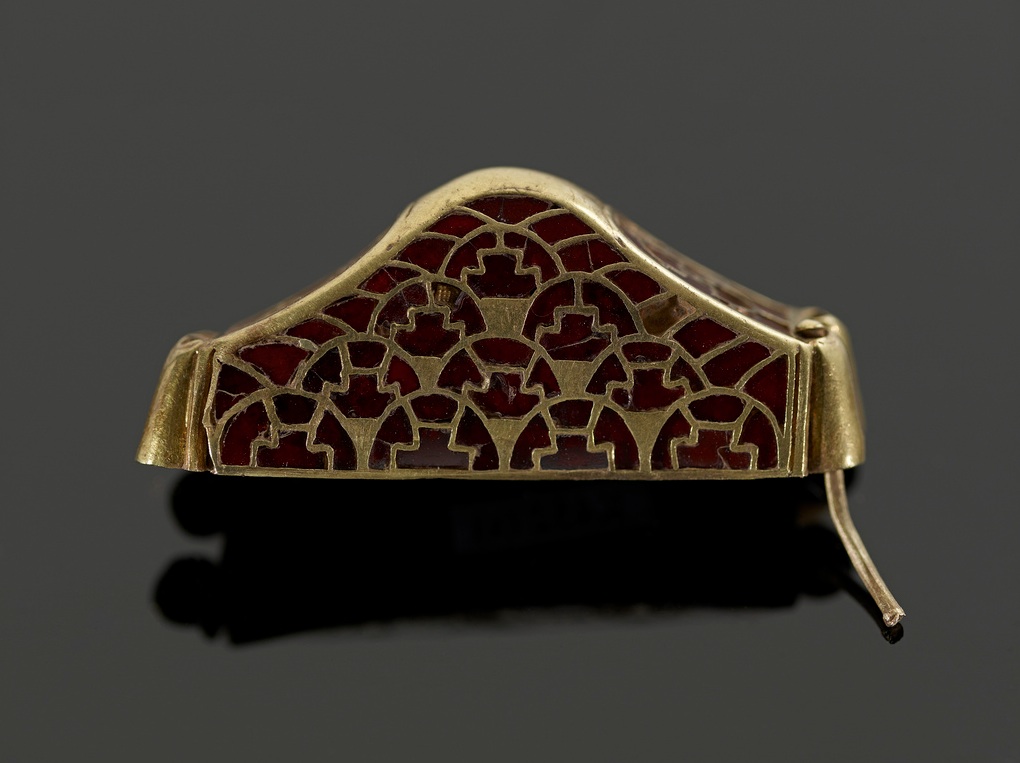
All this has strengthened the ‘conclusion that this is fundamentally a male and military hoard’. Nearly 60% of the identified material stems from swords and seax fittings. The team suggests, the hoard probably represents booty captured during multiple battles. Later the pieces have been chopped up to make them easily disposable as gifts for his retinue at a time and in a place (7th century Mercia) where coins were not minted. It has been estimated that the gold in the hoard represents something like 3000 contemporary golden coins. However, the small group of Christian items have increased slightly as there is believed to be yet another additional gold arm from a second pectorial cross, found in the hoard. And then there are the suites of large cloisonné mounts, as yet still enigmatic. Some of these appear to form pairs. They might just have been mounted on a thin plate, perhaps a book cover… Further information may be gathered from the techniques. For instance a number of suites of inlaid silver mounts have been made with a type of niello, which is not normally seen on Anglo-Saxon silver. Another major conclusion is that there are nearly three times as many filigree-decorated pommels, than cloisonné-decorated ones. Also the number of items decorated with Salin Style 2 (ca 570 – 700 AD) ornaments have risen to 130 pieces. Finally there is a group of silver pommels decorated with Insular non-zoomorphic ornamentation.
One intriguing find in the cloisonné pieces, is a type of green inlay, which has so-far not been identified. Perhaps it has been more widespread than generally believed, since old pieces in museums have often been to carefully cleansed, removing what might have been considered no-more than dirt. So far the scientific analysis has not yielded an answer to what the green stuff might be. However, further investigations are promised.

Currently funds will have to be found to continue with stage two. This is planned to be a 30 month long project leading to the final publication. And yes, it will be expensive. Meantime a new permanent gallery will be opened in Birmingham in October planned to exhibit parts of the magnificent find. Amongst other things a reconstruction of a mead-hall will be decorated by hangings embroidered by volunteers organised by the Embroiders Guild It is a great pleasure that the owners, the research team and the curators are so generous in providing updates on the scientific and scholarly investigations into the Staffordshire Hoard. Had it been in the old days, the tradition would have been to ‘hoard’ the results for scientific publications in the far-out future. Not so here!
Spoils of War. The brutal origins of the Staffordshire Hoards.
In: Current Archaeology May 2014.
Pioneering research shows ancient Hoard as ‘true archaeological mirror’ to early epic poem Beowulf.
Introduction into the Staffordshire Hoard Grouping Exercise – Video
Look out in the near future for a formal overview of the research results written by Chris Fern. When officially agreed upon, the text will appear at the Barbican Website.
Silver Pommel with face. Probably mainland Europe, perhaps Scandinavia. The team call ‘him’ Dave, but perhaps Beowulf is more appropriate?
Richard III: From Contemporary Chronicles, Letters and Records
By Keith Dockray and P. W. Hammond
Fonthill Media 2014
No English king has suffered wider fluctuations of reputation than Richard III, perhaps the most controversial ruler England has ever had. Vilified by critics as a ruthless master of intrigue and a callous murderer, he has been no less extravagantly praised by defenders of his reputation against Tudor and Shakespearian charges of tyranny. Richard III: From Contemporary Chronicles, Letters and Records, by its presentation of contemporary and near contemporary sources, enables the reader to get behind the mythology and gain a more realistic picture of the king. An invaluable collection of the primary sources presented clearly and concisely, it demonstrates just why Richard has remained an enigma for so long. Established as an essential part of the literature on Richard III since its first publication under the title Richard III: A Reader in History, this new edition has been completely revised and considerably expanded to offer an indispensable source book for historians, students and the general reader. Also, this up to date edition includes a chapter in relation to the exciting discovery of Richard III’s skeleton that was found under a car park in Leicester. The Genesis of this book came from a summary guide produced by Keith Dockray for all of his second year undergraduate students. Upon this foundation has been built an accessible and enjoyable history of this fascinating king, as seen by those who knew him at the time, or who were living shortly after his untimely death at Bosworth Field.
Keith Dockray was formerly a senior examiner in medieval history and early modern history at the University of Huddersfield.
Peter Hammond is a medieval historian and leading authority on the reign of Richard III. For thirty years, he was the research officer of the Richard III Society and is currently a vice president of the society. He is probably best known for his books The Battles of Barnet and Tewkesbury and Food and Feast in Medieval England. With Dr Anne Sutton, he wrote The Coronation of Richard III: The Extant Documents and Richard III: The Road to Bosworth Field. As an editor, he has compiled a new edition of Historic Doubts on the Life of Richard the Third by Horace Walpole. He has also written and contributed to many other books and magazines on medieval and local history.
Digging for Richard III: How Archaeology Found the King
BY Mike Pitts
Thames and Hudson Ltd (14 April 2014)
ISBN-10: 0500252009
ISBN-13: 978-0500252000
The book is available in hardcover as well as an E-book – iBooks, Kindle and Kobo.
First came the news that archaeologists were searching for a king in a car park. Next it was said they had located the church where Richard had been buried. Finally it was announced that a skeleton had been found – with curved spine and battle wounds. Archaeologists urged caution, as media frenzy led to questions in Parliament. The scientific conclusion came early in 2013. All the studies, including analysis of anatomy, DNA, high-resolution scanning and a digital facial reconstruction, led to one thing. This really was Richard III, England’s most disputed monarch and probable murderer of the Princes in the Tower.
The events of Richard III’s reign and his death in 1485 at the Battle of Bosworth are known worldwide through Shakespeare’s most performed, filmed and translated history play. ‘Digging for Richard III’ is the page-turning story of how his grave was found, the people behind the discovery and what it tells us. It is the first complete narrative of a project that blended passion, science, luck and detection. Told by a noted archaeologist with access to all the parties involved, it follows the quest from an idea born in an Edinburgh bookshop to the day, fourteen years later, when two archaeologists carefully raised the bones from a car park in Leicester, and the scientific studies that resulted.
The vivid tale of a king, his demise and now his rediscovery, this is also an insider’s gripping account of how modern archaeology really works, of how clues meticulously assembled and forensically examined are pieced together to create a narrative worthy of the finest detective fiction.
Mike Pitts is an archaeologist and award-winning journalist. He grew up in Sussex and studied archaeology at University College London. In his early career he directed his own excavations at sites such as Stonehenge and Avebury, and he continues with scientific research, including most recently on an Easter Island statue. For the last ten years Mike has edited Britain’s leading archaeological magazine, British Archaeology, and as a freelance journalist he writes frequently for national and international newspapers and magazines.
In 1485 the historic Battle of Bosworth took place just outside Leicester. A new book tells the story and presents the recent discoveries in the field.
Bosworth 1485. The Psychology of Battle
By Michael Jones
John Murrey 2014
ISBN: 9781848549081
ABSTRACT
In 1485 the Battle of Bosworth marked an epoch in the lives of two great houses: the house of York fell to the ground when Richard III died on the field of battle; and the house of Tudor rose from the massacre to reign for the next hundred years.
Michael Jones, co-author of The King’s Grave: The Search for Richard III, rewrites this landmark event in English history. He shifts our perspective of its heroes and villains and puts Richard firmly back into the context of his family and his times.
AUTHOR:
Michael Jones was awarded a history PhD by Bristol University and subsequently taught at Glasgow University and Winchester College. He is a fellow of the Royal Historical Society and member of the British Commission for Military History, and works now as a writer, media consultant and presenter. Among his historical titles he has written books on the battles of Bosworth, Agincourt, Stalingrad and Leningrad. He was TV consultant for Channel 4’s Richard III: Fact or Fiction and National Geographic’s Mystery Files: The Princes in the Tower, and co-author, with Philippa Gregory and David Baldwin, of The Women of the Cousins’ War.
Careful sifting of area around the gut of Richard III uncovered eggs from roundworm
The verdict is clear: The remains of Richard III will be reinterred in the Cathedral of Leicester.
The Wootton Helmet is a rare and important North European armet from app. 1500
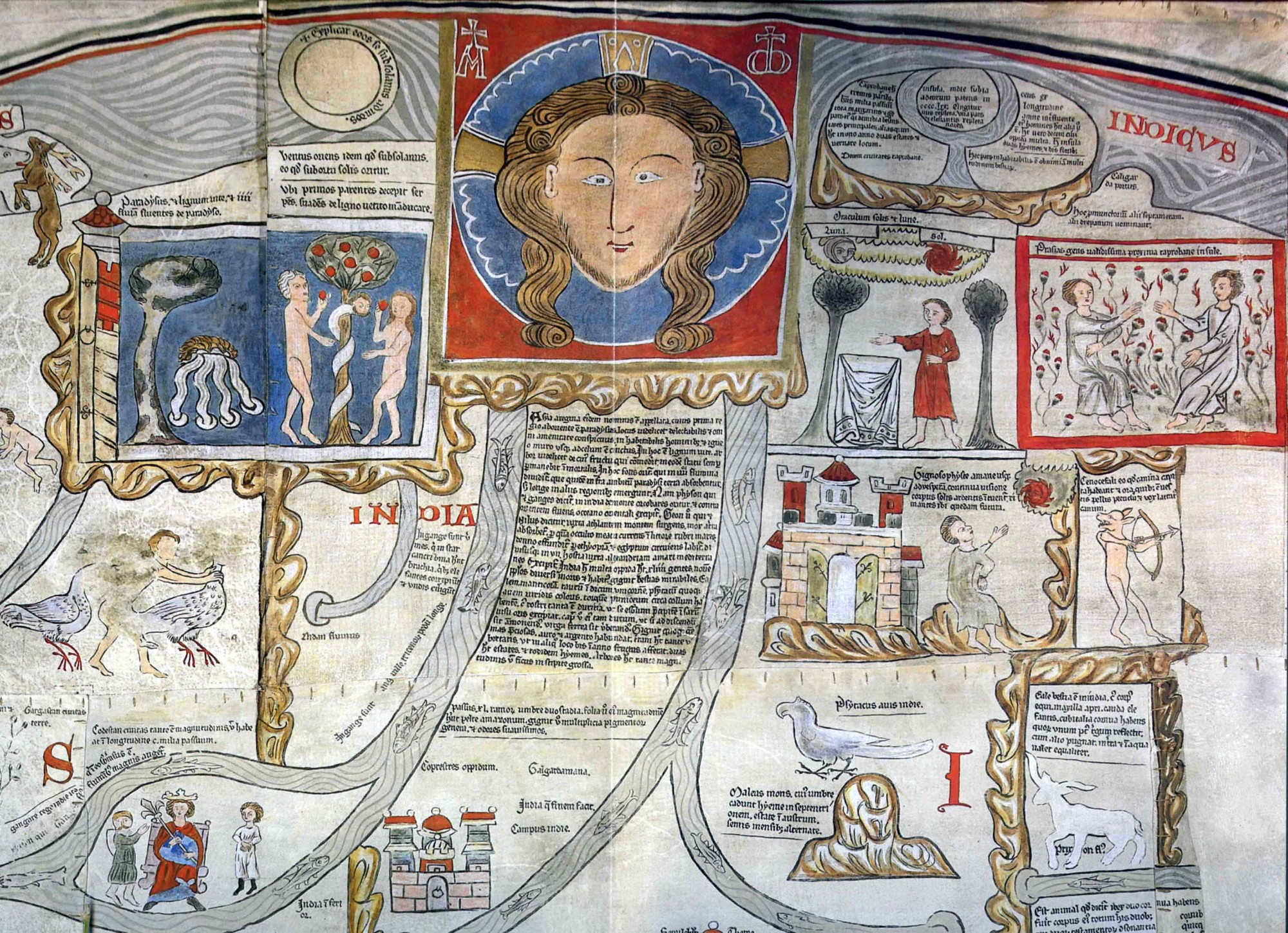
The visual aesthetic and the moral stance of Noah, the film, is obviously inspired by medieval maps of the ancient world ..