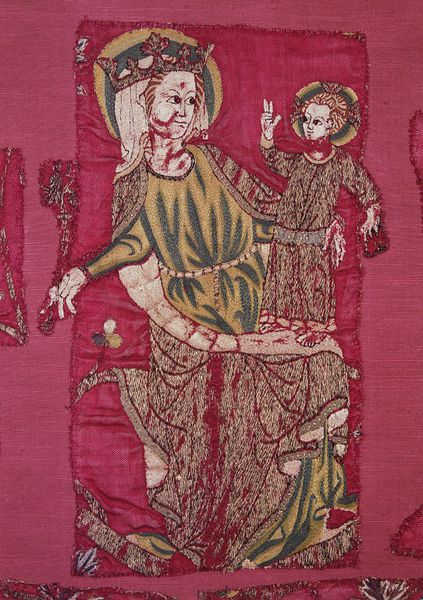
The Textile Collection at V&A in London reopens in October at a new location and with brand-new study facilities
Old aficionadas of Victoria & Albert have for a long time mourned the dissolution of the old gallery for textiles and embroideries, where it was possible to find and at will examine the most fabulous bits and pieces – woven, embroidered, spangled or just knitted. Alas, those were the days when museum exhibitions where not primarily shows, but also included study facilities. I still remember my very first trip to London as a youngster, which resulted in a peaceful afternoon spent in the old gallery perusing Tudor embroidery mounted on the large handmade frames of polished and varnished wood.
However, on the 8th of October it reopens in The Clothworkers’ Centre for the Study and Conservation of Textiles and Fashion at Blythe House, at Olympia in West London. According to the website the aim of the Clothworkers’ Centre is to provide the best possible access to the Museum’s outstanding collection of textiles and fashion in a relaxed and peaceful environment. The Centre also includes new custom-built storage and modern conservation studios to ensure the long term care and preservation of the collection.
Alas, managerial bureaucracy has won the day. Both individual and group appointments must now be booked in advance to ensure that the requested objects and the appropriate space to study them are available. Booking further enquires that you send an email with an explanation of why you want to study a specific group of textiles. Also, it appears, you have to bring photo identification. All this means that single-minded youngsters on silly quests have to be extraordinarily “nerdish”, while others have to “know” in advance, what they want to peruse. Which of course might help to sort the the ordinary textile buffs, medieval re-enactors and other riffraff from the serious students and conservationists.
On the other hand the study room, which has been designed to accommodate individual visitors and small groups of up to three people is said to be spacious, bright and well-equipped for study and research, while larger groups of up to 18 people will be welcomed in the adjoining seminar room.
The Clothworkers’ Centre for the Study and Conservation of Textiles and Fashion
Blythe House
23
Blythe Road
London
W14 0QX
SOURCE:
The Clothworkers’ Centre for the Study and Conservation of Textiles and Fashion
PHOTO:
Cope made in England, Britain between 1295-1315 Silver-gilt, silver thread and silk embroidery on silk twill. Victoria & Albert, Museum Number: 175-1889