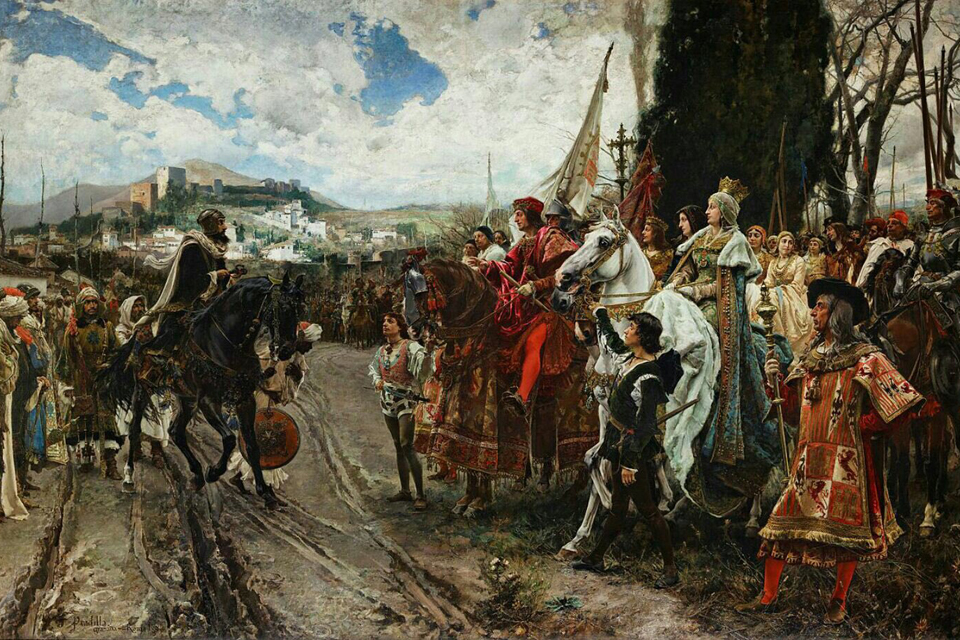
This week the re-conquest of Granada in 1492 was once more celebrated in the streets while a squabble broke out among politicians, artists and historians about the (lack of) political correctness.
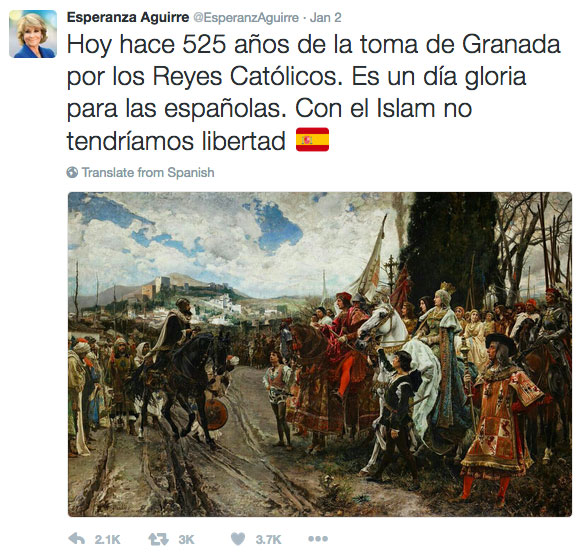 This January it is 525 years since the Spanish Army entered the street of Granada and Ferdinand and Isabella could declare that the whole of Spain was once more under Christian rule. This led Spanish MP Esperanza Aguirre to send out a twitter with the following text:
“Today it is 525 years ago, Granada was taken by the Catholic Monarchs. This is a glorious day for Spaniards. With Islam we would not have freedom”. Appended to this twitter were a Spanish flag and the painting of the Submission by Pradilla.
Now, Esperanza Aguirre is a well-known Spanish politician. Former member of the Partido Popular, she resigned from this in 2016 under a cloud of corruption, but she is still active in Politics. She has served as president of the Senate, Minister of Education and Culture and as President of the Autonomous Community of Madrid, Comunidad Autónoma de Madrid.
As such, her twitter soon got attention resulting in an uproar among political adversaries. For instance, Pablo Iglesias, leader of Podemos, twittered that “ he hoped that Esperanza Aguirre does not also admire the “hygienic habits” of the Catholic Monarcs, adding a short characteristic of the comment as a rancid, reactionary and uncultured.
Dia de La Toma in 2017
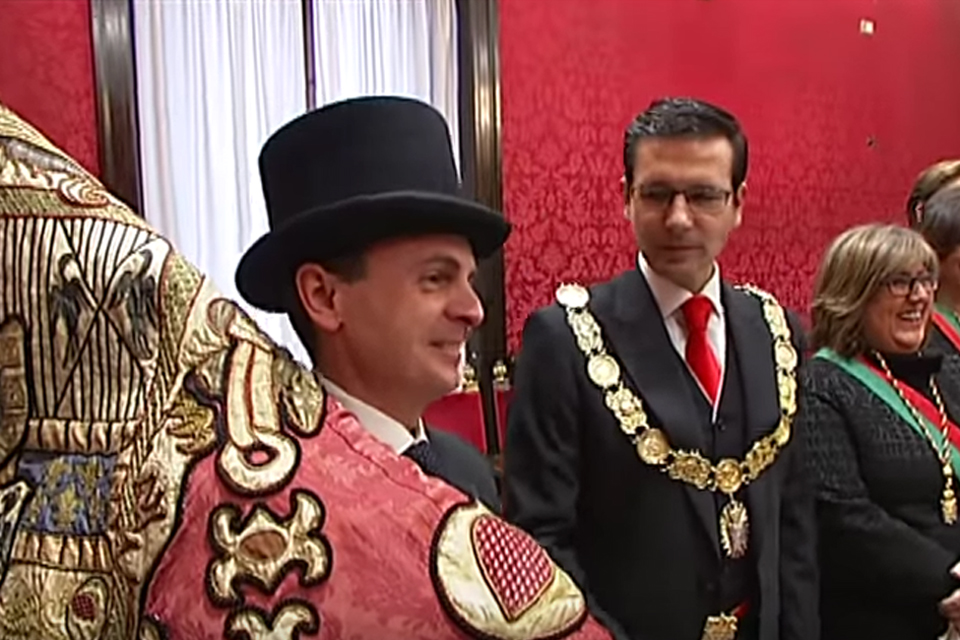
The twitter was of course prompted by the 525-years anniversary; but it was also as a comment to the recent political squabbles surrounding La Toma, the yearly parade, which is organised every January in Granada in commemoration of the surrendering of the city by Baobdil, its last Nasrid ruler in 1492.
As usual this year’s celebrations were initiated with a mass for the politicians, leaders and members of the council of Granada in the Cathedral during which special commemorations took place in the Royal Chapel, where the Catholic Monarchs – Ferdinand and Isabella – are buried. Afterwards the huge bell of Alhambra was sounded and the parade could proceed to the traditional finale in the main square, where the city’s banner – the Pendón – is waved from the balcony of the City Hall by the especially appointed “tremolar el Pendó”. During this waving a special dialogue is played out, calling for the unison acclamation of the participants ending with the cry: Viva España!, Viva el Rey!, Viva Andalucía! And Viva Granada!
For some years these celebrations have been girded with vivid controversies. By some they are even considered one of “the clearest indications of the controversies surrounding Spanish historical memory of the Middle Ages”. [1] Thus, with participation of Falangists carrying Francoist flags, the leftist parties – PSOE and IU – decided in 2013 not to participate, proposing an alternative celebration on the 26th of May, when the 19th century liberal, Mariana de Pineda y Muñoz was publicly executed, because she did not betray her accomplices. This led to a drive by the custodians to get the celebration of la Toma de Granada considered “Bien de Interés Cultural” . Although later rejected by the Andalucian Junta, the local historical association “Granada Históric” has also been petitioning to get the festival protected as Immaterial Cultural Heritage by UNESCO. [2]
Particular political controversies this year were caused by the new Socialist Mayor of Granada, Francisco Cuenca, which many felt had defected from his earlier stance. While in opposition, his party had boycotted the celebration; now, however, the Mayor took part claiming that the parade was part of the local traditions and although participation was not obligatory, the city would take part in the organisation as part of a compromise.
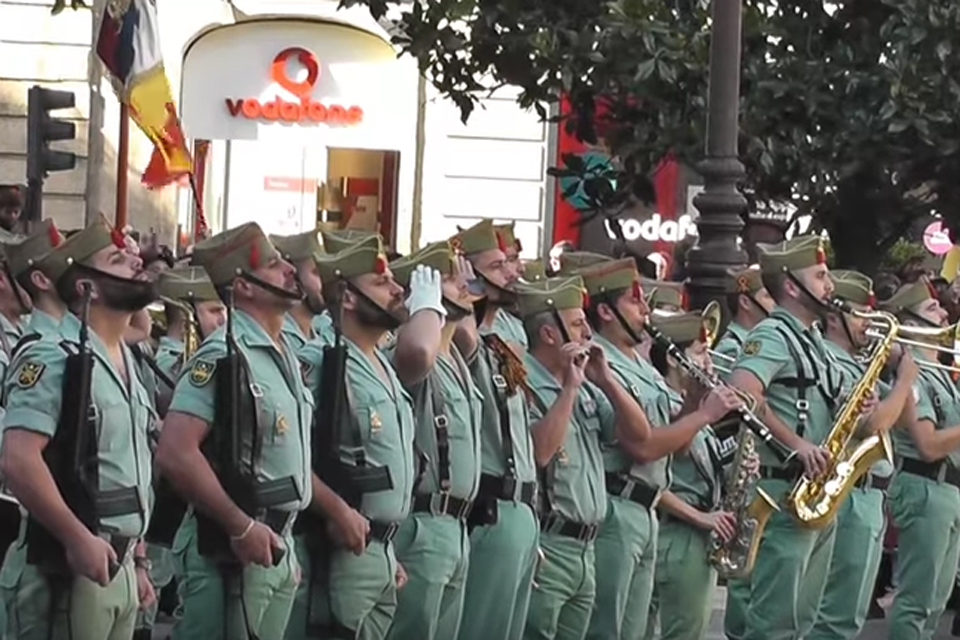
This led to the celebrations being especially contested. With streets full of flag-waving groups for and against the celebration and a very large and active police force, onlookers may have thought everything was just as usual.
However, the heightened police force and the vicious debate on twitter and other social media revealed that the concern not just had to do with the usual fight for regional independence in Spain, but also had to do with the fear of disruption and terror slowly seeping into all corners of Europe.
Thus, while a sermon was preached in the Cathedral reminding the audience that the events in Granada in 1492 “more than anything led to the unification of Spain” (the catchword here being “Unidad Nacional”, the cry of the neo-fascists of the Alianza por la Unidad Nacional) the streets were full of people shouting that military spending should go to hospitals, that the police should leave the streets and that Andalusia should become wholly autonomous.
All this was watched over by a huge police force, local as well as national, while the (in)famous Spanish Legion, marched through the streets followed by a large group of re-enactors from the local villages of the Benamaurel, Cúllar and Zujar, dressed up like Muslims and Moriscos. It should perhaps in this connection be remembered that the Spanish Legion was formed in 1920 by Franco, who later commanded it from 1923 – 35 and that the re-enactors came from some of the associations, which keep up similar popular festivals in the villages in the South of Spain.
Spanish Festivals
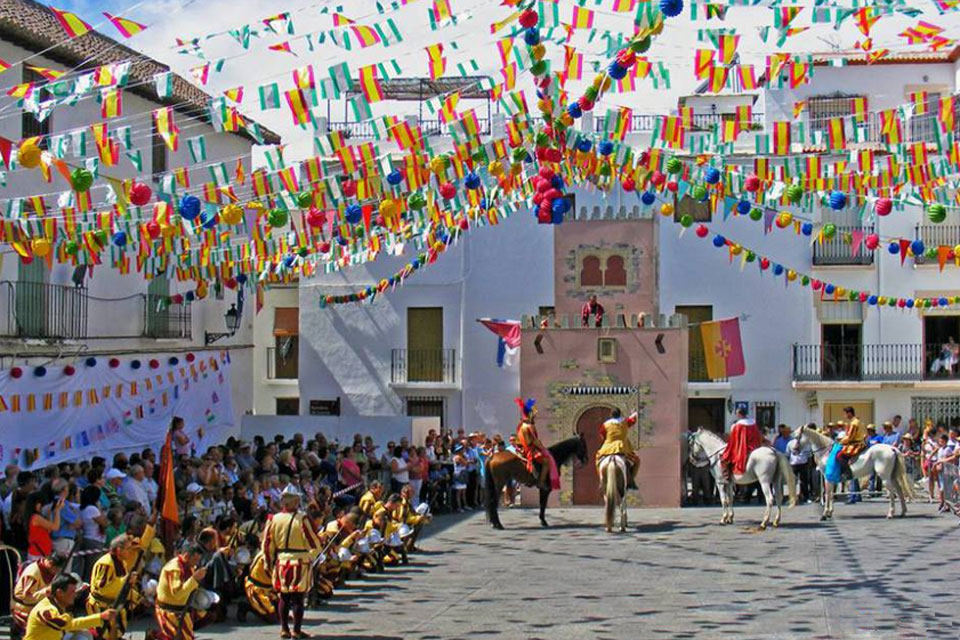
All this seems to offer spectators a fascinating glimpse of public authorities in 21st century Spain, who are unashamedly using their medieval history as a proxy for laying to rest the modern political and historical traumas: first of all the Civil War and its traumatic aftermath, but also the recent immigration of Muslims from Morocco, Tunis and Syria into the South of Spain as well as the increase in terror attacks all over Europe since 9/11 2001.
However, the type of festivals, to which the Toma arguably belongs, have a very long tradition behind, making it very complicated to define such festivals as to their component parts: the religious character (or lack thereof) as well as their dramatic content consisting of royal entries, religious celebrations and mock battles.
However, there is no doubt that the original core of the Toma was the highly ritualised and religiously enthused entry of the Catholic Monarchs into the city in January 1492. Indication of this are the stipulations in the testament by Ferdinand from 1516 according to which the parade should begin in the Royal Chapel, where the royal insignia – the crown, the sword and the banner – should be retrieved and paraded around the city before being returned. At the beginning and at the end masses should be said. [3]
Out of this grew a special genre, the spectacles in the Spanish countryside, which re-enacted historical events, which could be used for propagandistic purposes.
There is no doubt a direct link between these traditions and the popular Festivals of Moors and Christians, enacted in the villages in the Alpujarra Mountains since at least the 17th century and which continue to be celebrated in villages up till now.
However, often, such festivals might include elements of mock battles or jousting, which might set the scene for a reunification and thus a more nuanced understanding of controversies at stake. Sina Lucia Kottmann, an Ethnologists who have studied these festivals intensively, have
shown that by miming mock battles in the villages around Andalusia, Murcia and Valencia – the Fiestas de Moros y Christianos – the participants display a multitude of identities and alterities. This allows these festivals to create the scene for and possibility of what Kottmann has called a “lively politicisation of the public sphere”.
Back to La Toma 2017
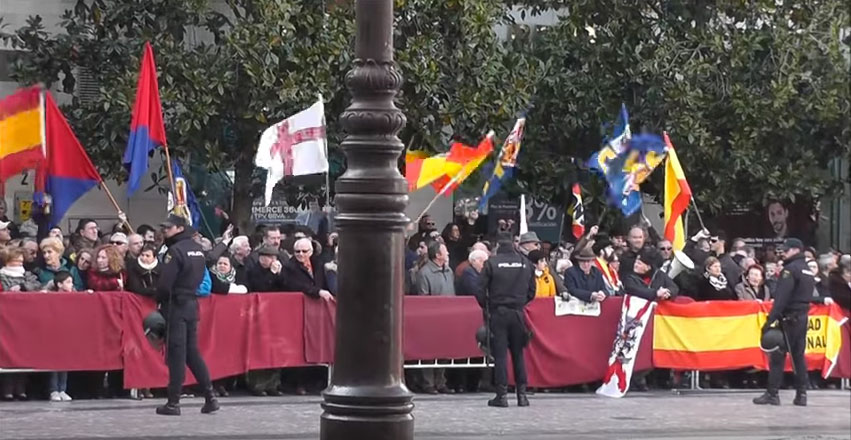
The standard story is that the city of Granada has celebrated the Toma with parades and festivities in nearly the same manner as was originally stipulated in the last will of the king from 1516.
However, studying the tradition as it has unfolded in the 20th century and up until now, reveal that the ritual has underwent some significant changes. For instance it is obvious from the fascinating films preserved of the celebratory Toma, celebrated in Granada in 1939, the festival had at that point been expropriated for propagandistic purposes by the victorious Franco (when the finale called for the people to acclaim “Viva España, Viva Franco, Viva Granada”.
Now-a-days, the acclamation calls for backing Spain, King, Andalucia and Granada. Also, comparing the film-glimpses from 1339 with those of 2017, it becomes obvious that the celebration has turned into a vivacious mock battle between opposing political parties –
- Falangists versus communists
- Traditionalists versus multi-culturalists
- Conservatives versus Podemos
- Autonomous Andalusians versus Castillian Nationalists
- Muslims versus Christians
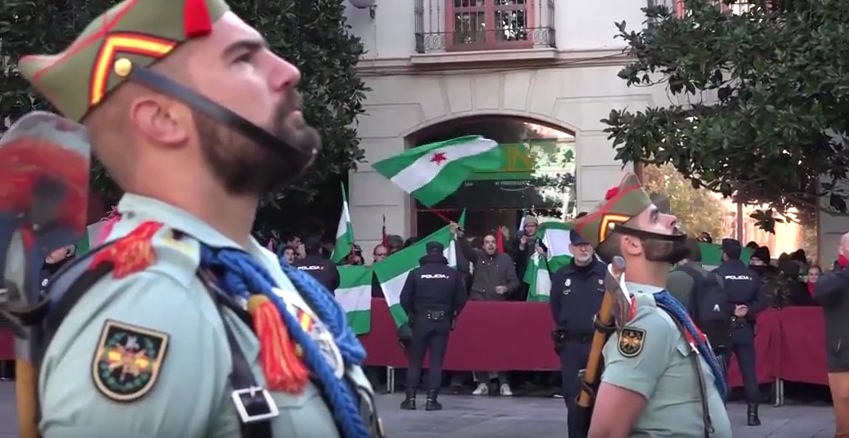
Lined up behind barricades they dutifully wave their different flags, while having a hilarious shouting contest. Thus, what we may experience local people getting together under the umbrella of a popular festival, staging the controversies between different groupings; and furthermore having fun while doing it.
Such an analysis of the controversies surrounding La Toma will probably seem irreverent by some. However, the video on YouTube does seem to reveal that the good people of Grenada obviously enjoyed themselves hugely the other day while waving their flags and banners: on one hand the Andalusian flag, but in its Cuban version with a red star in the middle; on the other hand the flag of Spain in more or less traditional garb. Nevertheless, later that day the falangistas were out in full force, waving the old banners of Franco down on the Plaza Isabel Catolica, while singing the old Franco hymn: Cara El Sol and claiming we are already waging WW3. In another corner of Granada the La Fundación Euroárabe paid homage to the autor Federico Garcá Lorca, who was killed during the Civil war.
NOTES:
[1] A García-Sanjuán 2016, p. 14
[2] This comes at a time, when UNESCO has voiced criticism towards the way in which the authorities in Granada favour the tourists to the Alhambra but not the so-called Muslim Quarter, the Albaicín, both of which are protected by the UNESCO label.
[3] Juan Ruiz Jiménez. Feast of the Taking of Granada: II. Procession, 02 Jan 2016
SOURCES:
Mocking and Miming the “Moor”: Staging of the “self and “the other” on Spain’s Borders with Morocco
BY Sina Lucia Kottmann
In: Journal of Mediterranean Studies (2011) vol. 20, No. 1: pp107 – 136.
Rejecting al-Andalus, exalting the Reconquista: historical memory in contemporary Spain.
By Alejandro Garcia-Sanjuán.
In: Journal of Medieval Iberian Studies. Published online 29.12.2016
The Crescent Remebered: Islam and Nationalism in the Iberian Peninsula.
By Patricia Hertel.
Eastbourne: Sussex Academic press, 2015.
Al-Andalus in Andalusia: Nogotiating Moorish History and Regional Identity in Southern Spain.
By Mikaela Rogozen-Soltar
In: Anthropological Quarterly (2007), Vol 80, No. 3, pp 863 – 886
Inhabiting Heritage: Living with the Past in the Albayzín of Granada.
By Chris Moreh
In: Open Library of Humanities(2016) Vol 2, No.1, pp. 1 – 34.
FEATURED PHOTO:
The Capitulation of Granada by F Pradilla 1882. Source: Wikipedia
SEE MORE: