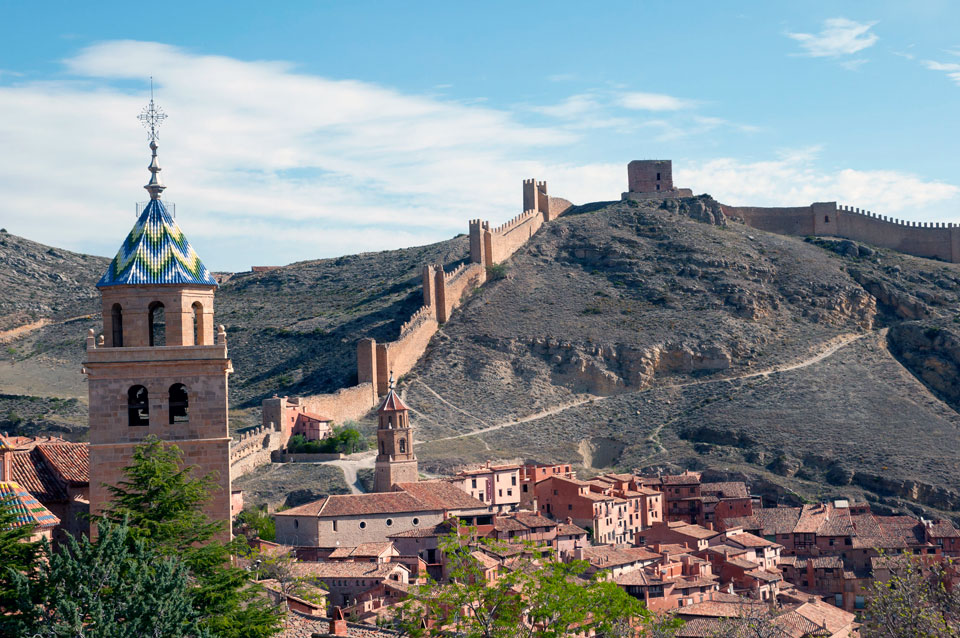
Declared a National Monument in 1961, the medieval town of Albarracín is probably one of the most beautiful and evocative places to experience old Spain.
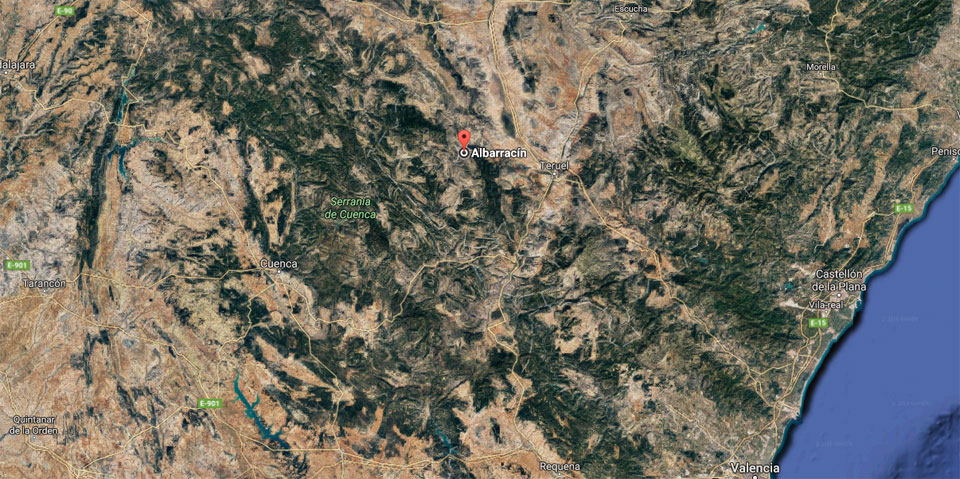
Climbing up a steep hill above the Rió Guadalaviar, which runs below in a gorge, the old medieval town of Albarracín will mesmerize anyone with a dream of entering a medieval time-capsule. Located 1170 m above the sea, the small town cascades down the steep slopes, while the houses and narrow alleys ooze life as it once was.
History
Already in Roman time the region was populated. This is primarily witnessed by the grand Roman Aqueduct, which runs from Albarracín to the Gea de Albarracín for more than eighteen km.
However, the town was first of all a Berber settlement in what was later known as the Upper March of Al-Andalus, covering the area between Huesca, Lérida, Teruel and Pozuel de Ariza. Later it was an independent signoria until it became part of the Kingdom of Aragon after 1300.
The Upper March of Al-Andalus – the al-Ṯaġr al-A’la – covered the region of the Ebro delta and to the south and west a hilly, stony and dry landscape, bordering the Mediterranean to the east, the Pyrenees to the north and the Sierra de Cebollera to the west. Not very well delineated it was foremost a frontier region; the concept of Ṯaġr in Arabic refers to any borderland between the Dar al-Islam and the Dar al-Harb, the “land of war”.
This determined that the region – even during the periods, when Al-Andalus experienced a firm centralized rule – was more or less autonomous ruled by hereditary clans. Although written sources from the early period (the 8th century) they point to a somewhat mixed group of immigrants consisting of both Arabs and Berbers. Later on, during the rule of the Almoravids (1086 – 1147), it has generally been thought that the Berbers came to play a greater role; however, the Almoravids never really got a firm grip on the Ṯaġr – it only lasted from 1100 – 1118 and it is highly probable the population was early on highly mixed. Already in 1112, the Aragonese took Huesca; after this, the region became infested with raids and the constant squabbles between the Local Muslim rulers and the Aragonese lords bent on extracting protection-money on a large scale. This was El Cid-country!

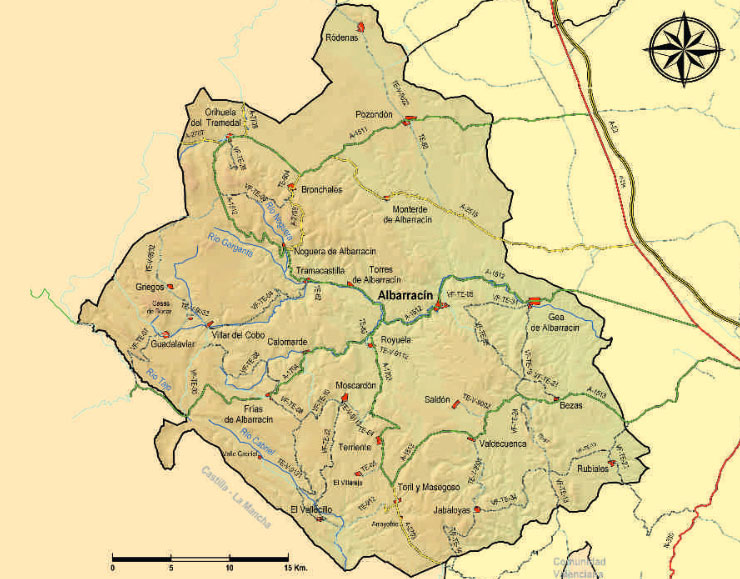
It is at the beginning of this period, Albaraccín – lying at the eastern entrance into the mountainous Sierra de Albarracín – became an independent independant kingdom (Taifa) governed by the family of Al-Banu Razin. From its position on the top of a hill, it governed the south western part of the present province of Teruel and the river basins of the rivers, Alfambra and Guadalaviar from Calamocha in the north to Teruel and Castielfabib in the South.
This lasted until 1170, when Pedro Ruiz de Azagra shifted sides. Between 1166 – 68 he had been in the service of Muhammad ibn Mardanis, ruler of the Taifas of Valencia and Murcia to defend Albarracín against the King of Aragon Alfonso II. However, Pedro Ruiz de Azagra, immediately began a process of Christianisation fostered by the immigration of people from Navarra to the region. He called himself “The Vassal of St. Mary”; obviously this was meant to mark his independence. During the reign of James I, the lords of Azagra took part in the conquests of Valencia and the Balearic Islands. This, apparently, kept them afloat as semi-independent lords. We hear that during this campaign, King James I was invited to hunt for wild boars around Alberracin and partake of dinner in narby Gea. Finally, however, in 1284, Albarracin was incorporated into the Kingdom of Aragon.
During the Middle Ages, the town was known as a centre for the production of wool, iron and weapons. It also functioned as a toll-station and as centre for the seignorial business of herding and transhumance.
According to taxregisters from around 1400, the composition of the town was highly mixed. Around 48% of the taxes recorded were thus paid by either Jews or the Mudejars, app. the same number of hearths belonging to these two communities have been listed (43%).
The Town
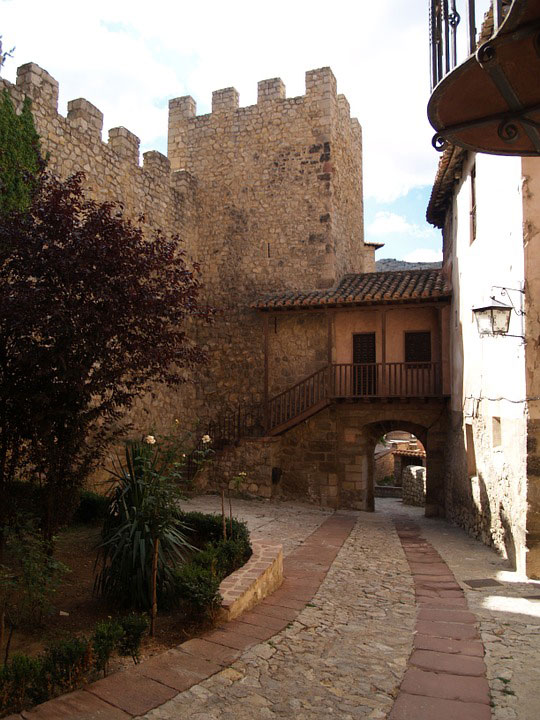
The town, which is located uphill, looks more or less as it did in the late Middle Ages; complete with castle, narrow streets and an impressive medieval wall it invites visitors to experience a sort of time-machine.
The river runs in a gorge, with steep cliffs on both sides. The township, however, has secured a path along the river, starting form the communal parking lot and offering a set of fine views from below. To see the city from the other side, one has to climb the walls up to the Torre del Andador, which dates back to the 11th century. Considered one of the best preserved towers from the Muslim period it became a National Monument in the 30s.
The Fortifications and the Castle
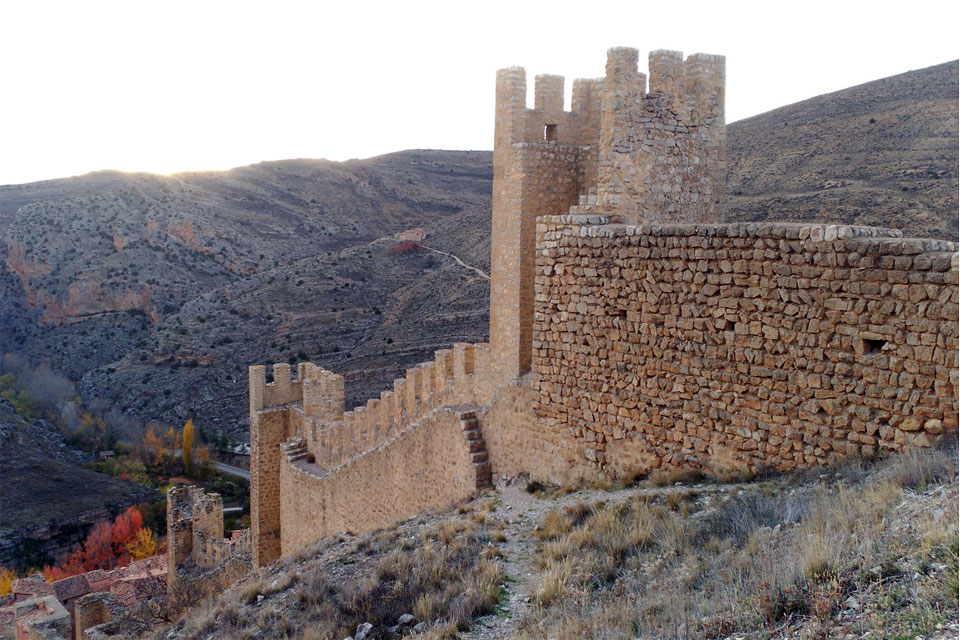
Most visitors to the small town are surprised by the fact that the perimeter of the walls encircles an area much larger than what is inhabited today. the explanation behind this is the shifting importance of the town according to its importance as gateway into the Sierra and the routes of transhumance.
Archaeological excavations since the 1990s have shown that Albarracin was probably already fortified in the 7th century. However, the main part of the fortification stems from the 10th century. Later rulers kept working on them, until the kings of Aragon had most of the present walls and towers rebuilt in the late Middle Ages. To understand the complicated history behind the Alcazar and the different fortifications, you need to go on a guided tour.
The castle itself is located on a high and impregnable cliff and offers views of palaces equipped with cisterns and a Muslim bath. The finds from the extensive archaeological excavations are exhibited in the local Museum found in the old hospital of Albarracin, down below. First used as a prison after the Spanish Civil War it now shows the impressive collections of ceramics, coins, musical instruments (flutes) and other stuff.
One of the towers – the White Tower – has been rebuilt and is now used as a locale for contemporary art exhibitions. However, the view from the top is astonishing. This tower is said to be where Doña Blanca, a sister-in-law to the Queen of Aragón, died. According to legend she was banished by the Queen, but taken in by the lords of Azagra. At some point, however, she disappeared, apparently to die in the confinement of La Torre de Doña Blanca. Nearby was the old Jewish quarter, separated from the town at the end of the 14th century. At this time, Jews were welcome and in fact invited to settle. Nearby is the old hermitage – the Ermita de San Juan de Albarracin. This was was probably built on top of the old Synagogue.
Noble Houses and the Cathedral
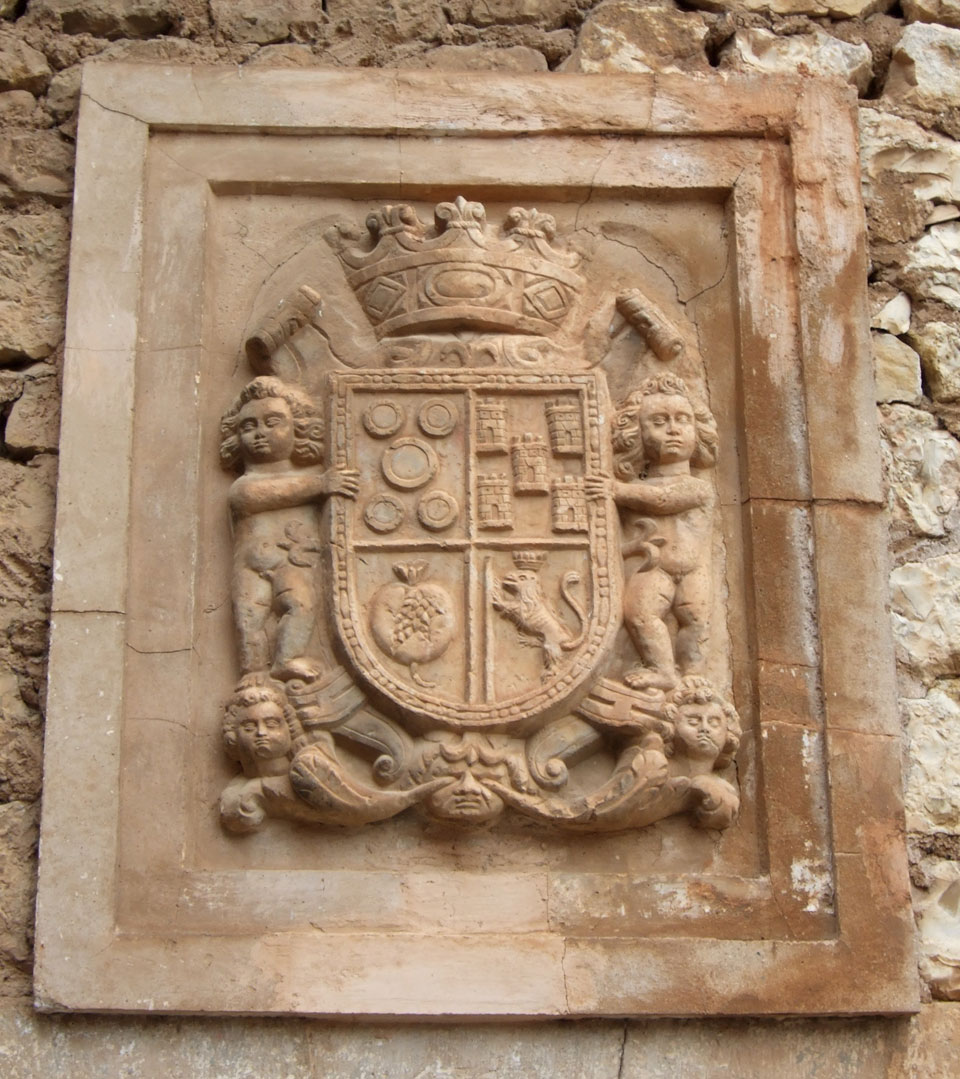
However, as impressive as the walls and the fortifications are, the main sight is the town itself. With its many small alleys and lanes we are constantly squeezed in between noble mansions from the 15th to 17th centuries, featuring heraldic coats of arms on their ports as well as balconies and windows protected by forged bars. Worthy of notice are also the heavily forged locks and knockers; and the feeling of being hemmed in by the towering, forbidding buildings. One of these houses is the Dolz de Espejo from the 15th century. Built by local stone it differs from the Casa de la Julianeta. Recently restored, it features the fin red plaster on the outside, while the interior has been turned into two studios and workshops. Run by the local cultural foundation it helps to turn Albarracin into a centre of art and restoration.
The Cathedral – Catedral de El Salvador – was built at the end of the 12th century, when the Azagras took over and began the process of Christianisation. Originally a mixture of Romanesque and Mudejar style,the present building dates mainly from the 16th century. The main altar was sculpted in 1566 by Cosme Damián Bas and shows the Transfiguration of Jesus on the Mount Tabor. This is one of the more important pieces of Aragonese Renaissance Art.
For medievalists, alas, the main attraction now hangs in the National Gallery in Edinburgh: the retable of the Archangel by the 15th century artist, Gonçal Peris Sarririà. In order to get a sense of what it might once have looked like, a trip to nearby Rodenas is necessary; here hangs another of those marvellous retables, attributed to Peris and his school.
Another church, La Iglesia de Santa María de la Vega, has been turned into a concert hall and auditorium.
Sheep, Cattle and Food
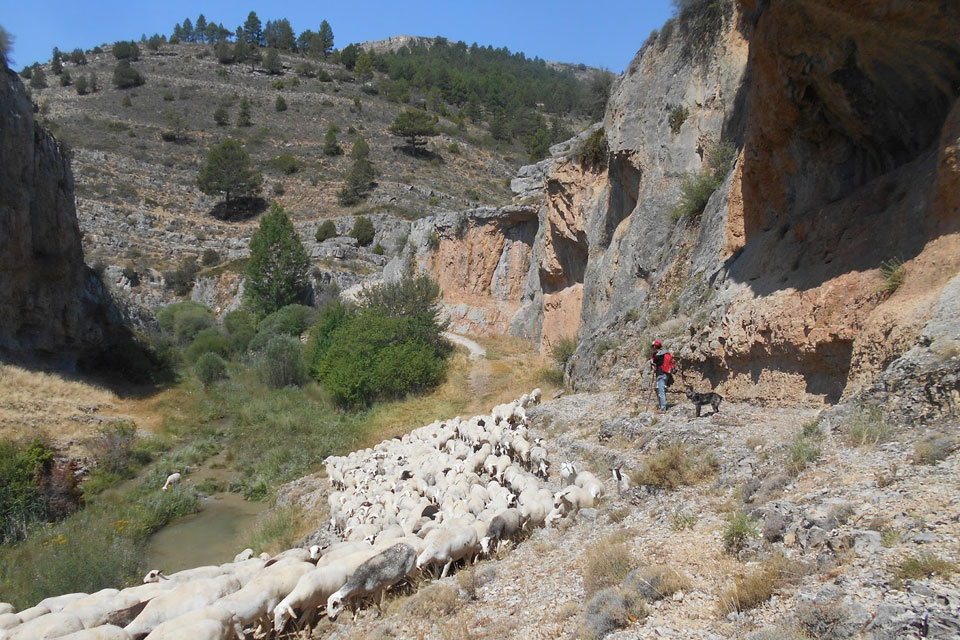
Excavations of medieval dumps in the castle have shown that 70% of the animal bones derived from sheep and goats during the early Muslim periods. Later, during the last and more violent period in the 11th century, rabbits became an important staple. When Christians took over in the 12th century, contributions from cattle, swine and red dear increased. But shifts also took place in the Muslim periods. At the beginning, milk and meat were the obvious priority. Later, the animals were allowed to live as long as they were able to provide wool for production and export. However, this necessitated the practice of transhumance, since wintering is not possible in the cold and harsh climate in the Sierra.
Thus, until recently, most of the income in the Sierra derived from the transhumance of large flocks of sheep and goats, which would move across the hilly and depopulated Sierras spending summers down south near Valencia to return to the Sierra de Albarracín in winter. At the same time, large flocks of cattle would be moved up to summer pastures in the Sierra, a resource which was seemingly jealously guarded by large landowners, communities and councils. Typically living in small hamlets consisting of houses, barns, orchards, meadows and a bit of farmed land, wool would be the main seignorial rent.
From early on cultivating the marshes and flatlands along the rivers yielded very little except fruit and nuts; animals were obviously the main source of income.
Unfortunately, the agrarian policy of the EU has contributed to a 60% reduction of livestock farmers and 55% reduction of cattle heads since 1992. Nevertheless, the tradition of transhumance seems not to be in its last throes. Main impetus to keep it all going is currently tourism and ecological concerns plus generous funding from the EU.Thus, while the numbers of farmers has contracted, the number of sheep has actually increased. In the 1980s no more than 25.000 sheep moved through the Ebro Valley; at present the number exceeds 135.000.
One characteristic element is nevertheless the skewed population: for every two women in the Sierra between the age of 20 – 49, only one man is around. The rest have left to find work in the large cities. Each year since 1991 the Sierra has experienced on average a marked deficit between deaths and new borns: since 1991 – 2004, 60% more deaths than births. The only place in the Comarca, where the numbers of men and women balance, is in the town itself. In 1900 the Sierra had a population of nearly 16.000. In 2006, this had fallen to 5000. This exodus began in the 60s.
This is cold and mountainous country and in the traditional cuisine, vegetables are far and few between. The showstopper is the traditional roasted baby goat or lamb (served around Easter). If this makes you cringe, a heartwarming stew or Jerigota made of oxtails and served with white beans and wild mushrooms will bring you the taste of a more ordinary medieval feast. If possible, you should of course opt for the Jabalí in Salsa: Wild Boar marinated in red wine spiced with thyme, laurel, pepper and clove for a couple of days. Before cooking, it should be dried with a cloth and sizzled in olive oil. The sizzle it slowly in the marinade to which is added chopped onions, carrots or other roots as well as garlic. A slice of bacon in the pot will reduce the sour taste provided by the red wine. If you wish for the real medieval experience of eating like James I, forget about the chopped tomatoes!
Another option is of course to go for the local Jamon, designated as the first D.O. jamón in Spain in 1983 (Jamón de Teruel). If you wish to know how the Jamon is produced, a visit out of town to the village of Broncales is recommended. Here it is possible to learn how to prepare your own Jamon. The local variety of cheese can be had in any shop around town, but a walk three km. along the road to Gea de Albarracin will take you to the producer, where a full range of cheeses can be tasted and bought to bring with you when hiking the old paths of transhumance crisscrossing through the Sierra.
SOURCES
Berber Settlements in the Upper March of Al-Andalus (8th -12th century). A Postdoctoral research project.
By Bilal Sarr.
In: Debates de Arqueología Medieval (2015) Vol 5, pp. 207 – 226
Comarca de la Sierra de Albarracín. Ed. by Javier Martínez González.
In: Colección Territorio, Vol 28.
Gobierno de Aragon 2008
READ MORE:
The Local Historical Association – Centro de Estudios de la Comunidad de Albarracín – publishes a local historical journal, called Rehalda. With articles spanning the whole Sierra and not just the history of Albarracín, it is worth delving into. Early issues are made generously available on the dedicated website.
TOURISM:
Fundación Santa Maria d Albarracín administrates most of the cultural heritage in Albarracín as well as access to the more prominent houses and sights. Their office is located next to the Cathedral and should be a first stop. Remember to check out concerts and temporary exhibitions. Locals are
A fine introduction in Spanish – with gateway to hotels – can be found at the official website of Albarracin. Which also provides a first overview of the routes into the Sierra.
Albarracín is a member of the Spanish network, Peublos Màs Bonitos de España; from 2016 it is member of the international netowrk: Les plus Beaux Villages de la Terre