The Story of the Lovers of Teruel was first published in Spanish some time in the 16th century. Now harnessed for the purpose of tourism, the myth is said to have a medieval tragedy at its core.
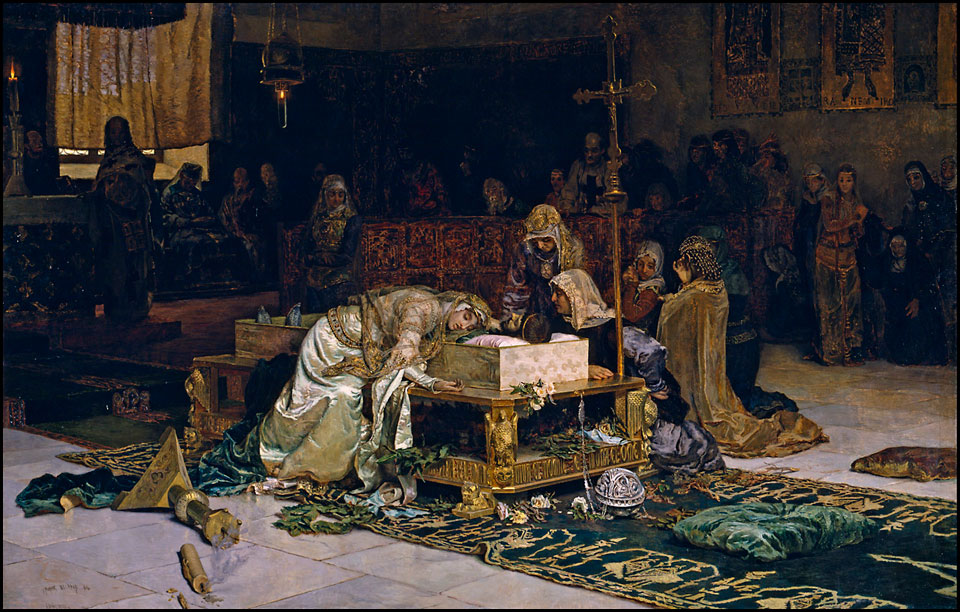
In 1838 Pascual de Gayangos reported that he had seen a book printed some time in the mid-16th century, which told the story of the Lovers of Teruel. This fits well with the fact that in 1566 Antonio Serón published the Silva tertia ad Cynthiam, which told the story of the two lovers; but as the story was told in Latin it is highly unlikely this publication had a role in the propagation of the legend. After 1581, the legend began to take hold of the imagination as a play by Andrés Rey de Artieda was increasingly performed. Here we find unfolded for the first time the main elements in the drama.
According to this, the hero Marcilla returns to Teruel after seven long years, only to discover that Isabel has married the self-same day. When he manages to see her later that evenening, he demands a fare-well-kiss, which she denies him. At this point he dies of grief. To avoid suspicion, Isabel and her husband leaves the body at the doorstep of her father. Later, at the funeral, a grief-stricken Isabel turns up in church to kiss him goodbye; at which point she dies.
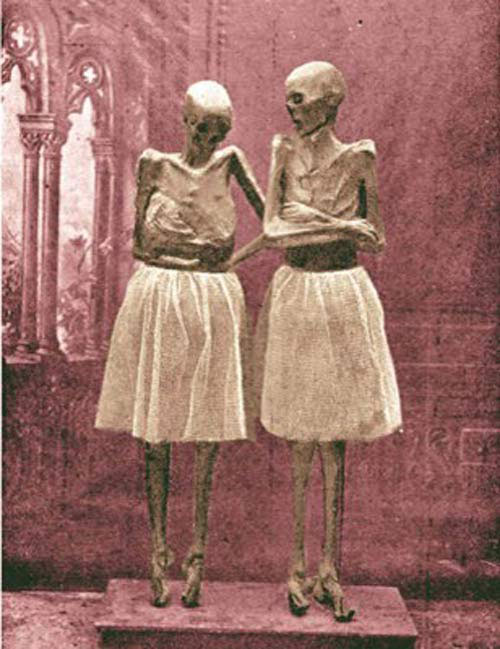
While the play of Artieda provided a starting point for popularity of the story, it was nevertheless not until 1619 the story really hit the headlines. At this time, two mummies, which had been exhumed in 1578 in the church of San Pedro in Teruel, beneath the side-chapel of San Cosme y San Damian, were said to be “proven” as belonging to the ill-fated lovers. The Notary, Yagüe de Salas, who had also written about the lovers a few years before, simply claimed that he found documents witnessing to the fact that the two mummies were indeed the fated lovers. Fifteen years later a new version of the play by Pérez de Montalbán hit the stage. This play – Los Amantes de Teruel – was published in 28 editions from 1635 -1800. After 1837, this text was once more substituted by an updated version by Juan Eugenio Hartzenbusch, the director of the National Library of Spain.
Veracity
Until recently it was believed that the inspiration for the story of the Lovers of Teruel could be found in Boccaio’s Decameron and the story of Girolamo and Salvestra (day 4, story 8). As Boccacio’s story can be found in a Catalan translationin a manuscript from 1429, it seems plausible. Further evidence seems provided by the early Spanish edition of Decameron published already in 1496 and printed five times until 1550.
The challenge, however, is that if there is any kernel of veracity behind the legend, it seems to be Spanish or rather Catalan. According to this story, a certain Marcilla was appointed governor of Terual after the conquest of the region by Alfonso II in 1217. During the same period – 1212 to 1213 – a man called Pedro Segura was judge. His name corresponds to that of the unrelenting father, who bans the immediate marriage between the two lovers and sends Marcilla out on travels lasting seven years in order for him to make his way in the world.
As of now the jury is out: either Boccacio heard the story told by Aragonese merchants and craftsmen, and caused it to be re-circulated to Eastern Spain; or the story was Italian in its kernel and later adapted to its Aragonese setting. Whichever way the inspiration was sailed back and forth over the Western Mediterranean, it ended up securely in Aragon. During this process of gestation it is further likely that elements from the French courtly tradition were adopted and elaborated upon, creating one of these vibrant stories, which would continue to ignite the fantasies of people immersed in popular theatre and story-telling.
As to the mummies, recent DNA-studies have proven that they are from the 14th and not the 13th century; also they belong to two males.
Europe in Love

Until this day, the story has continued to hold sway over the imagination of Europeans. Thus, in 1962 a French film was screened with a refrain song by Edith Piaf; other popular expressions can been found in a plethora of paintings, murals, sculptures etc.
A new era was nevertheless inaugirated in 1998, when a foundation was set up to market the love story as part of a wider tourism strategy. No longer, was the Lovers of Teruel to be considered to be part of an old popular cultural heritage; rather, this was a significant piece of tradition, which could be harnessed in the search for survival of a regional town, which could not even boast of a direct railroad line to Madrid.
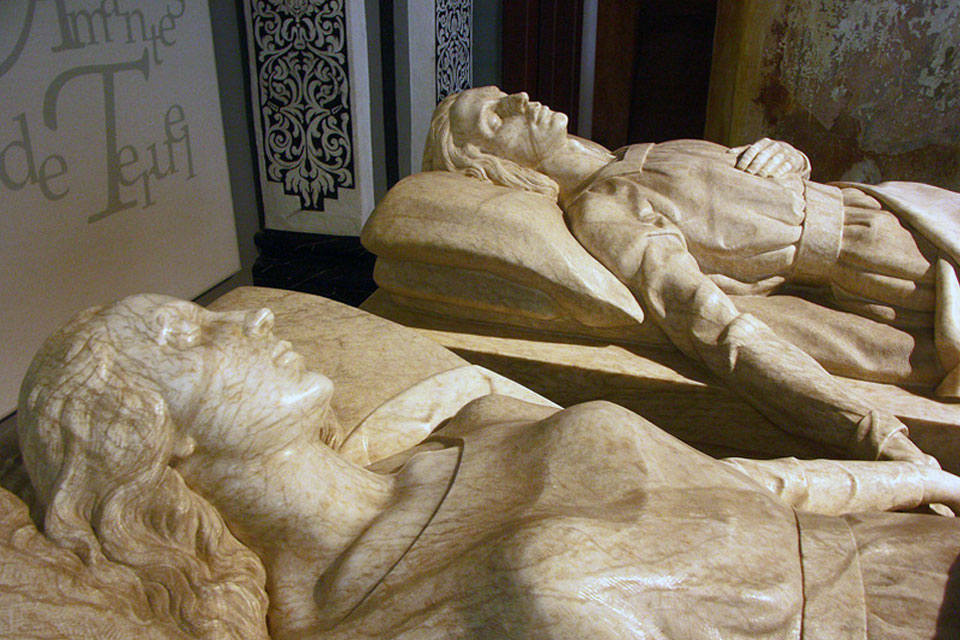
In 2005 these initiatives culminated in the opening of a new and renovated Mausoleum attached to a side entrance of the Mudejar church . At the centre ofthe new mausoleum are the tombs – Túmulo de los Amantes de Teruel – commissioned by the town of the sculptor, Juan de Ávalos in 1956. These were placed on top of the – once again – excavated mummies. According to the sculptor one of the features is the hands between the two lovers, which grace each other without touching. The reason is that their love should remain “pure”, the sculptor later claimed.
This apparently set the tone for the town of Teruel, which has recently worked actively to create a tourism strategy based around the concept of “Europe in Love”; part of this strategy is also as fostering a network of other “romantic cities” – Verona (Italy), Coimbra (Portugal), Krosno (Poland), Sigulda (Latvia), Longford (Ireland), Heraclion (Greece) Harghita (Romania); with Monteccino Maggiore and Sulmona as other possible members. The long-term aim is to establish a Cultural Route of “Europe in Love”. Recently, in 2015, a group of European members of parliament were touring the local region in order to inform itself about the possibilities of supporting this project.
Hope is obviously that the legend about the two lovers still holds sway over the imagination of romantics and that this will lead to a renewed appetite among modern consumers for the old stories, which are perhaps no longer as sellable in the form of renaissance dramas, but rather as a stop on the trail of the cultural heritage tourist.
Perhaps an opera might also fill the hotel! A recent initiative have been to have the local composer, Javier Navarrete, to compose an opera, Los Amantes, with a libretto based on medieval texts and inspired by medieval music. Javier Navarrete is known for a number of film scores, which have won international prices.
The opera will be staged from the 08.02.2017 – 14.02.2017 in the church of San Pedro de Teruel in connection with the annual medieval festival, Las Bodas de Isabel, which will take place from the 16th to the 19th century. Las Bodas de Isabel has been declared a “Fiesta de Interés Turistico Nacional”.
Teruel – A Contested Past?
Behind this initiative lurks nevertheless another past, which Teruel obviously does not wish to remember; the fact being that one of the most vicious and bloody battles during the Spanish Civil War was fought in and around Teruel from December 1937 to February 1938, during the worst Spanish winter in twenty years. Nobody really knows how many died, but estimates range between 56.000 for the Nationalists and 85.000 for the Republicans. What happened to the local population inside the city is anyone’s guess. While international projects to build the main museum commemorating the Civil War has been afoot in Teruel for some time, the city seems to have chosen another option: to “recreate” Teruel as a city of love. For instance a recent intervention in the planning of the city succeeded in turning a void in the center, which had been caused by bombing, into a new square, which has been named the “Plaza Amantes,” created by the architect, José Ignacio Linazasoro.
Nevertheless, a group behind creating a local museum commemorating the battle recently found support in the local council, and things seems to be moving once again.
SOURCES:
The Lovers of Teruel: A “Romantic” Story.
By D. W. Cruikshank.
In: The Modern Language Review (1993) Vol 88., No. 4, pp. 881 – 893
FEATURED PHOTO:
The tomb by Juan de Avalos exhibited in the mausoleum in Teruel. Juan de Avalos is primarily known for his sculptures in the Fascist monument, created by Franco in the Valley of the Fallen. It is obvious that the Tomb in Teruel will send complicated and mixed signals to the local population. Teruel suffered terrible Spanish Civil War during the two months, the Battle of Teruel was fought. The combatants fought the battle between December 1937 and February 1938, during the worst Spanish winter in twenty years. The battle was one of the bloodier actions of the war with the city changing hands several times and Teruel was subjected to heavy artillery and aerial bombardment.