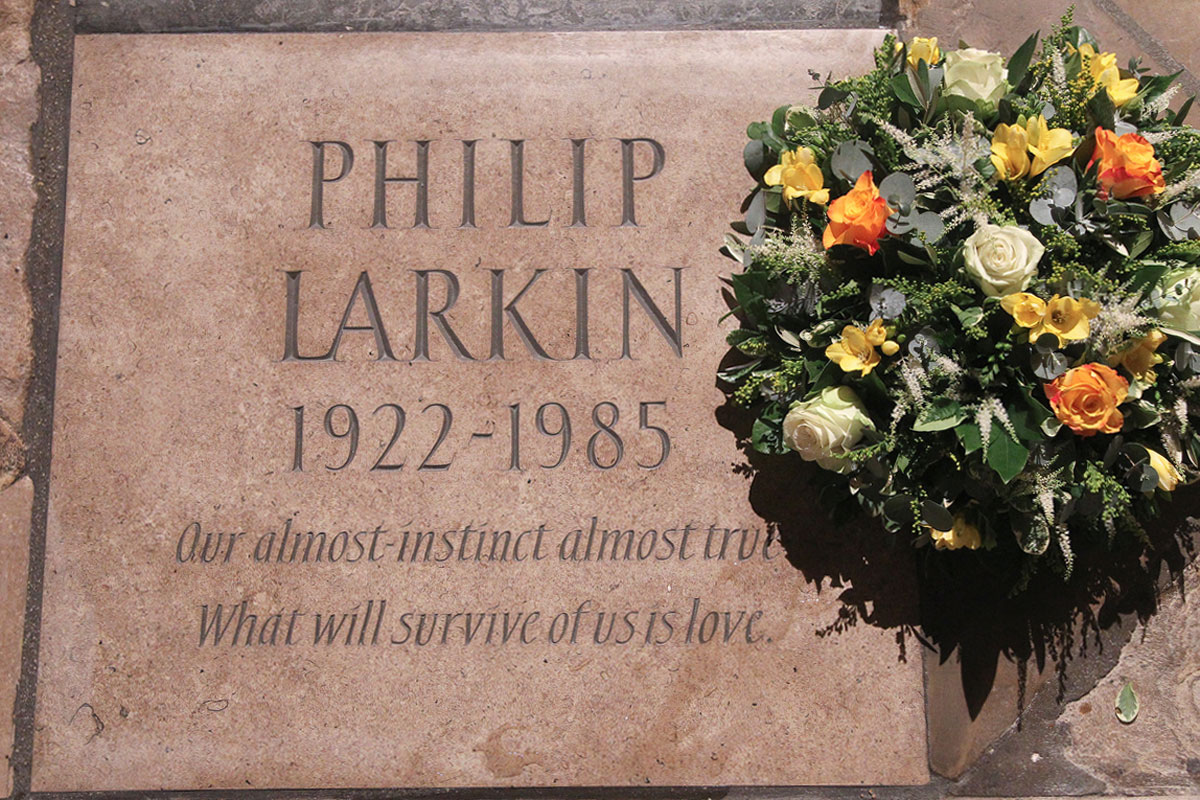
Philip Larkin’s memorial was recently revealed in the Poets’ Corner in Westminster Abbey. Inscribed with the verse-line: “What will survive of us is love”, we are invited to ponder the Arundel Tomb, which inspired the poet to this concoction.
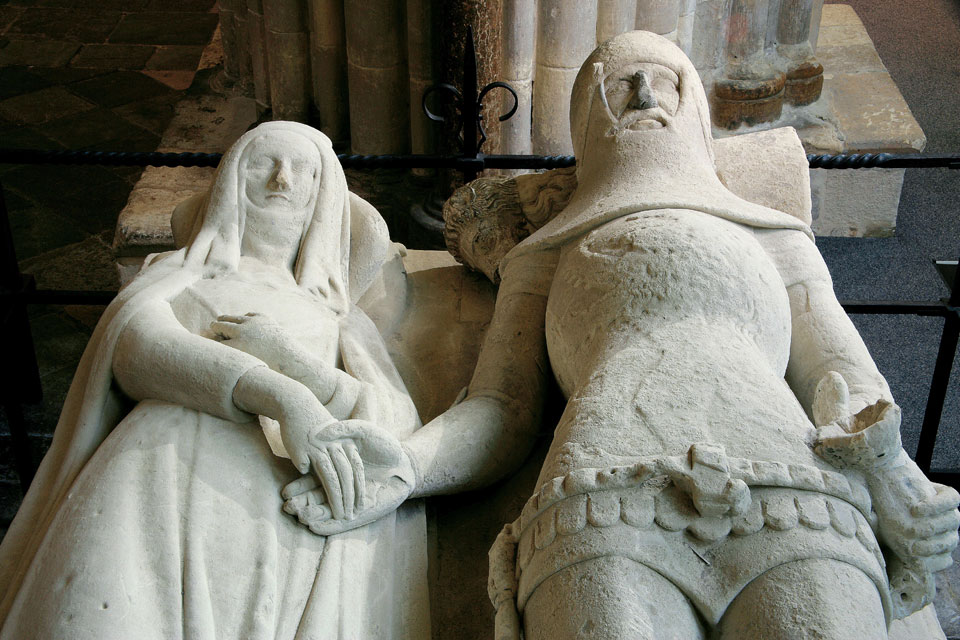
In 1956, an English poet, Philip Larkin (1922 – 1985) happened to visit Chichester Cathedral. Here he was forcefully struck by the evocative Arundel Tomb, which used to harbour the remains of Richard Fitzlaen, Earl of Arundel (c. 1303 – 1376) and his second wife, Eleanor of Lancaster (c. 1318 – 1372). What Philip Larkin experienced as so remarkable was the tender gesture whereby the tomb lets the earl grip the hand of his wife. This led to a poem, which forcefully ends with the oft quoted line: What will survive of us is love.
19th century myth
What Philip Larkin apparently did not know was the intimate gesture of the Earl was probably no more than a fanciful recreation from the 19th century by the sculptor and archaeologist, Edward Richardson, who made a career out of not so much restoring as recreating medieval tombs.
Edward Richardson (1812 – 1869) began his career in 1842, when he was commissioned to restore the effigies of the Knights Templar in the Templar Church in London. Although the figures had suffered considerable damage, the restoration met with much criticism: the intervention was considered insensitive and in general he did not get the public acclaim he wished for.
Nevertheless, he soon established himself as an expert restorer of medieval mausoleums as well as a supplier of funerary monuments commemorating officers and civil servants dead in the service of the Empire as well as tombs for some of the high and mighty: many of these were in the neo-gothic style while others feature a more bland Victorian taste.
One of the early jobs, which he was commissioned to carry out, was a restoration of the Arundel Tomb in Chichester Cathedral. Originally brought from Lewes Priory after the dissolution, the tomb had suffered greatly in the following centuries. Exactly what it looked like, we don’t know much about. However, in his will, the Earl of Arundel wrote that he did not wish to reside in a tomb higher than that of his wife, who had died four years earlier. The interesting bit of the text says that he wished to be buried “near to the tomb of Eleanor de Lancaster, my wife; and I desire that my tomb be no higher than hers, that no men at arms, horses, hearse, or other pomp, be used at my funeral, but only five torches…as was about the corpse of my wife, be allowed.”[1] From which we learn that she already had a tomb erected over her grave, when he died. This probably accounts for the uneven character of the tomb, which may have been a later mixture of two separate tombs.
As it stands today, it does indeed seem as if the two reclining figures don’t match very well. Richard, who is dressed as a knight, rests next to a slighter effigy of Eleanor, who is wearing a wimple and the dress of a noblewoman. Her feet are resting on a dog, while a somewhat larger lion lies at his feet. Although it is complicated to discern the details, the two effigies seem to differ both in size and in expression.
One intervention we know of is that when Richardson took on the job, the figures lacked two of their arms. This inspired him to create the curious “loving scene”, which lets the Earls un-gloved right arm grasp that of his wife’s. It is this seemingly loving gesture which later struck Philip Larkin so evocatively.
Effigies Holding Hands

Of course there can be found some precedents to the holding of hands, the most famous of which is the tomb, commissioned by Richard II in 1395 at the death of his beloved spouse, Queen Anne of Bohemia. However, this is a later example than the Arundel Tomb. It is also nearly unique, because we know that marital love was indeed behind the success of this union. Another example was the no longer extinct tomb by Yevele commissioned by John of Gaunt and his wife Blanche in St. Paul’s Cathedral, which is said to have presented this feature.
Nevertheless it was probably the somewhat earlier memorial of Thomas de Beauchamp, 11th earl of Warwick, which inspired Richardson to fix the Arundel tomb. On his tomb from 1369 lies Thomas, holding the hand of his wife Katherine Mortimer. But this tomb is distinct as it in this case was obviously commissioned as a whole, not yet a very common practice. The explanation is probably that the Earl and his wife died of plague inside three months. Since then, the couple has resided in perfect harmony in their beautiful alabaster tomb.
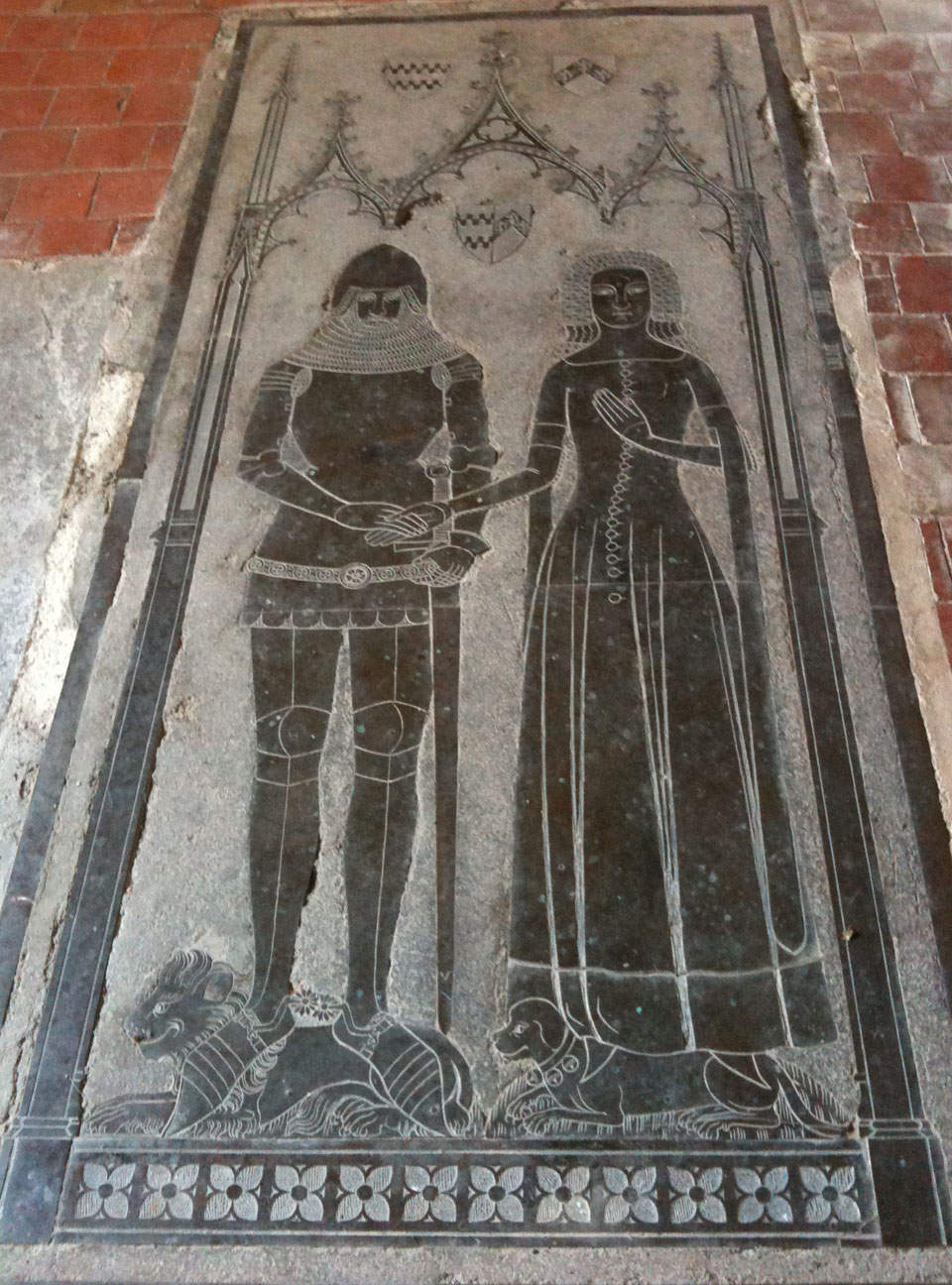
Another example of this posture can be found on a memorial slab for an unidentified couple in the church of St. Peter in Winterbourne Bassett (Wiltshire), but this time it is not that of a knight and his lady, but a couple, where he is dressed in civilian clothes. This compares well with other brasses from the turn of the 14th century. One such can be found in the church in Great Berkhamstead, Hertfordshire c. 1380 – 90. This brass commemorates Richard Torryngton, a prosperous London wool-merchant, who exported wool with his partner, John Norborw. He died in 1356, while his wife Margaret Incent died in 1349, presumably a victim of the Black Death. Another such example may be found at Owston, where Robert Hatfield c. 1409 commissioned a joint brass on the death of his wife, showing the two holding hands while declaring that they “had been right fully” in love. This may still be seen in the Church of All Saints in Owston. Robert Hatfield was a Lancastrian official and controller of Henry of Derby’s household. Also he was shown as a civilian witnessing to the fact that his gentility was conferred to him as part of his service.
It is perhaps not without significance that the posture was seemingly adopted by representatives of the gentry, which may have been more inspired by the late medieval bourgeois lifestyle than the high and mighty.
Finally, a couple of other brasses should be mentioned, such as the now lost brass from Ingham, which shows Sir Miles Stapleton and his wife Joan de Ingham holding hands. In this instance we have a knight in front of us. However, again there might be another explanation than love. It is likely that Sir Miles was himself responsible for the commissioning of the brass around her death in the beginning of the 1360s. She was a considerable heiress and Miles Stapleton is known to have adopted her name, “de Ingham”, losing his economically less significant “de Bedale”. It is possibly significant that the brass held an inscription informing us about her being the daughter of Lord Ingham. Sir Miles died in 1364, probably from wounds received in the battle of Auray (1364) at which point their son and daughter – not yet of age – inherited a considerable fortune from both parents.
Finally a brass can be found in the church at Chrishall in Essex depicting the couple of John and Joan de la Pole. Here we have a brass, which depicts a knight whose hand is grasped by her. He died in 1380, while she died eight years later. It is believed she commissioned the brass. This brass is said to be one of the first examples of “the hand-holding” series. In this case, the gesture may have signified her importance; the wealth of the couple stemmed primarily from her and her daughter later adopted the surname of her maternal grandfather, de Cobham. [2]
Listing these instances, we might get the impression that this hand-holding pose “enjoyed a relatively brief lifespan”; and it was – even in its heyday – never employed on more than a minority of monuments, Saul writes. [3]
Position of hands
One of the more intriguing questions raised by these funeral tombs, slabs and brasses are the position of the hands. According to Peter Coss , they differed widely. On some, the husband is seen grasping the lady’s hand firmly as if to signal male dominance. In other instances the hands are just pressed against each other. Finally – as in the case of the de la Pole monument in Crishall in Essex – Joan de Cobham is seen grasping the hand of her husband, John de la Pole. [4] Perhaps, the exact gestures signified more than just an important bond of love.
However, chances are – concludes Nigel Saul – that the position of hands did not so much show how to “understand” the relationship between the couples, but rather the conventional expression delivered by the different workshops; which means that even if the couple on the Arundel Tomb was in fact originally positioned with clasped hands, it might not have meant anything more than that this was a brand-new style.
On the other hand, were it original, the signalling of a specific and unbreakable bond between the two might have been the reason behind the eventual hand-clasping at the tomb in Chichester. It is perhaps noteworthy that the extremely wealthy Richard had in fact been married before [5] . The story goes that Richard, was married at the age of seven (soem sources say 15) to Isabel Despenser, when she was eight. Later, he claimed that they had been forced “by blows” to cohabit …so that a son was born”. Richard later had this marriage annulled and his son declared a bastard. This paved the way for his marriage to Eleanor and for their descendants to inherit what was probably the largest fortune in England at that time. It is remarkable that his first son, Edmund, was not even mentioned in the will. After the death of his father, he contested the will bu to no avail.
There is no doubt that clasped hands as witnessed by the tombs of Richard II and Robert Hatfield, signified love in some instances. However, we also seem to find them on funeral memorials of couples, whose marriages might be contested by heirs bent on trying to get a finger in the pie.
Whatever the explanation for this short-lived and not very common fad, there is no doubt that Philip Larkin got it all wrong. First of all, if the Arundel tomb did indeed show the Earl clasping the hand of his wife, it would possibly have been nothing more than a very early example of a fashion, and thus an “empty” gesture, which was just about to unfold. Further, chances are, that if the couple in the original version by design did indeed clasp their hands, it probably would have had more to do with making a statement about inheritance than love. But please remember, we don’t even know if they really clasped their hands…
Which makes it slightly amusing, when that verse line – What will survive of us is love – was quoted on the poet’s memorial slab in Westminster in December 2016. He may have been a great English poet; but a good historian he was not!
SOURCE:


English Church Monuments in the Middle Ages: History and Representation
By Nigel Saul
Oxford University Press 2011
‘Beautiful remains of antiquity’: the medieval monuments in the former Trinitarian priory church at Ingham, Norfolk Part 1: the lost brasses
By Sally Badham.
In: Church Monuments (2008) XXI, pp. 7-33.
The Lady in Medieval England 1000 – 1500.
By Peter Coss.
Stackpole Books, 2000
NOTES
[1] Excerpt fron the testament of Richard Earl of Arundel. In: Testamenta Vestusta.: being Illustrations from Wills, of Manners, Costums, etc. As well as of the Descents and Possessions of Many Distinguished Families. From the Reign of Henry the Second to the Accession of Queen Elizabeth. By Nicholas Harris Nicolas, London 1826, Vol, 1. p. 94 ff. https://archive.org/details/testamentavetust01nico
[2] Saul 304 -06
[3] Saul p. 303 ff.
[4] The Lady in Medieval England 1000 – 1500. By Peter Coss. Stackpole Books, 2000, p. 93 – 105
[5] Wealth and Credit, Public and Private: The Earls of Arundel 1306 – 97. By C. Given-Wilson. In: The English Historical Review (1991) Vol. 106, No. 418, pp. 1 – 26