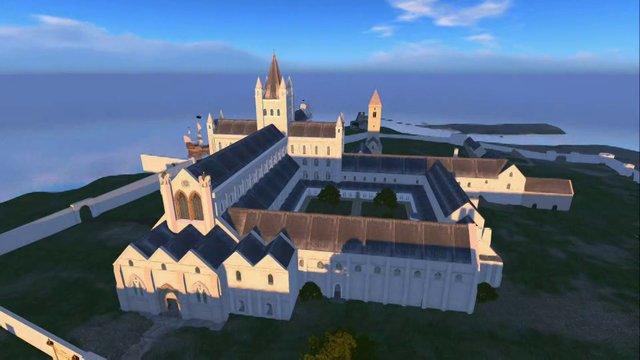
REVIEW: Archaeologists, historians and computer scientists at St. Andrews University are busy exploring new technology to create open worlds for time-travellers
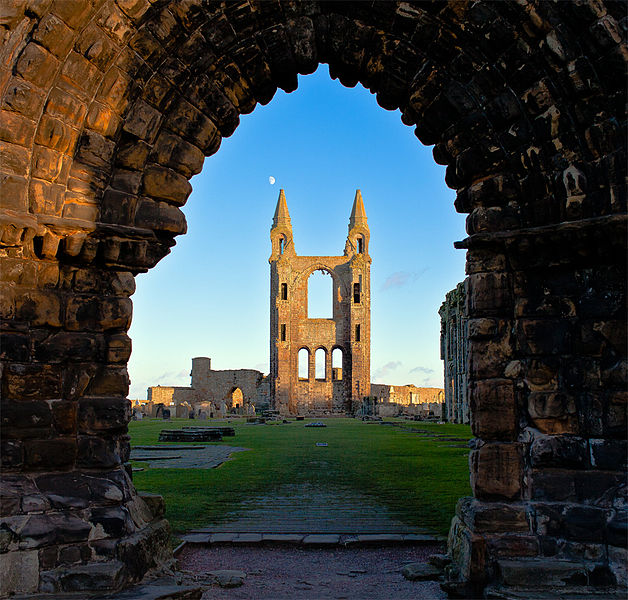
Wikipedia © Magbaara
St. Andrews Cathedral is located on the East Coast of Scotland. Construction was begun in 1160, but the church was first fully consecrated in 1318 four years after the battle of Bannockburn and in the presence of Robert I. When finished it spanned Romanesque and Gothic Architectural styles. For several hundred years, the Cathedral was one of the most important religious buildings in Europe and the centre of religious life in Scotland. During the reformation, however, it was divested of all its finery by the Scottish reformer, John Knox, who personally took part in the desacralisation; after which it fell into a slow decline ending up as the ruins, which are all that’s left today.
Recently an interdisciplinary group of historians, archaeologists and digital wizards have partnered up to use the Open Virtual Worlds (OVW) to support new modes of engagement with cultural heritage. The first project was to produce a pre-modern model of the small Scottish hamlet, Caen. Second project was to produce a virtual world of the Cathedral of St. Andrews. The programme used is Open Simulator (OpenSim), a freely available OVW environment, which can be used to develop and deliver historical reconstructions.
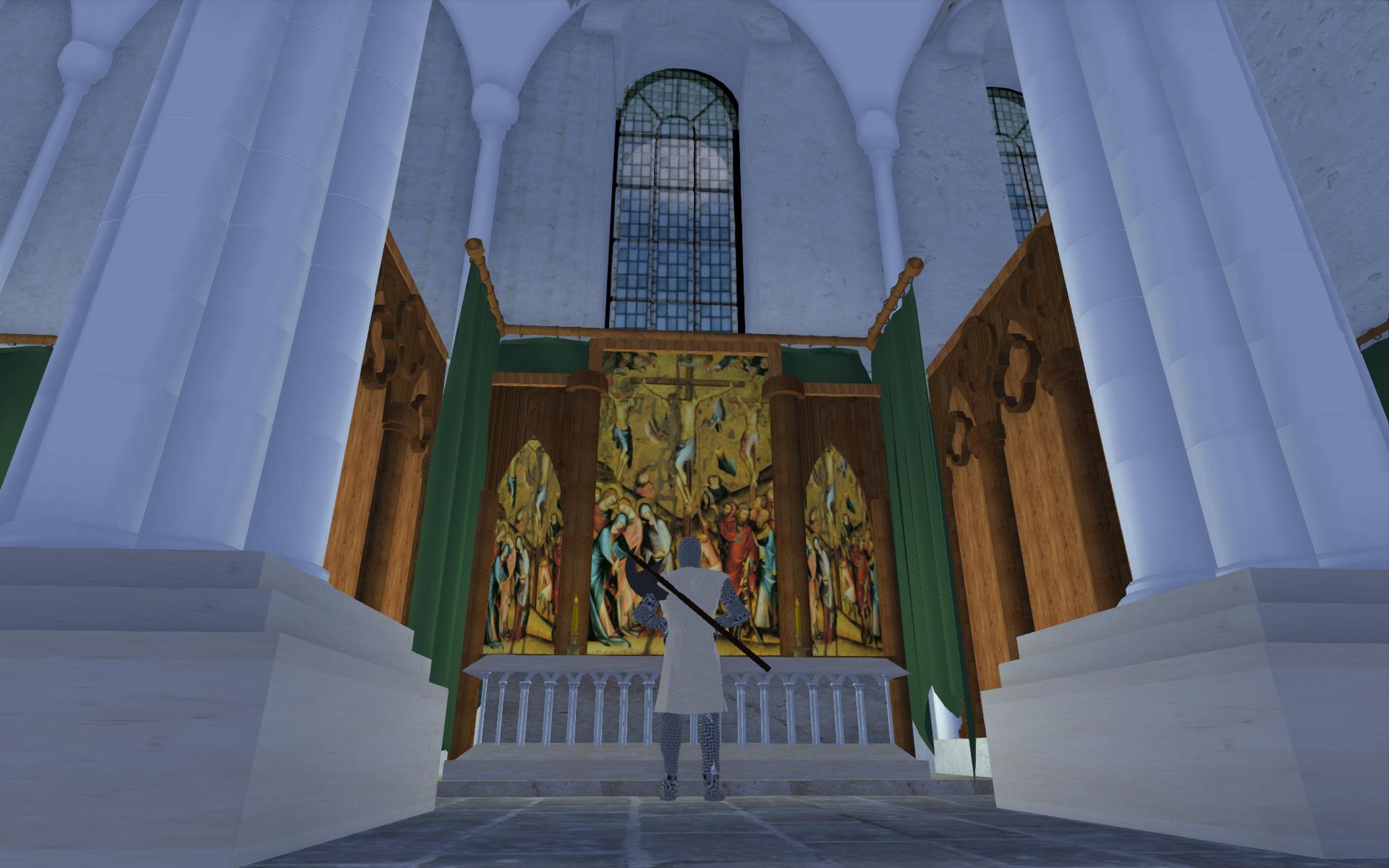
Source: facebook
Such worlds have been around for some time, beloved by museums, who wish to spiff up their old exhibitions plus cater for the younger generation by producing walk-through videos. A new feature, however, makes the Scottish project especially interesting: the possibility to hook up to the world via an avatar. This should make it possible for children, well-versed in digital gaming like for instance World of Warcraft to move into the OVW and discover a bit of what life was like in the Middle Ages. Several different roles are available for those, who wish to immerse themselves in the environment experiencing the life of clerics or grave-robbers alike. Also it is possible to meet historic characters like Bishop William de Lamberton, King Robert I or the cannons of the cathedral and hear their pre-scripted stories or take part in the daily prayers of the church.
Trying it out, however, is quite frankly a bit of a disappointment. To begin with, it is not as easy to create an account as might be hoped for. First you have to create an account in order to download the programme, which secures your access to the world; which in fact turns out to be a “corner” of Second Life . The project thus garner you an avatar who is not in any sense a “medieval person”, which means that you end up entering the world as a postmodern avatar of the second-life-variety (which also means you have to go shopping in the local currency in order to get properly dressed, which is not possible because the shop mostly contains “Harry Potter” outfits!)
Further the world – as it is created – is still Second Life, which is to say it is in the least a bit dated. It is awfully tempting to wonder how the project might have looked and felt, if the developers had gone all-in and created such fantastic worlds as are made in films like for instance “The Adventures of Tin-Tin”? Or made it possible for youngsters to take part in the building of a cathedral – or a village nearby – like it is possible in such games as for instance Minecraft (It is much too complicated for school-children in the Second Life World variety).
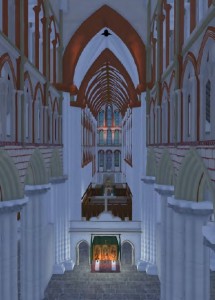
Source: Open Virtual Worlds
Granted, such efforts most likely require resources on a wholly different scale than those available to the group, which created virtual St. Andrews. It is nevertheless an interesting project.
Morten Juul Nielsen
TO CREATE A LOGIN:
virtualworlds.cs.st-andrews.ac.uk/cathedral/login.php (once completed you will be given a link to download a virtual world client). The apollo grid can be found at: apollo.cs.st-andrews.ac.uk:8002.
READ MORE
Open Virtual Worlds
The official blog of the project
Exploring Canons and Cathedrals with Open Virtual Worlds. The Recreation of St. Andrews Cathedral, St. Andrews Day 1318
By S. Kennedy, R. Fawcett et al
The University of St. Andrews 2013
The Architecture of the Scottish Medieval Church, 1100-1560
By Richard Fawcett, professor in the School of Art History at the University of St. Andrews
Hardcover, 432 p, 300 b/w + 100 color illus, $100
Yale University Press 2011
ISBN: 9780300170498 Cloth: $100.00