From Shards to Sea Routes: Glass Evidence for Venice’s Mediterranean Networks in the 7th and 8th Centuries
When we think of Venetian glass, our minds leap to the blazing furnaces of Murano, to delicate filigree and the vivid colours of the Renaissance, and to the fragile works of art that, from the thirteenth century onwards, were packed in butter and shipped from the island. Recently, however, new research from another island in the lagoon, Olivolo, has uncovered evidence that glass production was already a feature of the Early Medieval city of Venice from the sixth century.
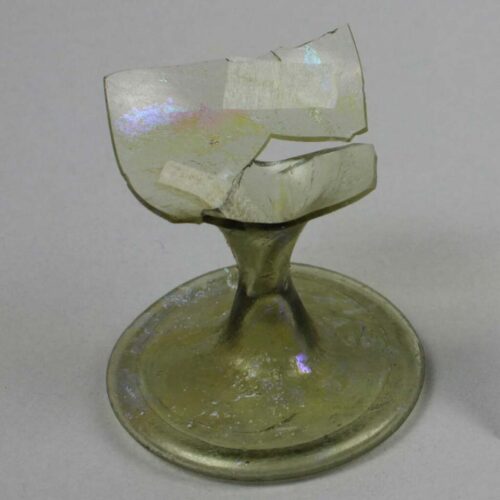
The study carried out at Ca’ Foscari University of Venice has demonstrated that glass production took place on the island of Olivolo in the Early Middle Ages. The analysis is based on archaeological finds excavated from a waste heap located next to a glass production workshop at the site of San Pietro di Castello, at the entrance to the Venetian harbour. These discoveries show that the history of glass in Venice is far older, more complex, and technologically more advanced than previously imagined. A nearly forgotten past is resurfacing through a collection of over a thousand minute fragments stemming from vessels, table ware, window glass, production waste, and a steatite crucible. Of these 45 fragments were analysed in depth.
The key to this new understanding is an archaeometric study of an assemblage of Early Medieval glass, based on a new technique developed after the collapse of the Western Roman Empire in the aftermath of the sixth-century climate crisis and the Justinian Plague.
In Roman times, glass was made using natron from Egypt, but when this material became difficult to obtain, European glassmakers began to produce glass using ash derived from plants. By studying the fragments from the waste heap, researchers discovered that this new recipe was already being used in Venice as early as the eighth century, and that the ingredients had been imported from the Levant—today’s coasts of Syria, Lebanon, Palestine, and Israel—as early as the seventh and eighth centuries, when Mediterranean trade was reawakening after the crises of the sixth century.
Evidence for this trade in raw materials comes from the discovery of plant-ash beakers that are identically shaped to beakers produced locally using the older natron-based technique. This indicates that Venetian artisans imported raw glass and worked it according to local stylistic traditions. At the same time, however, the discovery of fragments from conical-based glasses—common in Syrian production but not manufactured in the Adriatic during this period—indicates the direct import of finished luxury goods.
The article reveals that Venetians were not only aware of this new technology as early as the eigth century, but also that trade networks were sufficiently efficient to allow craftsmen in Venice to import cutting-edge materials from workshops across the Mediterranean. This offers a fresh perspective on Venice’s origins: a city that was advanced, connected, and innovative as early as the eighth century—a key hub in the Early Medieval Mediterranean, capable of extensive trade and of mastering the most sophisticated technologies of its era.
A New Technology
Further testing has shown that an Early Medieval blue mosaic tile containing an opacifying agent that had fallen out of use after the fourth century was made using recycled Roman glass. The reuse of Roman glass products in the Early Middle Ages is, however, well documented across Europe.
In addition, within a single blue tessera, scientists identified the coexistence of two different opacifying agents: calcium antimonate—an ancient technology no longer in use after the fourth century—and lead stannate, a more recent innovation. It appears that artisans melted down an older Roman tessera to recover its material and reused it, blending the result with a more “modern” sample exploiting metalworking slag, a by-product rich in cobalt. This choice reveals not only a sophisticated understanding of material properties, but also an intelligent reuse-based economy: a proto–circular economy of sorts.
Early Medieval Venice and its Trade Networks
Analysis of the provenance of the raw glass therefore presents a vivid picture of Venice as an early international commercial crossroads. The finds reveal an almost equal proportion of glass originating from the two main production regions of the period: Egypt and the Levant. Venice’s trade routes were dynamic and adaptable, responding to shifting geopolitical and production conditions in the Mediterranean. The lagoon was not simply a recipient of goods, but played an active role in the complex and evolving network of exchanges.
How, then, did these new technologies and exotic objects arrive in Venice? Were they intended as raw materials to be processed in local workshops, or as finished luxury goods? The answer is both, demonstrating a remarkably sophisticated supply network already established in the eighth century, as outlined by McCormick in his magisterial work on The Origins of the European Economy from 2001 (curiously enough not mentioned in the biographical list).
FEATURED PHOTO:
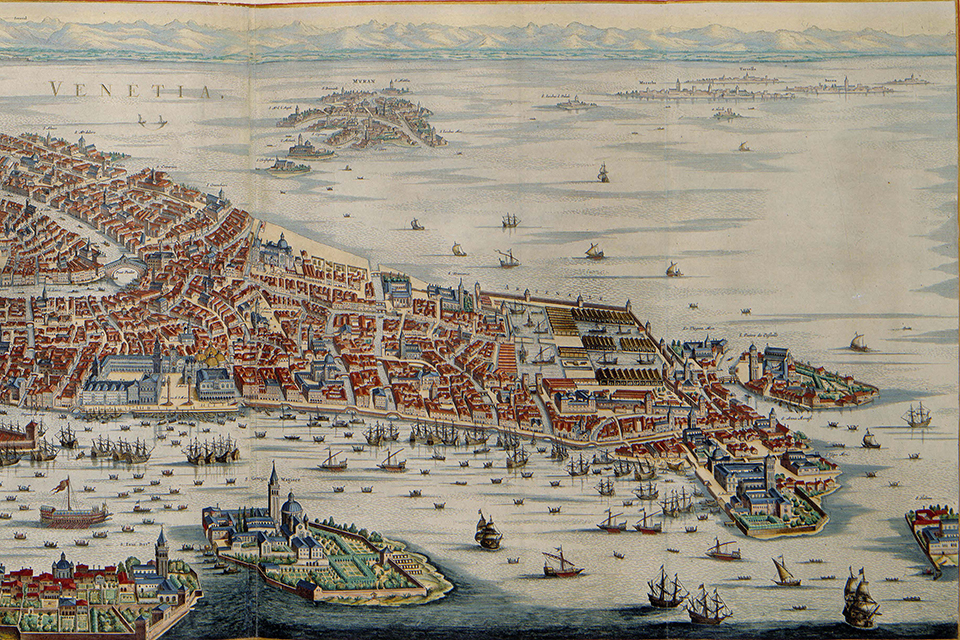
Map of Venice: Van der Hagen. Source: Wikipedia