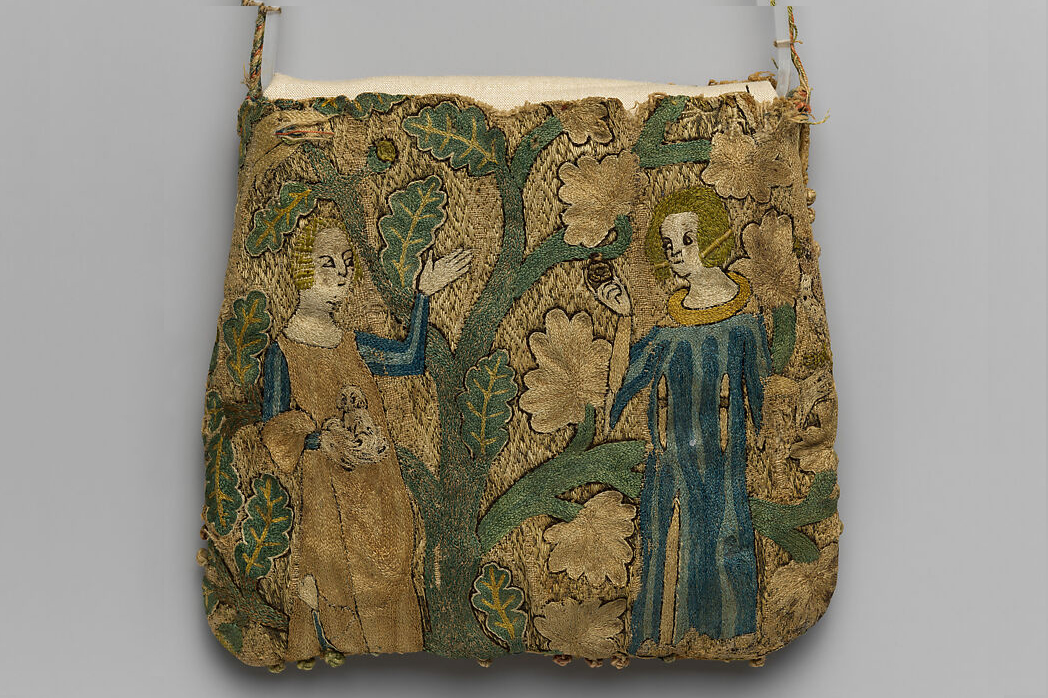
Purses in the Middle Ages were not just practical devices for carrying or storing things. They were symbols of both sinful behaviour and status. And came to play a part in the changed marriage rituals in the 13th century.
Purses are practical. They solve the problem of carrying personal valuables of all sorts on your person while going about your business. In 2025, we carry keys, glasses, and phones in our purses or pockets together with credit cards and perhaps coins. Other items might be visiting cards, pens, analogue calendars, cosmetics, medicine, and whatnot.
Hence, it is no surprise to us that people in the Middle Ages also had purses, nor that some of those were fitted out to be the equivalent of the coveted 20th-century Hermès or Gucci bags, and were carried around by servants.
To unpack these purses, though, we have to be more precise: what are we talking about in terms of words and their meanings? How were purses made made and marketed? What did they contain and for what purposes? And what might they mean to the people juggling these things? Perhaps it is all in a name?
Purse and Bourse
“Purse” is a ubiquitous word. It derives from Proto-West Germanic pusō, from Proto-Germanic pusô, meaning bag, sack. We also find the word in Ancient Greek βύρσα and in Latin bursa (animal’s hide and/or wineskin). Accordingly, a Greek tanner was called a βυρσεύς (burseus). Derived from this, a bursa came to indicate a leather bag in Medieval Latin, while the bursar came to denote the profession of the person who carries or cares for the bursa/purse and the wealth therein. Another derived word was the boursier or purse-maker.
It is known in:
- Old High German pfoso (“pouch, purse”) or burissa (wallet)
- Old English as pusa or purs (purse, bag)
- Middle English purs (purse, bag)
- Old Norse posi (“purse, bag”)
- Danish pose (“purse, bag”)
- Dutch beurs (“purse, bag”)
- Old French borse and French bourse
- Low German as pūse (“purse, bag”).
As is well known, the word has also generated the words for the modern stock exchanges – bourse (French and English), børs (Danish), Börse (German), etc., i.e. places where values were and are settled. In short, a purse held valuables, as opposed to a bag or a sack, which “just” held something, for instance, seed to be dispersed in a field. In form, they might look alike; however, in terms of connotations and symbolic value, a purse and a bag were never the same.
Purses and bags in the New Testament
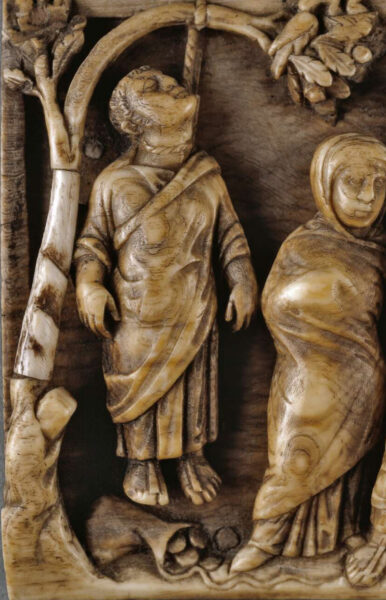
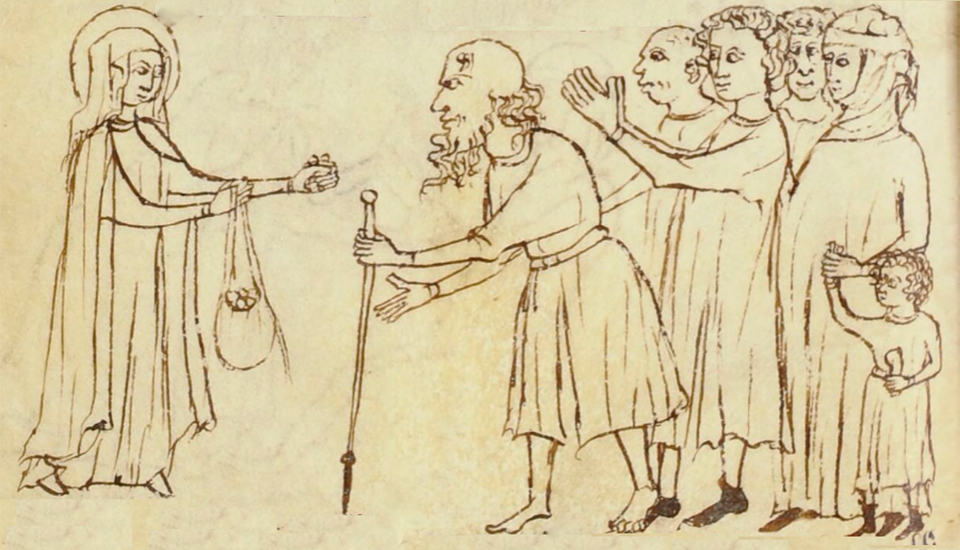
© The Trustees of the British Museum. Shared under a Creative Commons Attribution-NonCommercial-ShareAlike 4.0 International (CC BY-NC-SA 4.0) licence.
Interestingly, there are four other words for purse or bag which may be found in the New Testament in Greek. The most common word is the ζώνη (zone), the traditional Greek word for the belt holding a peplos or a tunic up, and one which might be fitted out with a pouch to hold valuables.
Next is the word πήραν (pēran), which has a wider meaning as a travelling bag or leather pouch for food. In the Odyssey, the hero was equipped with such a sack or bag with holes when Athena dressed him up as a beggar.
Both of these words are found in the key text from Matt. 10:9–10, where Jesus admonishes the Apostles to “Provide neither gold nor silver nor copper in your money belt (zone), nor in the bag (peran) for your journey , nor two tunics, nor sandals, nor staffs; for a worker is worthy of his food.”
However, a third word may also be found, the γλωσσόκομον (glossokomon), which originally denoted a container for a flute. The word is found in John 12:6, outlining how Judas was in charge of the common “container”, that is, in this case, the money box or casket, and not a purse per se. This word is likely responsible for the early medieval fondness for creating bejewelled golden small caskets holding relics in the form of “purses”.
Finally, the last word is βαλάντιον (ballantion). This noun is only found in Luke 10:4, where the commission without a “money belt” is demanded, and in Luke 12:33, where the disciples are challenged to renounce property by means of carrying a [spiritual] purse which does not wear out. Such “belts” were, according to Rabbinic tradition, worn by the Jewish priests, as described in Exodus 39:29. The word is etymologically connected to the word balteus or Roman sword belt, later known as the baldric, which we know as a military belt holding arms. In short: a belt.
Now, in the Vulgate (Latin) translation from AD 390–405, the Greek texts from Matt. 10:9–10 read like this: “nolite possidere aurum neque argentum neque pecuniam in zonis vestris, non peram in via neque duas tunicas neque calciamenta neque virgam dignus enim est operarius cibo suo”, while the parallel Lucan text 10:4 uses sacculus instead of zone: “Nolite portare sacculum, neque peram, neque calceamenta, et neminem per viam salutaveritis.”
Interestingly, we see here how Jerome (or the texts of Matthew from which he copied) used the Greek words, the zone and pera, which were carried directly from Greek into the Latin Vulgate text, while he, in the Lucan text, uses the Latin word sacculus. Also, we might notice that pera is used in ten instances.
We may notice, that none of the Greek texts in the New Testament uses the word purse, although it was definitely known in old Greek, denoting (wine)skins.
From zone to sacculus
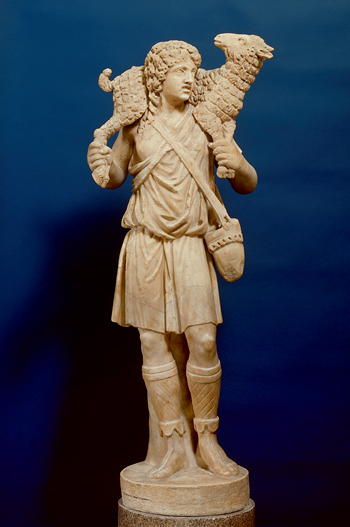
Thus, it appears that “zones” or “money belts” in Late Antiquity were intended as holders for wealth in one form or another, such as coins, amulets, and other precious items, while “perae” were travel bags intended to hold provisions, and bursae – perhaps – was limited to denote were bags of skin intended to transport wine.
However, it appears there is a famous “pera” which was turned into a sacculus or purse. The point was that Judas was not only the traitor who sold Jesus for 30 pieces of silver; he was also the bursar of the provisions gathered by Jesus and his disciples on their perambulations through Galilee and beyond. This pera appears to have been depicted at the feet of Judas hanging from the tree in the ivory panel made in Rome c. AD 420–430. Interestingly, the thong attached to the simple pera holding the large coins paid as a bribe was rendered as the evil snake sliding along the ground. Apparently, the pera holding the daily bread which Judas had guarded had suddenly turned into a zone or sacculus holding money. What was at stake here?
In a sermon (no 51) by Augustine of Hippo (1), he comments on this text, trying to explain the difference by pointing out that the pera, which was holding the provisions and daily bread, was one thing. Such perae were, he claimed, metaphorically holding a fountain of wisdom to be shared with each and every one. On the opposite side was the zone or rather sacculus, as Augustine calls it, which was something else, a closed hoard of wealth. However, a pera could be turned into a sacculus as the story of Judas showed. On one hand, he wrote, Jesus had Judas carry the bag of provisions (the pera). And yet he admonished the Disciples to stop this practice when on their own. This contradiction Augustine explains in the following way. We should be looking metaphorically at such a bag – pera – as a hoard of wisdom which we are urged to share widely. Hence, if we turn our perae – as Judas did – into money bags, we are lost. He ends his sermon thus: Hoc est pera, quod est sacculus – this is the bag, which is (becomes) a purse. Where the pera is the travel bag, the sacculus is the closed-off money belt (in the future, the purse). The former being acceptable because it is in fact a metaphor for the source of wisdom, which we have to impart to our travel companions. Nevertheless, we should guard ourselves against falling into the trap of Judas and turning our pera or bag into a sacculus or purse, he preaches to us.
As Isidore of Seville later explains, there are a number of containers (de vasis repositoriis), such as one which he calls a saccus, which he tells us is made by sewing a blanket up (the later purse). Meanwhile, the smaller “pouch” is covered by the word marsupium, derived from ancient Greek, and which denotes a little bag of money. He also mentions the fiscus as the name of the public purse. Finally, he mentions the pera, which he also calls a melotes and describes as the skin of a goat, which hangs from the neck and covers as far as the loins. A practical way of carrying one’s baggage while perambulating.
At this point in our history, however, the classical Latin words denoting purses and sacks or bundles, were already shifting under the intermingling with the Barbarian languages offering new words for old objects.
Early Medieval Purses – Archaeological Evidence

It appears that Isidore did not experience a significant difference between his saccus (short for sacculus) or pera, while a third word entered his vocabulary, the marsupium or wallet denoting what we think of as a purse for money.
Perhaps this was his “word” used to denote the purses mounted with a cloisonné style and known from multiple graves in the Frankish world.
The clasp to such a marsupium or purse has been excavated from a silo near Senda de Granada in Murcia and dated to the fifth century. It consisted of a bronze plate with two terminals in the shape of predatory birds – eagles – each measuring 6.5 cm × 1.9. In the middle, between the two eagles, would have been a buckle mounted on a leather bag. The eyes of the birds were highlighted by silver encircling the mother-of-pearl eyes. Likely, the inner pupils might have been fitted with stones of a different colour.
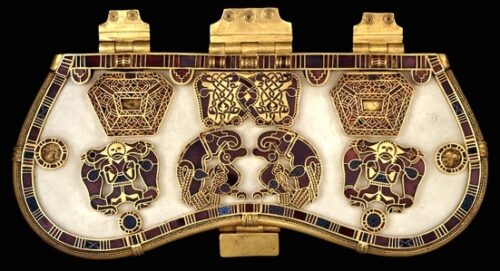
Such purses may well have belonged to the material culture of Isidore’s, which a century later presented him with a conundrum: what to call these non-Roman purses, which are typically found in upper-class Frankish graves, such as, for instance, the purse ends found in the grave of Childeric at Tournai from the end of the 5th century. Here, though, the animals were blinking horses and not eagles. Also, the material was gold and not plain bronze. It appears from other archaeological finds that this design was not particularly rare, while the materials might be more or less rich, indicating social and economic, yet not cultural, differences.
We do not know precisely how these early Frankish purses were carried. However, the purse known from the burial at Sutton Hoo c. AD 600 demonstrates that a purse might be fitted with metal clasps to hang from the belt. The same fittings appear to be part of the clasp discovered at Saint-Dizier. Likely, more simple systems were also used. Both the purses from Tournai and Sutton Hoo held treasures of gold coins.
Later archaeological excavations on Gotland have revealed the remains of several “Viking bags”, comparable to the later Scottish sporrans. Usually made of leather and often fixed with metal frames, they have often been found holding not just coins but also the weights for dealing with trade in broken silver. To some extent, they appear to be akin to the famous examples from Tournai and Sutton Hoo. (Sörling 1939)
Purses as Reliquaries
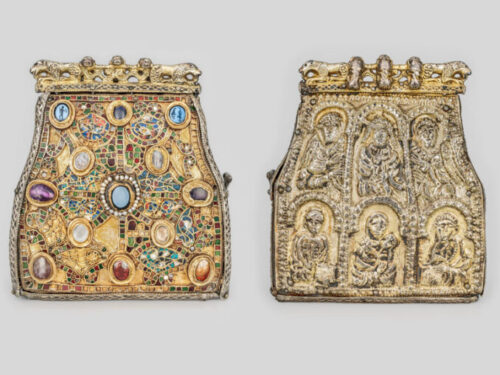
Meanwhile, some of the earliest reliquaries were made of plywood and shaped as purses. Covered by decorated golden plaques and jewels, they were designed to be protected while being carried around by missionaries in the early medieval Church. One such famous purse is the Carolingian Burse of Enger from the end of the 8th century, now in the Museum of Art in Berlin.
However, relics might also be carried around in smaller purses and hung around the neck. At the Battle of Hastings, William the Conqueror had with him the relics on which Harold had sworn his oath of allegiance. William fought with them hung round his neck. One such purse from 14th-century Germany is preserved in the collections of the British Museum. Purses used in this fashion, which carried relics or objects of devotion, were suspended from the neck. In the same manner, we may presume clerics attending to the ill and dying would carry the host in a purse around their necks.
Finally, of course, purses were downright used to preserve relics, and have been found in the treasuries of multiple churches, offering valuable insights into textile history.
Practical bags and beautiful purses

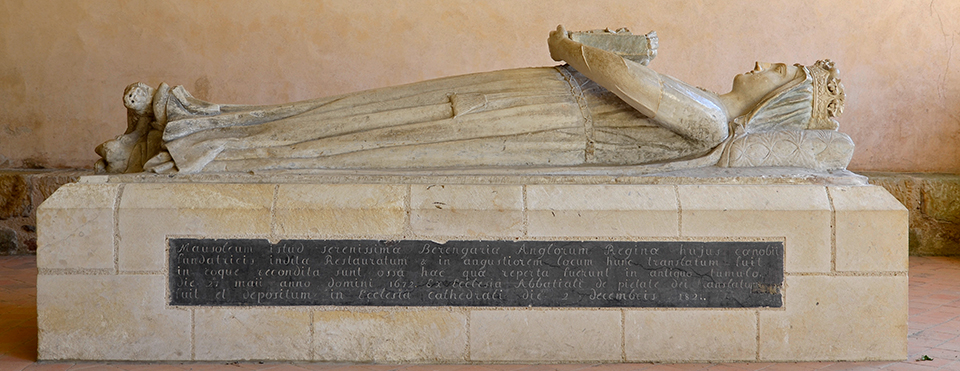
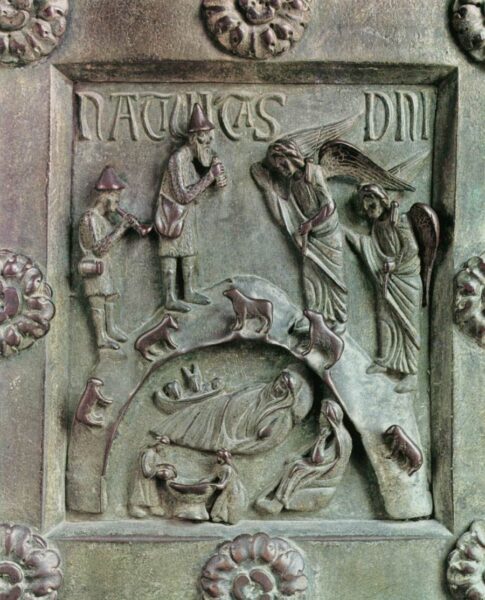
Meanwhile, medieval people went about their business using a number of containers of all sorts and sizes, such as what we today would call bags, sacks, purses, and pouches, and for diverse purposes. Also, it appears that the ancient vocabulary concerning purses and bags was rapidly being displaced by the vernacular purse or bourse. Although the pera still dominated in Latin texts, the bursa appeared often enough. Less common appears the sacculus or the marsupium.(2)
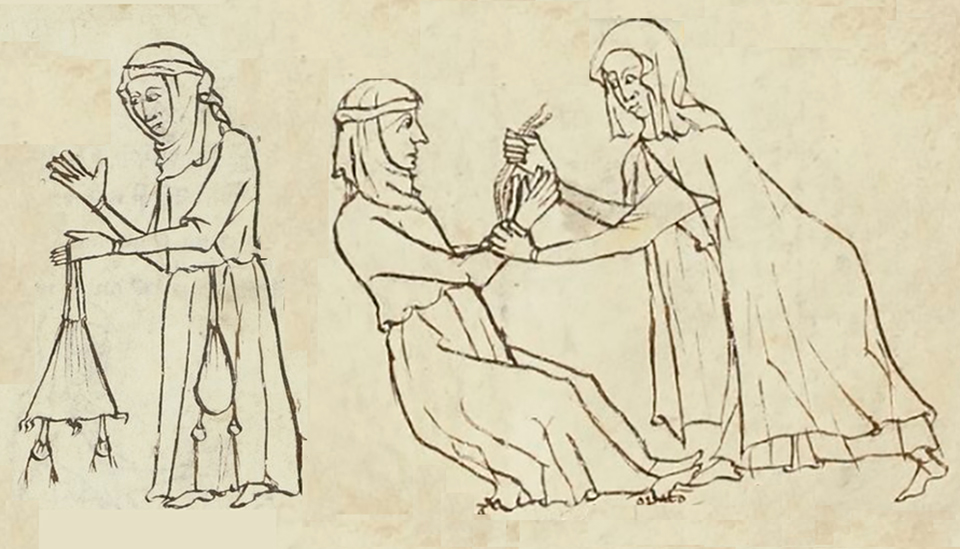
As witnessed by archaeology, preserved pieces of art as well as illuminations and sculpture from the high and late Middle Ages, four distinct types of “bags” were around. The basic bag was square, closed with drawstrings, and perhaps fitted with a shoulder strap. Another type was the pouch fitted with a flap fastened by hooks, strings, or buttons. A third type was the cylinder or pipe-shaped bag, closed with a set of metallic sliding rings (hence the word bague, which also means ring) or strings with tassels. At the end of the Middle Ages, metal beams or frames became more common. Judging from images and other scant written evidence, all types were in use at the same time and for differing purposes; and might be considered just bags or purses.
Nevertheless, a certain pattern emerges, if we look at and compare the archaeological evidence from large productive excavations such as those from for instance Medieval London. This shows that drawstring leather purses were abundant in the period between the 12th and 14th centuries. Later, cloth pouches came to dominate. Likely, this was a reflection of the changed fashion taking place when the flowing tunics and dresses were replaced in the 14th century with the fashion for “cut” clothes. No longer could purses be hidden in the sleeves or pockets, but were worn as pouches hanging from the belts. At the same time, also, purses closed with drawn strings appeared in numerous illuminations (Gilchrist 2012).
Later, in the 15th century, leather purses with flaps became more common. However, the evidence from the catastrophe of the Mary Rose tells us that the assemblage there consisted of two drawstring bags, twelve pouches, one purse, and three purse-hangers.
To a large extent, the contents of these consisted of personal items such as combs, toothpicks, tweezers, pocket mirrors, and, for women, their knives, keys as well as cosmetics. (Men wore their knives in scabbards hanging on belts.) Other purses held coins. (Gilchrist 2012). However, from the more exalted world of royals and nobles, we know that purses held jewels, seals, relics or religious bling such as bejeweled cruxifixes, agnus dei pendants etc.
Behind this multitude of forms and contents, however, the old moral distinction between the sacculus and the pera continued to exist. Thus in the 13th century Ancren Riwle (The Ancient Rule) the author explains to his or her readers – be they nuns or anchoresses – how “noblemen and gentlemen do not carry packs, nor go about trussed with bundles, nor with purses. It belongs to beggars to bear bag on back, and to burgesses to bear purses, and not to God’s spouse, who is a Lady of Heaven. Bundles, bags, and packs are all earthly wealth and worldly revenues”, the author tells us. Elsewhere in the text, the nuns are strictly forbidden to make purses or bandages of silk” (Morton 1907, p 126).
Bling Bling
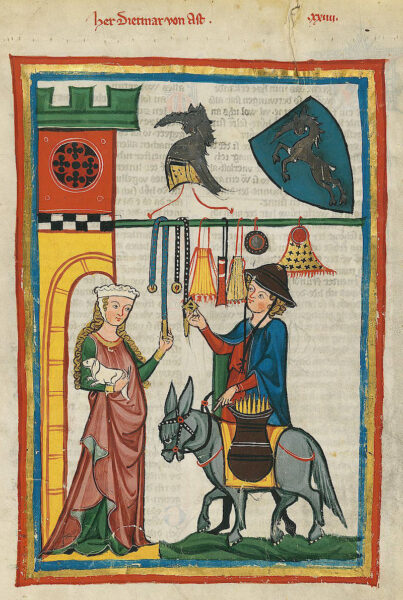
It is a curious fact that medieval re-enactors dress up in “undecorated, brownish belts, purses and shoes, propagating a dull, ‘eco’ idea of medieval fashion”, writes Willemsen (2012). This ignores that all we know points to a widespread use of colours and decorations to embellish these minor elements in the dressing up of common men and women. Silk garments might not be for everyone, but an embroidered purse or decorated leather bag might not be out of reach.
Thus, we find that the purse, which was a distinctive symbol of wealth, came in all shapes and sizes, where some might be virtual pieces of art produced by skilled craftsmen and -women in the large industrial quarters in Firenze, Paris, London, etc.
No wonder some of the more precious examples survived despite the fragile nature of the material used. Preserved items show how they presented some of the fables and stories recirculated in the romantic and courtly literature from the 13th and 14th centuries. Also, moralists tended to look askance at these purses which might or might not play a role in illicit affairs of the heart.
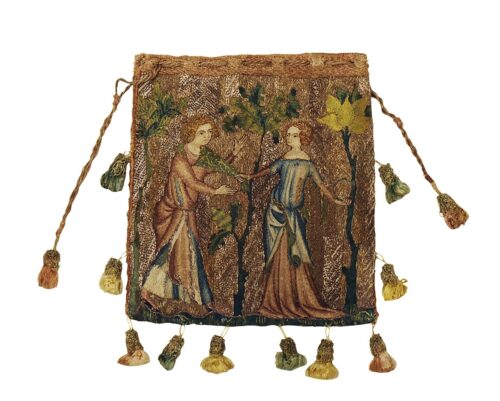
Thus, in the “The Art of Courtly Love by Andreas Capellanus” from 1184-86, we read that “A woman who loves may freely accept from her lover the following: a handkerchief, a fillet for the hair, a wreath of gold or silver, a breastpin, a mirror, a girdle, a purse, a tassel, a comb, sleeves, gloves, a ring, a compact, a picture, a wash basin, little dishes, trays, a flag as a souvenir, and, to speak in general terms, a woman may accept from her lover any little gift which may be useful for the care of the person or pleasing to look at or which may call the lover to her mind, if it is clear that in accepting the gift she is free from all avarice”. (3)
However, a hundred years later, the church was busy expropriating the secular business of betrothal and matrimony by “forbidding” this exchange of gifts, which were turned into signs of illicit love affairs. In 1260, we read the admonition of Robert de Blois, who writes:
“Take jewels from no one, unless you wish to do him a disservice. Where you do not wish to do a disservice, no lady who aspires to honour and wants no blame should keep such jewels. And know ell that if she takes them, he who gives them sells them to her dearly, for jewels given for love soon cost her honour. They are not a gift pure and simple at all, rather such gifts cost dearly, for a lady whose soul and body are injured has made a very dear bargain. Know that this comes from covetousness: when covetousness makes a lady take them, she cannot long defend herself from doing mischief and grievance to God and the world… but if any relation desires to give you a jewel, you ought not to refuse him, whether it be a girdle or a fair knife, a purse, brooch or ring. Provided there be naught but good intention between you, take all assurance and thank him for it gratefully, and hold it dearer for his affection than for its worth. But you are forbidden to take rich gifts or receive them privily: taking and giving in private soon leads to thoughts of folly. “(4)
The Marriage Aumônières

Apart from the blessing of the ring, another special category of these gifts came to be known as aumônières – purses for almsgiving.
Traditionally such aumônières have been regarded as distinctive noble accoutrements, signalling the bearer’s generous attitude towards his or her people.
According to Feldman (2012), though,these purses were not so much used for practical purposes; rather, they figured as an institutionalised element in the rituals connected with the formalisation of marriages as sacraments.
To understand this role, we have to remember how the Church in the 11th and 12th centuries succeeded in changing the matrimony from being regulated through a private contract among kin groups to a public contract between a man and a woman. In this seismic shift, the pattern of “gifting” turned public, involving not only the transfer of pledging gifts but also dowries, morning gifts, as well as appropriate donations to the Church (and, on the way, the poor).
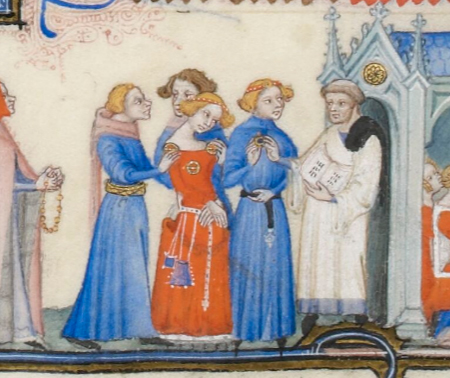
Hence, the future wife would enter the church carrying her matrimonial purse holding her dowry (or part of it), being expected after the ceremony to offer her thanks through an appropriate donation of a part of said dowry to the church. This purse might be embroidered with silk and gold vignettes of heraldic nature as well as love scenes. Perhaps the purse might also be used to receive the gifts of guests and witnesses, often donated in especially valuable coins.
Many of these purses might well have been embroidered by the future bride. However, guilds are documented which organised the embroiderers. Thus, in 1299, a group of primarily women organised themselves in a powerful corporation under the supervising Prévot de Paris (the city bailiff). The guild counted 124 such faiseues.
FEATURED PHOTO:
French Purse, early 14th Century. The Metropolitan Museum of Art. The embroidery illustrates either a popular story or a courtly pastime. A lady and gentleman stand beneath a tree; she cradles a small dog under her arm and he offers her a flower or ring. This scene is commonly represented elsewhere on fourteenth-century ivory mirror backs. Perhaps, the scene depicts a betrothal, however the church did police the gifting of rings outside the marriage proper, as it then lack the proper blessing. Such gifts were deemed illicit by moralising writers, yet likely a common way of establishing a relationship. The bag may have been made by a professional embroiderer or by the woman who carried it, inasmuch as skill in fine needlework was considered essential for ladies.
NOTES:
(2) Searching for the words in the corpus of the texts published in the Monumenta Germaniae Historica yielded 139 instances of the pera, 81 bursa, 33 sac(c)ulus and 28 marsup(p)io. The evidence is not complete as it is not possible to search in the corpus for “stems”.
(3) Quoted from Parry 1941.
(4) Howard 1950. Quoted from Camille p. 73
BIBLIOGRAPHY
The Etymologies of Isidore of Seville
Transl by Stephen A. Barney et al
Cambridge University press 2010
Some Textual Sources for the Purse as Reliquary.
By Preston McLane
In Athanor (2003) XXI
Penningväskor från vikingatiden
By Erik Sörling
Fornvännen (1939) Vol 34, 45-57
The Nun’s Rule being the Ancren Riuwle.
Modernised by James Morton with Introduction by Abbot Gasquet.
London 1907
The Leather and Textile for the Frame: From Davis William’s purse bars to excavated, preserved and depicted medieval purses
By Annemarieke Willemsen
In: Back in the Bag. Essays in Honour of Davis Williams.
Surrey County Council 2019
Man is a sack of muck girded with silver’: Metal Decoration on Late-medieval Leather
Belts and Purses from the Netherlands
By Annemarieke Willemsen
In Medieval Archaeology (2012) Vol. 56
Medieval Life. Archaeology and the Life Course.
By Roberta Gilchrist.
Boydell Press 2012)
The Medieval Art of Love: Objects and Subjects of Desire
By Michael Camille,
New York: Abrams, 1998
Towards a new reading of Aumônières: the Term “Aumônière Sarazinoise” and the role of alms purses in images of Late Medieval French Marriage Ceremonies.
Thesis, Chicago, Illinois 2012.
The Art of Courtly Love by Andreas Capellanus.
Tr. by John Jay Parry.
New York 1941
Robert de Blois, son oeuvre didactique et narrative.
Ed by John Howard
Paris: Nizet, 1950.