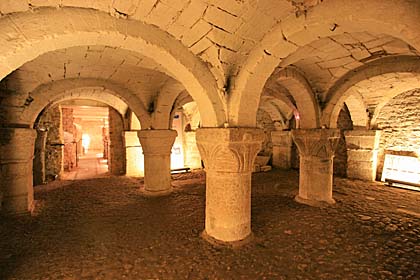
A now-crumbled chapel on the site of Oxford Castle is almost certain to have been the place, where the Legends of King Arthur, part of the 12th century History of the Kings of Britain, were written by Geoffrey of Monmouth.
Oxford Castle is a large, partly ruined Norman medieval castle situated on the west edge of Oxford in Oxfordshire, England. The originally moated wooden motte and bailey castle was replaced with stone in the 11th century. It played an important role in the conflict of the Anarchy, a civil war in England and Normandy between 1135 and 1153. However, in the 14th century the military value of the castle diminished and the site was used primarily for county administration and for detaining prisoners. Most of the castle was destroyed during the English Civil War and by the 18th century the remaining buildings were used as Oxford’s local prison. Today the medieval remains of the castle, including the motte and St George’s Tower, are classed as a Grade I listed building and as a Scheduled Monument. The castle is used as venue for historical events and guided tours. In May there will be a week of family quests and Sword in the Stone-style activities around the castle celebrating the discovery that Geoffrey of Monmouth conceived his Historia Regum Britanniae there.
““It was Geoffrey who introduced the figures of King Arthur and Merlin to a wide medieval readership while he served in St George’s Chapel, on the site of what is now Oxford Castle,” explains Helen Fulton to BBC, Professor of Medieval Literature at the University of York with particular knowledge of Arthurian literature. She continues: “We know he must have been in Oxford in at least 1129 or earlier and the book was written around 1136. He must have been based there when he wrote his famous Latin chronicle, Historia Regum Britanniae, around 1136.
Oxford Castle
Oxford castle is first recorded in1071 when the Annals od Oseney states that “in the same year the castle of Oxford was built by Robert de Oilly the First”. The castle was inserted into the Western end of the late Saxon Town and made use of the river in its defences.
The first Norman castle was presumably made out of earth and timer; it may have had the form of a “ring-work”. However, very soon its plan comprised a mound and bailey.
The castle never played a significant role in the History of England, except during the Anarchy when King Stephen besieged the Empress Matilda in 1142. The castle was yet again under attack in 1215 during the war of the Barons.
Very early on in the 12th century the original wooden buildings were replaced by stone-work. However from the 14th century the castle was allowed to fall into disrepair and its functions ceased to be military.
St. George’s Tower and the crypt belong to the earliest stone-work. It is even possible these edifices belonged to an earlier church, since the parish of St. George is documented from pre-conquest. The crypt and the tower is all that is left of this church. In the end of the 18th century a huge part of the old building was sacrificed in order to built a prison in the former castle. The former nave and chancel was at that point rebuilt as a prison hospital. However, part of the crypt still stands. Its massive proportions and its rough stone-carvings represent the vestiges of this very early building from the 12th century.
Geoffrey of Monmouth
Geoffrey of Monmouth was a 12th-century cleric and writer who was a key figure in collection and distribution of the legends of King Arthur. Relatively little is known about his life but it is believed he was born around 1100 in Wales or the Welsh Marches and had a Breton father and a Welsh mother. He is described as magister, a Latin word meaning master, which suggests he may have been teaching in the early days of the university. He was made bishop of St. Asaph in Wales in 1152 and died in 1155.
READ MORE:
A Companion to Arthurian Literature (Blackwell Companions to Literature and Culture)
By Helen Fulton (Editor)
Wiley-Blackwell (6 Jan 2012)
This Companion offers a chronological sweep of the canon of Arthurian literature – from its earliest beginnings to the contemporary manifestations of Arthur found in film and electronic media. Part of the popular series, Blackwell Companions to Literature and Culture, this expansive volume enables a fundamental understanding of Arthurian literature and explores why it is still integral to contemporary culture. Offers a comprehensive survey from the earliest to the most recent works Features an impressive range of well–known international contributors Examines contemporary additions to the Arthurian canon, including film and computer games Underscores an understanding of Arthurian literature as fundamental to western literary tradition
The History of the Kings of Britain (Classics)
Geoffrey of Monmouth (Author), Lewis Thorpe (Introduction, Translator)
Penguin Classics; New Impression edition (25 Jan 1973)
Completed in 1136, The History of the Kings of Britain traces the story of the realm from its supposed foundation by Brutus to the coming of the Saxons some two thousand years later. Vividly portraying legendary and semi-legendary figures such as Lear, Cymbeline, Merlin the magician and the most famous of all British heroes, King Arthur, it is as much myth as it is history and its veracity was questioned by other medieval writers. But Geoffrey of Monmouth’s powerful evocation of illustrious men and deeds captured the imagination of subsequent generations, and his influence can be traced through the works of Malory, Shakespeare, Dryden and Tennyson.
Oxford Castle Unlocked
The official Guidebook