More than 3000 medievalists will be gathering in Kalamazoo next week. With a bonanza of more than 550 sessions and 39 roundtables plus other events like 90 business meetings and receptions plus 70 exhibitors, it should seem as if every scholarly whim is catered for.
However, a word-count-analysis reveals some interesting facts about what Medieval Studies in America is still about: overwhelmingly it is about manuscripts – the most common word mentioned 83 times in the program. However not all manuscripts are en vogue. Primarily these manuscripts will probably contain some form of literature (68) and even then either English or Anglo-Saxon (63) (as e.g. compared to Anglo-French which garnered only a count of 2.) According to the list interest in the writings about Arthur (39) or the writings of Chaucer (31) or texts like Piers Plowman (22) dominates.
Next on the list is of course the never-ending story of the saints (64), their lives or rather the stories about them. However the more traditional studies of hagiographies still dominate, while the study of sermons (23) and preaching (15) (a generally overlooked source) seems less than half as fascinating.
What more? Gendered studies – or rather: women (59) – are still very much en vogue although a roundtable asks the question whether it is decidedly “post” to be queer (Are We Post-Queer? A Roundtable on the Present and Future of Queer Theory in Medieval Studies).
Next on the list is medieval law (50) and medieval art (49) plus architecture (18). Further down the list we find Cistercian studies (34) and then it peters decidedly out… However Thomas Aquinas (30), Dante (29) and Boccaccio (18) should also be mentioned while the focus on Tolkien (26) has to do with his anniversary this year.
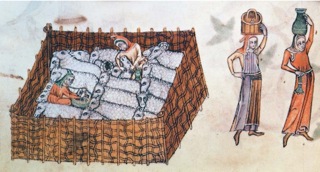
Decidedly non-words are archaeology (8), peasant (4) and rural (2). This is especially interesting in view of the last column posted by the former president of the Medieval Academy, Maryanne Kowaleski, on the 13th of April, in which she lamented the lack of interest in medieval peasants and their lives and times. In it she writes that there are “many possibilities for studies that explain regional differences in inheritance regimes, or images of the peasant in medieval literary or religious texts, or the material culture of the peasantry as evident in inventories, references to pledged goods, and archaeological evidence. In both our teaching and our research, we can and should make more use of this rich trove of scholarship and sources about the 90 pct. on whom all the rest of medieval society and culture so depended.”
A count of the frequency of words can be done here
– which by the way is a neat way of finding your way around the program if you have special interests….