
In spring 2026, the Prado in Madrid will offer a spectacular exhibition inviting us into the artistic world of Mediterranean Gothic, 1320–1420.
Without Italian influence, it is difficult to understand the artistic landscape of Spain in the late Middle Ages. Initially, the focus lay on the intermingling of artists moving back and forth between Siena and Barcelona. Later, however, workshops expanded beyond Catalonia, establishing satellite centres in Valencia and elsewhere. Central to this process was not only the importation of works destined for the Italian market, but also the transmission of new techniques. These exchanges gave rise to numerous aesthetic and iconographic innovations that left a profound mark on the visual and spiritual culture of the four Iberian kingdoms—Portugal, Castile, Navarre, and Aragon.
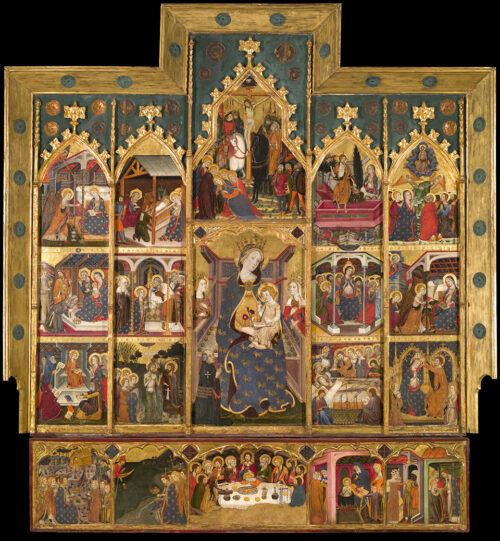
These connections will be visualised in a major exhibition scheduled for spring 2026 at the Museo Nacional del Prado in Madrid. Masterpieces by fourteenth-century artists—such as those produced by the workshop of the brothers Jaume and Pere Serra—will be presented within the broader cultural world in which they were created. Alongside a substantial presentation of some of their major works (four of which are held by the Prado), the exhibition will provide rich contextualisation through the display of more than one hundred fourteenth-century objects: drawings, rare illuminated manuscripts, precious goldsmith works, and richly embroidered textiles. More than fifty artworks and artefacts will be on loan from public and private collections.
Throughout the exhibition, the increasingly close relationships between the Iberian kingdoms—and Aragon in particular—and the Italian peninsula will be explored. In fourteenth-century Iberia, the two shores of the western Mediterranean became the stage for ever more frequent travel, through which artistic production and the tastes of patrons and viewers alike contributed to the formation of a distinctly Late Medieval Mediterranean way of life and artistic outlook.
To some extent, the exhibition will also immerse visitors in the distinctive political climate of the fourteenth century, when the widening gulf between a chivalric worldview and a prolonged and brutal civil war shaped the lives of plague-stricken populations.
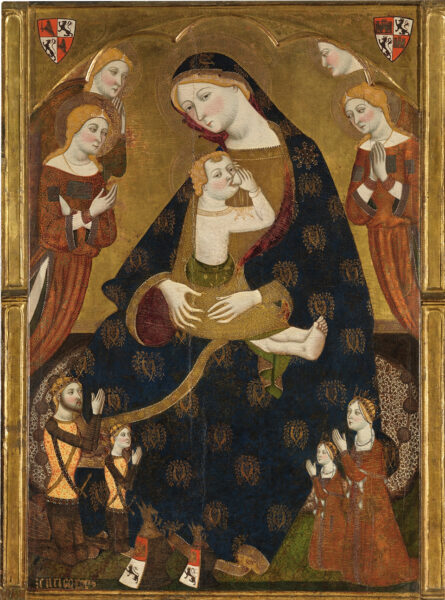
This perspective arguably emerges most clearly in the exhibition’s central work, The Virgin of Tobed by Jaume Serra. The painting was created to celebrate the victor of the Castilian civil war, the new king Henry II of Trastámara, depicted alongside his wife Juana Manuel and two of their children. Notably, the son is shown with a “facial likeness” referring to his mother. This detail is significant: Henry II was the illegitimate half-brother of his predecessor, Pedro the Cruel, whom Henry had personally killed at Montiel. By aligning the son’s features with those of his mother, the artist subtly indicated that while Henry himself may have been illegitimate, his heir was not, since Juana Manuel was a direct descendant of the ancient Castilian royal line.
Presented to the general public as an exploration of a fascinating phase in art history, Alla Manera italiana. Spain and Mediterranean Gothic 1320–1420 will illustrate exchanges fostered by trade routes and diplomatic relations, and will further illuminate the dialogue between emerging Gothic culture and the Islamic world—represented in the Iberian Peninsula at the time by the Emirate of Granada.
FEATURED PHOTO:
Jaume Serra, The Virgin of Tobed with the donors Henry II of Castile, his wife Juana Manuel, and their children Juan and Juana, 1359–1362. Tempera on panel. Museo Nacional del Prado.
VISIT
26.05.2026 – 20.09.2026 Alla Manera italiana. Spain and Mediterranean Gothic 1320–1420
Museo Nacional del Prado
READ MORE: