
Fourteenth-century Barcelona was home to a number of flamboyant artistic workshops producing cartoon-like altarpieces for a wider market.
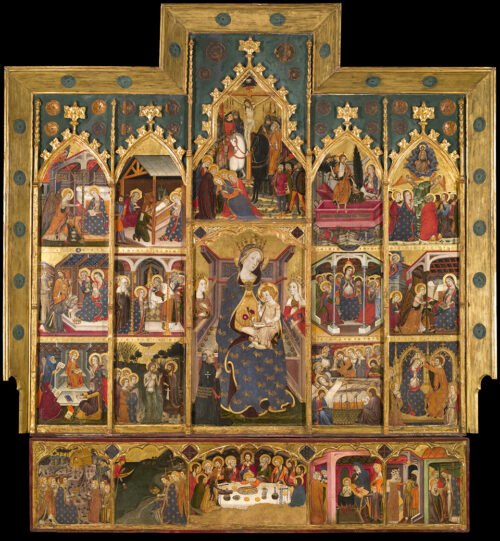
In the fourteenth century, the Kingdom of Aragon—and Barcelona in particular—acted as a gateway for the introduction of Italianate-inspired Gothic art. As Aragon, together with Genoa, dominated trade in the western Mediterranean, artists flitted back and forth, acquiring stimulation and knowledge of the crafts involved in creating the masterpieces produced and preserved in Siena and elsewhere. In the process, Barcelona—and later Valencia—were transformed into the most successful pictorial hubs of the fourteenth-century Mediterranean.
In the first half of the century, Ferrer Bassa (1285–1348) and his son Arnau (†1348) learned from Simone Martini. After 1350, however, the political and religious landscape fostered close contacts with artists active in Avignon, such as Matteo Giovannetti (1322–1368). Both appear to have died of plague during the first wave, leaving their workshop in tatters. At this point, Ramon Destorrents and Francesc Serra the Elder entered the scene to complete the many unfinished altarpieces and other works cluttering the order books, a situation that makes it difficult to identify the contributions of each painter. At present, only one work by Francesc the Elder has been securely identified: the retablo of Saint Louis of Toulouse, destined for Barcelona Cathedral.
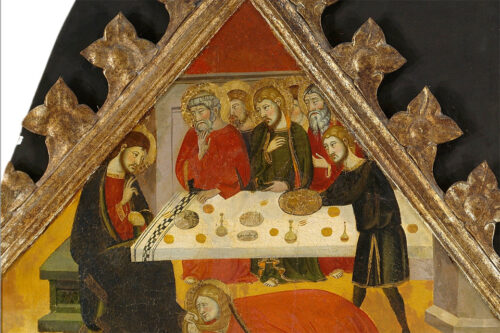
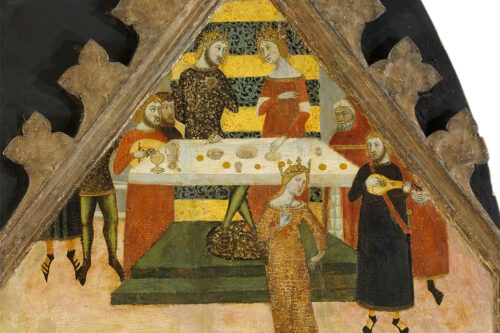
Tempera, gold leaf and metal plate on wood
From the Chruch at Tobed. © Museo del Prado.
Jaume and Pere Serra
After 1365, the centre of this artistic milieu shifted to the Serra brothers, Jaume and Pere, along with their extended family. A nephew, Francesc Serra the Younger, was active in Valencia between 1379 and 1396. While earlier Barcelona workshops had produced a mixed portfolio—paintings, altarpieces, illuminated manuscripts, and polychrome sculpture—the Serra brothers focused exclusively on the production of grand altarpieces, a format distinctive to Iberia. Nor were they solely court painters: although they occasionally worked for the Crowns of Aragon or Castile, they also relied on a broader range of patrons.
One of the defining characteristics of their oeuvre was the retablo, the large, fixed, monumental altarpiece, echoing the layout of the popular Biblia Pauperum manuscripts. These were not only collected by wealthy nobles and urban elites, but also served as sources of artistic inspiration. Often filling the apse behind the altar, such grand retablos command attention for extended periods through their brilliant colours, generous use of burnished gold leaf, and scenes drawn from daily life in late medieval Catalonia.
Whether the Serra brothers achieved particular economic success by narrowing their output to a single genre remains uncertain. What is clear, however, is that they gained a reputation defined by a highly distinctive artistic style that dominated the artistic landscape of Aragon for more than fifty years. With their signature features—tiny, stylised, slanted eyes, small mouths, and carefully constructed domestic scenes—their works are immediately recognisable. The result was a distinct artistic look, but also a style that makes it difficult to distinguish the hand of one artist from another.
FEATURED PHOTO:
Retablo of the Holy Virgin by Jaume Serra
Tempera, gold leaf and metal plate on wood
From the monastery of Santa María de Sigena (Villanueva de Sigena, Huesca).
© Museo d’Art Nacional de Catalunya
SOURCE:
Gothic painting in the Catalan-speaking lands between
the 14th and 15th centuries
Rosa Alcoy*
Universitat de Barcelona
CATALAN HISTORICAL REVIEW, 8: 29-44 (2015)
VISIT: