
A recent issue of the French Journal: Études anglaises ( Vol 3/2013 (vol 66) has collected a series of studies touching upon the materiality of manuscripts as medieval objects as well as medieval objects figuring inside the “texts”
The Innocence of Medieval Objects
Études anglaises Vol. 66, 2013/3
136 pages
Publisher: Klincksieck
E-ISBN: 9782252038901
ISSN : 0014-195X
ISSN en ligne : 1965-0159
Studying material aspects of medieval culture is one way of satisfying that imperious manuscript fetish in whose thrall most medievalists lead their (academic) life. A recent issue of the French Journal: Études anglaises (Vol 66, issue 3, 2013) has collected a series of studies touching upon the materiality of Manuscripts as medieval objects – or medieval objects figuring inside the “texts”.
The volume’s title picks up on Ohran Pamuk’s “Museum of Innocence,” devoted to the re-creation and conservation of the Istanbul habitat in which he grew up and conceived his œuvre. Thus the volume harbours ordinary everyday objects as well as materiality in a wide variety of texts.
“Whether manuscripts, “real” objects, or circulating texts, they know too much, and need only gentle coaxing to reveal secret agendas. Naughty spoons, corrupt manuscripts, allegorical figurations are the stuff not of dreams or nightmares, but the very material available to medievalists, the only object of their studies”, claims the editor, Florence Bourgne, in her introduction. The articles are accompanied by a select bibliography.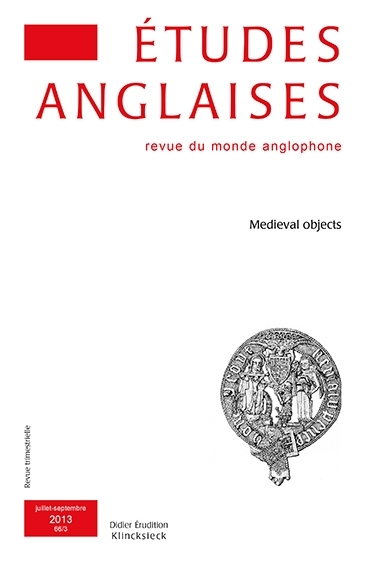
A cruel spoon in context: cutlery and conviviality in late medieval literature
By Stephanie A. Viereck Gibbs Kamath
ABSTRACT
Indebted to Derek Brewer’s “honor-group” theory, this essay explores how ideas of community and individuality found expression through depictions of spoon use in late medieval English and French texts. “Guillaume de Digulleville’s Pèlerinage de vie humaine” employs a spoon to represent the dissolution of monastic communal ideals, an implement described as a cruel spoon of singularity in John Lydgate’s fifteenth-century translation. Exploring Geoffrey Chaucer’s spoon references uncovers a discourse on social unity and its challenges; it seems no coincidence that the Canterbury Tales pilgrims who mention desirable, costly spoons are the singular figures of the Pardoner and Alison of Bath.
Piers Plowman and institutional poetry
By Emily Steiner, University of Pennsylvania
ABSTRACT
William Langland’s Piers Plowman wields a reformist agenda while experimenting with religious verse. Wit’s (allegorical) castle of the soul echoes Sir Gawain and the Green Knight and Digulleville’s Pèlerinage de vie humaine. Together with St. Truth’s elaborate shrine/penitential castle, whose keys are reminiscent of romance rapes, and the barn of Unity/Church, these buildings demonstrate Langland’s deep attachment to institutions. Similarly, Langland shows Digullevillian taste for the handling and transcribing of legal documents. The English fifteenth-century craze for the Pèlerinages may well have been triggered by Piers Plowman, which was their natural conduit.
Calling a spade a spade: allegorical tools in the Pilgrimage of the Lyfe of the Manhode and Chaundler’s Liber apologeticus
Florence Bourgne, Université de Paris-Sorbonne
ABSTRACT
The allegory in Guillaume de Digulleville’s Pèlerinages (1330-1358) is known to rely heavily on craftsmen’s tools —just as the medieval Sunday Christs extant in English and Alpine wall-paintings. In an illuminated copy of the Pilgrimage of the Lyfe of the Manhode, Labour the mat-maker, whose activity symbolizes the author’s industriousness, is given a spade as attribute, thus aligning with Ricardian authors’ humility topoi. In Thomas Chaundler’s Liber apologeticus (c. 1460), a spade is introduced in the allegorizing scheme, identifying mankind and Adam, but also hinting that the author hopes for “mediocre” perfection, in proto-Renaissance fashion.
Braying peasants and the poet as prophet: Gower and the people in the Vox clamantis
Sarah Novak, Université de Paris-Sorbonne
ABSTRACT
Gower’s public writings target the “common people,” whom the Ricardian poet hopes to reform while embodying its very voice. In the Vox clamantis II-VII, Gower’s poetic persona is that of a strident reformist, who records the complaints of the vox populi “in general.” In the allegorical vision of the 1381 upheaval (Book I), Gower adopts a different prophetic mode. As he foresees the labourers’ rebellion, the peasants morph into wild animals, London turns into a wasteland, a new Troy. The peasants’ voices become mere animal grunts, and the voiceless rebels are excluded from the “common people,” for whom Gower normally writes.
Wisdom in the margins: text and paratext in The Seven Points of True Love and Everlasting Wisdom
By Dirk Schultze, Universität Göttingen
ABSTRACT
The only comprehensive Middle English translation of Henry Suso’s Horologium sapientiæ has a uniform manuscript tradition, inclusive of paratextual material. This material was supplied early, most probably by the translator, and “marries” the translation to the Latin original, while additional marginal annotations open a space of authority for the translator. This space was meant to safeguard the text from later modifications, and exerted some control over the intended audience’s vernacular reception. This hierarchical interplay between margin and text proper and the permanence of a Latin authoritative voice bespeak the Seven Points’ locale in a time of religious and translational strife.
Mouvance, or the fortunes of a late fifteenth-century sermon cycle
By Stephen Morrison, Université de Poitiers
ABSTRACT
A firmly orthodox late fifteenth-century sermon cycle, extant in seven manuscripts falling into three groups (CUL Gg.6.16; then the more erudite BL Harley 2247 and Royal 18.B.xxv; and finally Oxford, Bodleian Library, e Musaeo 180, Lincoln, Cathedral Library, 50-51, Gloucester, Cathedral Library 22, and Durham, University Library, Cosin V. iv. 3, with the complete cycle in the same hand), exemplifies textual variance as it displays various degrees of unconscious rewording, deliberate rewriting, even massive amplification. Instances of textual corruption confirm manuscript grouping into chronological stages of development, while scribes may have been prompted to deviate from their exemplars by a desire for clarity or didactic concerns.
The Chastising of God’s Children from manuscript to print
By Steven Rozenski, Harvard University
ABSTRACT
Possibly the first print by Wynkyn de Worde was the devotional treatise The Chastising of God’s Children (c. 1493). Extant manuscripts correct scribal errors carefully, but the incunable introduces many variants. These, as well as the incunable’s colophon and title page, show Wynkyn de Worde’s Chastising evincing more skepticism about human virtues, and amplifying the distinction between corporeal and non-corporeal revelations in the discernment of spirits. The incunable is concerned with spiritual needs, not with the social approbation of revelatory experience or the suppression of heresy; its critique of images and visions foreshadows future controversy.
Malory and the cowardly Cornish knights — “The strangest races [that] dwell next door”
By Kevin J. Harty; La Salle University, Philadelphia
ABSTRACT
Malory repeatedly charges Cornish knights with cowardice in Book V of his Morte Darthur, thus conforming to the Roman de Tristan, his principal French source. The Cornish otherness already features as early as Book II. Despite medieval Cornwall’s multiple Arthurian associations, Malory’s condemnations align with a general derogatory view of at times almost all things Cornish which prevails from the twelfth century onwards. Malory is even aware of the linguistic otherness of the Cornish people, whose rebelliousness continues well into the Early Modern era —and later.
Staging Everyman. A “Dance of Life,” or of the use of medieval drama to re-energize our contemporary stage
Jérôme Hankins, Université de Picardie-Jules Verne, Amiens, Centre de Recherche en Arts et Esthétique
Florence Bourgne, Université de Paris-Sorbonne
INTRODUCTION
In 2008, the Centre Dramatique Régional de Haute-Normandie (Théâtre des Deux Rives), and its artistic director, Élizabeth Macocco, in Rouen, asked me to develop a triptych of Edward Bond plays for young people, to be performed by artists selected within a “compagnonnage” whereby young trainee actors perfect their art through permanent residence in a major professional theatre….