Estonia is known for its very old tradition for using knitted mittens for prestigious gifts. The oldest fragment is from the 13th century.
 In 1949 a cemetery from the 13th century in Jouga near the northern coast of Estonia was excavated. One grave, dated to 1238 -1299, contained a very precious find: a fragment of what appears to be a knitted mitten. Until recently the find was only published in German; (however an English discussion of the singular piece may be found here).
The find is singular in so far as most of the other fragments of mittens from Estonia, Finland, and Western Russia (Novgorod) appears to have been made with needle-binding technique, also called knotless netting. However, this fragment has definitely been knitted.
Knitting is generally believed to have been invented in Northern Africa and exported via Southern Italy and Spain into Northern Europe via the crusaders. The unique find in Estonia is believed to reflect the import of the technique via the German Order, which conquered the Baltic area in the 13th and 14th century. However, another route might be the vibrant trade from the Middle East through Novgorod and into the Baltic. Until now, the earliest European knitted textiles were found in the royal burials in Las Huelgas in Burgos.
Mittens in Estonia
 Mittens played a very important role in the traditional folklore in Estonia. First of all they signified fertility. When a man wished to court a woman, his mother would send a bottle of spirits to the family of the girl. If the bottle was returned empty and with a pair of mittens attached, he was said to be on. Rings were later exchanged, but with gloves on! Apart from that, mittens were placed in sheep-stables, carried in the belt even in summertime and – not least – used for gifts. At burials the deceased wore mittens, like the ones, from which the knitted fragment stems.
The Fragment
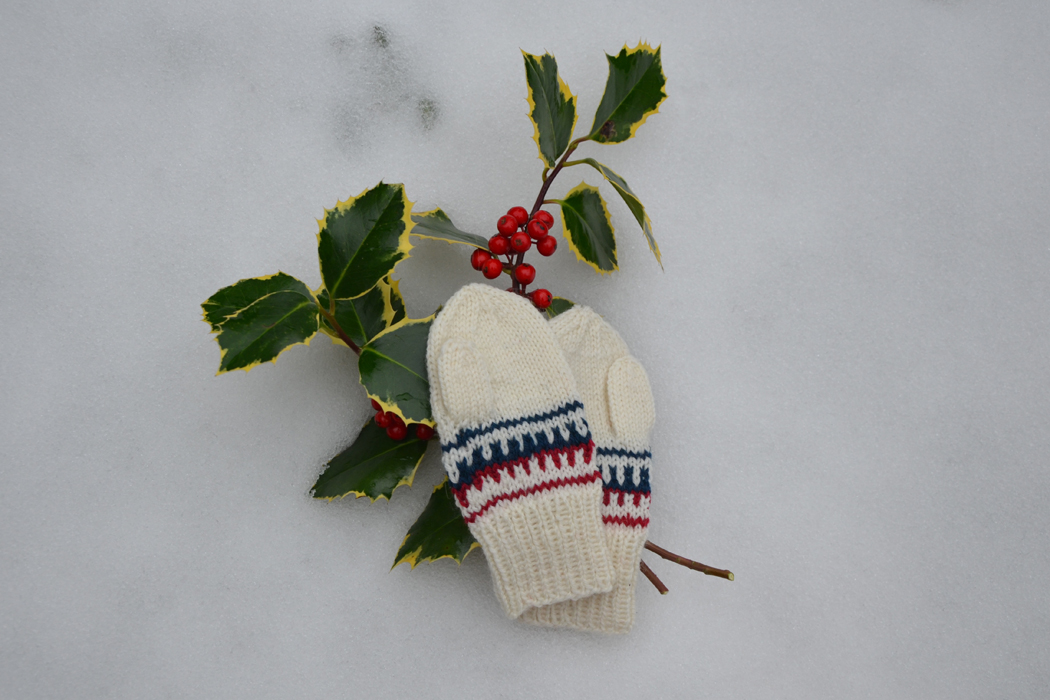
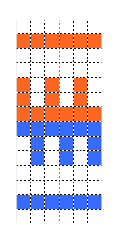
The mittens were made of white wool and with a pattern made from dyed wool. The blue was dyed with indigo, while the red was dyed from madder. There is some confusion as to whether the fragment had been started with rows of purl. The “reconstruction” in the featured photo was made with an ordinary functional rib (practical for pushing up under the sleeve of a child’s jacket). The gauge in the fragment was 2.5 x 3 rows pr. cm.
SOURCE:
Totenhandschuhe im Bestattungsbrauchtum der Esten und anderer Ostseefinnen
By: Juri Peets
In: Fennoscandia archaeological IV (1987)
READ MORE:
 Folk Knitting in Estonia. Tradition and Technique
By Nancy Bush
Interweave Press 2000
ISBN 1883010438