
A recent issue of “Le Moyen Age” treats a diverse number of subjects from the high and late Middle Ages
Le Moyen Age, Revue d’histoire et de philologie
2013/2 (Tome CXIX)
272 pages
De Boeck Supérieur 2013
I.S.B.N. 9782804180478
DOI : 10.3917/rma.192.00403.
The Diplomacy in the “Memoires of de Commynes”
[La diplomatie dans les Mémoires de Commynes]
By Jean Dufournet, Université Sorbonne Nouvelle – Paris 3.
ABSTRACT
The Mémoires by Philippe de Commynes, – a mixture of war stories and transactions – represents a way, among others, of looking at diplomatic negotiation as it was conceived and practiced in the 15th century. The art of negotiation, which Commynes observed and practiced over a long period, is described throughout his Mémoires as lessons intended for his readers, most importantly princes. In fact, the latter should learn, through diplomacy, to know their friends and enemies better; and, to accomplish this, they should be able to rely on able and faithful ambassadors, whom they should therefore choose with care. From this perspective, the Mémoires becomes a manual for using diplomacy well; but a manual intended, as far as the author was concerned, for the French.
Redemption and Extension of “Journeys” in the Accounts of Hainault in the 15th century: Indicators of a Military Situation
[Rachat et ralongement des « voyages » dans la comptabilité du Hainaut au XVe siècle : des indices de la conjoncture militaire]
By Jean-Marie Cauchies; Académie royale de Belgique – Université Saint-Louis, Bruxelles.
ABSTRACT
Legal pilgrimages, called “journeys,” were common in medieval justice. An order could also be given, proclaimed by crier, to “extend” them; i.e., to postpone the deadline for their completion, sometimes with an offer of an alternative – a redemption, through payment of a sum of money. It is revealing to compare the texts and notices of these measures in the accounts to the military situation at the time. These occurred in times of trouble caused by external threats; a case in point is the county of Hainault, when the roads were far from safe and when it was feared that there would not be enough hands available to defend the country. There are a glaring number of them during the military campaigns of Charles the Bold and Maximilian of Austria against France, between 1467 and 1493.
Semantic Transfers between Islam and Christianity in the 12th century through the Translation of the Quran by Robert de Ketton (sourates al-fātiḥa and al-baqara)
[Transferts sémantiques entre islam et chrétienté au XIIe siècle à travers la traduction du Coran de Robert de Ketton (sourates al-fātiḥa et al-baqara)]
By Olivier Hanne, Université de Provence (UMR–TELEMME) .
ABSTRACT
Although Robert de Ketton’s Latin translation of the Quran is a well-known source from the 12th century, no critical edition of it has been published, nor has it been the subject of comparative semantic analysis. This paper presents the translation methods used from Arabic to Latin, by focusing only on the first two suras of the Alcoran (al-fātiḥa and al-baqara), which are published in an annex. Although Robert de Ketton attempted to stay faithful to the meaning of the original text and looked for appropriate Latin expressions, in fact his work took him away from the Arabic Quran as he reorganized its verses and redirected its ideas, images, and prosody. In contrast to the editor of the marginal gloss, who was radically hostile to the text and the language of the enemy, this rather compassionate translation attained a kind of Christianization of the Quranic vocabulary and therefore managed to achieve a cultural adaptation. However, in these two translated suras, Islam emerged as a form of Jewish legalism, or heresy.
Filius cum patre. Kinship, Alliance, and Passing On the Office of Viscount-Mayor in Dijon in the 15th century
Filius cum patre . Parenté, alliance et transmission de la charge de vicomte-mayeur à Dijon au XVe siècle
By Cécile Becchia, Université Paris–Sorbonne, .
ABSTRACT
Based on a study of the mayors of Dijon (1419-1509), this paper is concerned with the role of kinship and alliance in the inheritance of urban power. It examines the importance of family groups in the political life of the town, the relationships they fostered to pass on mayorial power within their own ranks, the strategies developed by the most important families in carrying out their offices, and their place in the respective lives of the people in power. The paper stresses the gradual concentration of mayorial duties in the hands of men, who remained in power for several years and belonged to a limited number of families, and gradually formed alliances with each other. The passing on of power would then tend to happen between allies. In fact, the most important of these families came to power after their sustained and organized presence as aldermen, and this coincided with their integration into princely institutions.
Inscriptions and Images in some Prose Romances (13th-15th C.)
[Inscriptions et images dans quelques romans en prose (XIIIe–XVe siècles)]
By Sandrine Hériché Pradeau, Université Paris–Sorbonne
ABSTRACT
Starting from the Platonic idea that writing and painting are linked by virtue of their power of representation (mimesis), and based on prose romances from the 13th to 15th Centuries (Lancelot-Graal, Prose Tristan, Perceforest and René d’Anjou’s Le Cuer d’Amor Espris), which regularly inserted the text of inscriptions into their narratives, the article examines the visual power of these inscriptions, viewed from their purely iconic dimension within the narrative itself. The article then considers ways in which the inscribed characters are linked to the meaning of what is seen, either as material objects or as elements perceived within a dreamlike framework. Finally, inscriptions and images are considered jointly, their association apparently transformed into a relationship: between dream and reality, sacred and profane, or Time Past and Time Present.
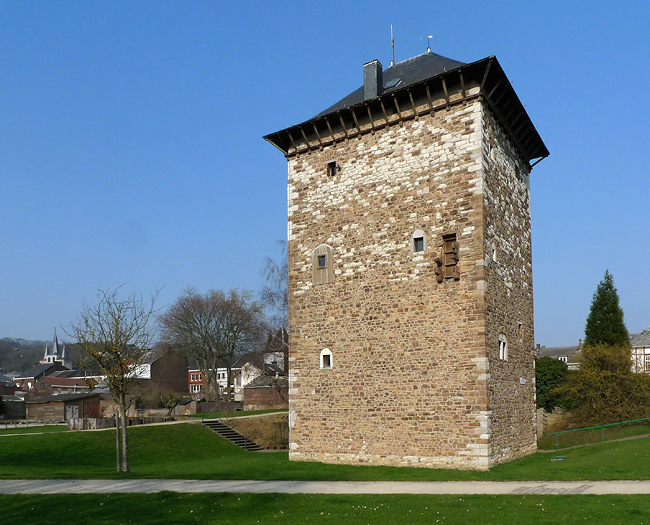
The War between the Awans and the Waroux. A “Vendetta” in the Hesbaye of Liège (1297–1335)
La guerre des Awans et des Waroux. Une « vendetta » en Hesbaye liégeoise (1297–1335)
By Christophe Masson, Université de Liège, « Transitions ». Département de recherches sur le Moyen Âge tardif et la première Modernité
ABSTRACT
The war between the Awans and the Waroux has always been viewed as a prototype of an aristocratic family war in the country around Liège. In this feud, with the exception of a few contingents of foot soldiers, cavalry played a dominant role throughout the conflict. Even though the art of war was beginning to involve a much broader range of weapons, the people of Hesbaye thus refused to change their style of combat, or their life style, which was an expression of their status. This attachment to tradition and to the old ways was also found in the mechanisms of lineage solidarity affected by this conflict, which, based on a series of very simple ties (between brothers, cousins, uncles and nephews, and brothers-in-law), structured the Hesbaye nobility. Finally, the conflict did not do away, either quantitively or qualitatively, with the nobility in the country of Liège, as many writers have claimed.