Six Medieval Episcopal Thrones in Britain has survived. New book describes and analyses five of these
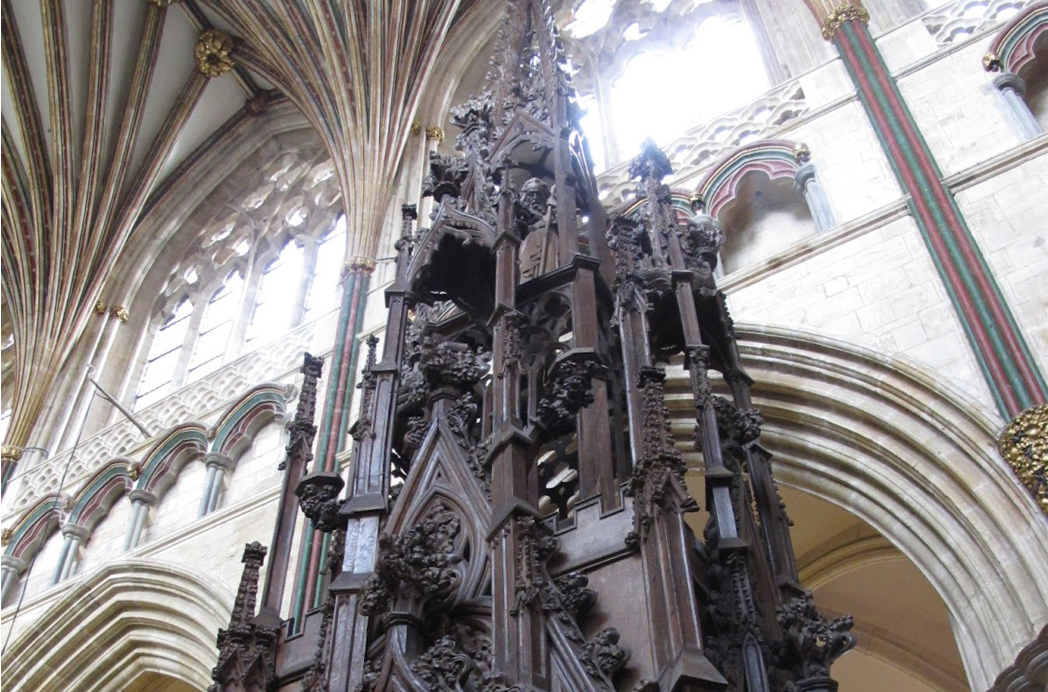
 This newly published book by Charles Tracy with Andrew Budge describes and analyses five out of the six surviving medieval episcopal thrones in English and Welsh cathedrals: the magnificent timber example that is shown on the cover at Exeter, plus those (also of timber) at St Davids and Hereford, along with the stone chairs at Lincoln, Wells and Durham. The stone chair at Canterbury has been so much studied by others that it features here mainly as one of several comparanda. These also include a number of surviving thrones on the Continent, analysed and illustrated in the first chapter, though the authors make clear that reliquaries also had a strong influence on the design of English and Welsh examples, and that the throne itself could be considered a relic — not just a piece of ecclesiastical furniture but something venerable in its own right and a symbol of continuity and authority, even when, as is the case with these thrones, they were made for and by known individuals.
No throne better illustrates this fact than that at Exeter, about which the authors have gathered together a huge amount of information, including accounts of the selection, cutting and seasoning of the timber, the costs involved, the names of some of the people involved in its design and carving, and the major change of plan that resulted from Bishop Walter de Stapeldon’s growing ambitions for his cathedral and throne, leading to the original design, of no great height, soaring to fifty-three feet by the addition of the crowning filigree spire. The Exeter throne is the largest and most impressive in Europe. It is a distinguished innovatory example of the English Decorated style, with antecedents passing back to the court of Edward I. It exemplifies most of the historical and formal strands that suffuse the entire book – visual appearance, distinctiveness within the building, prestige, construction, stylistic context, finance, and the patronage and personal role of the bishop himself; as well as the subtler issues of the personal and collective politics of bishop and chapter, the monument’s liturgical applications, its relationship with the cathedral’s relics, its symbolism and what it tells us about the aspirations of the institution within the existing ecclesiastical hierarchy.
The text is by the art historian, Dr Charles Tracy, a seasoned expert on church furniture both in Britain and on the continent of Europe. The chapter on the stone thrones was prepared by Andrew Budge who is currently preparing a Ph.D thesis on ‘English Chantry Churches’ at Birkbeck College. The polychromy authority, Eddie Sinclair, spent many hours on the scaffold to bring forward her remarkable report on the Exeter throne. Her full report is to be published online.The Exeter throne is also interpreted by the established timber conservation practitioner, Hugh Harrison, and the St Davids throne by the experienced draughtsman, Peter Ferguson. In an age of the CAD, his meticulous measured drawings of the Exeter and St Davids monuments are one of the most remarkable features of book. The architect, Paul Woodfield prepared the drawings for the Lincoln chair.
This book is the first major investigation of a subject of seminal importance in the study of church history and archaeology. The two stone thrones, at Wells and Durham, the three timber monuments, at Exeter, St Davids and Hereford, and the mid-14th-century bishop’s chair at Lincoln, all come under a searching empirical enquiry.
Table of Contents
Acknowledgement
Preface
1. Episcopal thrones in the early-medieval church
2. The timber episcopal thrones of medieval britain
I. Exeter Cathedral
ii. St Davids Cathedral
iii. Hereford Cathedral
3. The Lincoln Cathedral bishop’s chair
4. The medieval stone episcopal thrones at Wells and Durham Cathedrals, by Andrew Budge
Appendix 1. Significant items connected with the manufacture of the Exeter Cathedral bishop’s throne (extracted from the fabric accounts of the Exeter Cathedral)
Appendix 2. Significant items connected with the manufacture of the Exeter Cathedral choir furnishings by Thomas of Witneys’s ‘high altar team’ et al., 1316–1326. (Representative extracts from the general and high altar accounts of the fabric rolls of the Cathedral)
Appendix 3. The construction and assembly of the bishops’ thrones at Exeter, St Davids and Hereford Cathedrals, by Hugh Harrison
Appendix 4. The medieval polychromy scheme of the Exeter Cathedral bishop’s throne: a summary, by Eddie Sinclair
Appendix 5. Chudleigh, Norton and the carriage of timber for Exeter’s bishop’s throne, by John Allan
Index
All of this is illustrated through the superb drawings of Peter Ferguson, along with photographs of diagnostic details,
Britain’s Medieval Episcopal Thrones: history, archaeology and conservation
By Charles Tracy, with a chapter by Andrew Budge
Oxbow Books 2015
ISBN 9781782977827