
Lake Constance – Bodensee – was early on renowned for its medieval fisheries. Remarkably, the focus was on sustainability from at least 1350.
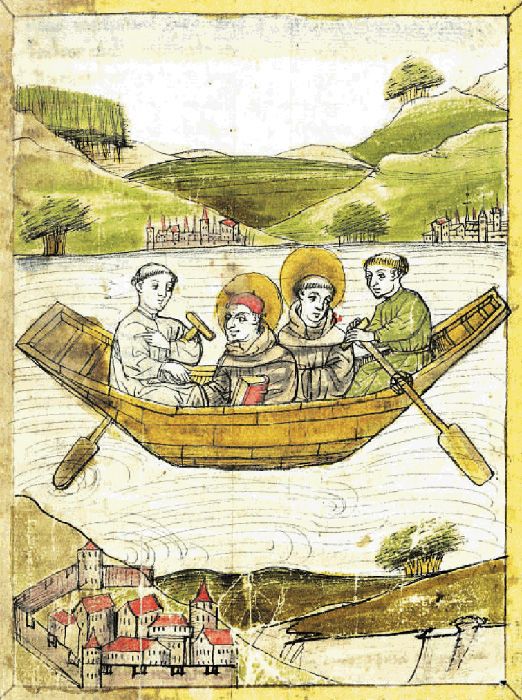
Lake Constance is a lake on the Rhine at the Northern foot of the Alps. It consists of three bodies of water, the upper lake, the lower lake and the connecting Seerhein. Characterized by abundant fisheries, it was early on exploited by professional fishermen, who knew how to navigate the different fishing waters for their prey: salmon, eels, roach, bream, trout, pikes and not least the renowned “Felchen” – a beloved whitefish
With different ecologies, different habitats and different migratory patterns the many species represented a rich, albeit challenging resource. Early on this created a niche for professional fishermen well versed in where, when and how to fish for the different species. Not least, the wielding of different types of gear and the access to local knowledge about the diverse fishing waters made this a highly specialised artisanal craft.
Contributing to this development of this professional fishery was also the political situation. Lake Constance (Bodensee) was early a very important hub for long distance trade in linen cloth, salt, iron and luxuries with important North-South and East-West routes traversing each other in the region, dominated by a number of monasteries and towns along the lake-side, Reichenau, St. Gallen, Constance, Lindau etc. It is thus no surprise that the region early on became the centre of constant fighting and warring, resulting in a patchwork of localities answering to different (and constantly shifting) overlords: the Church, the Hapsburgs, the Swiss confederacy etc. Even today, the lake is not divided by a border; Germany, Austria and Switzerland govern the lake through separate treaties.
Fishermens’ Guilds

In the midst of all these upheavals, the local fishermen went about their very important business, which was to supply the towns and the monasteries around the lake with their daily fish. Early on – and at least from the mid 14th century – it was known that this business could not be a free-for-all. Although the resources were plentiful and fishing might be intensified when climatic events caused poor harvests, there were obviously limits. Especially the fishing of certain types of fish had to be regulated since they were highly sought, for instance the young perch, the Hürling, which was considered a delicacy. Accordingly the use of certain types of gear (trawling nets), the size of meshes, the size of fish, they were allowed to land, dates for the conservation of species, the number of fishermen allowed to fish in the lake etc. was constantly renegotiated. In order to organise this, fishermen set up local guilds or cooperative bodies, which were overseen by the magistrates or local authorities bent on balancing their need to secure stable supplies of fresh fish on a daily basis with those of the fishermen to have a satisfactory income. To this should be added the constant need to “police” the strife and fray between fishermen from different localities fishing from one end of the lake to the other, as well as to negotiate the treaties proclaimed by the diverse principalities in the region.
In a recent book this fascinating story is told in all its details by the German historian, Michael Zeheiter, who has been able to demonstrate how both fishermen and local authorities were bent on a sustainable approach from 1350 and onwards. Reading this, we learn of how the Abbot at Reichenau changed the allowed size of the pikes, when an illness hit the fish; or about the allowed size of fishes, which had to be cut into the railing of the boat; or about the ban on a small trawling net, called the Streiffen, which was used to catch bullhead, a kind of bait-fish. Obviously, the fishermen needed to use this gear; but with its close meshed net and its use near the shore, a significant by-catch of young fish of more valuable species was to be expected. For almost a century the local authorities and in collaboration with the fishermen tried to regulate the use of the Streiffen.
Michael Zeheter have demonstrated how authorities together with the fishermen were able to negotiate a set of sustainable practices in and around Lake Constance. How often, these practices failed and the lake verged on overexploitation cannot be measured accurately. However, it is clear that for more than 400 years, there was “something” to protect and negotiate about. In spite the lake was a commons, order was upheld. “Again and again they prioritised their long-term-interest and the inhabitants of the Lake Constance are still profiting today from this chain of decisions, writes Michael Zeheter.
Today the Lake still accommodates more than 140 professional fishermen and services 13.500 anglers. As in the middle ages the gear, the number of nets, the sizes of the mesh and the days as well as dates for the season are laid down in an international treaty. Today, fishing is on level with the catches, which were landed in the 20s and 30s.
A highly interesting piece of research with important modern resonance.
SOURCE:
 Die Ordnung der Fischer. Nachhaltigkeit und Fischerei am Bodensee (1350–1900)
By Michael Zeheter
Series: Umwelthistorische Forschungen Vol 6.
Böhlau 2014
ISBN: 978-3-412-22356-4
An article was recently published, which presents the main conclusions for an English reading audience:
Order in the Lake: Managing the Sustainability of the Lake Constance Fisheries, 1350-1900
By Michael Zeheter
In: Environmental History Vol 21, No 4., November 2015, pp. 597 – 629.