In the 21st century medieval romances are bestselling as never before. Now time has come to read the real thing, the Middle English romances from the 13th and 14th centuries.
 After centuries of being dismissed “a wit-besotting trash of books” written by “literary hacks”, the Middle English romances have only recently been recognized as intelligent and evocative texts helping to illuminate medieval insular culture.
New book hopes to further such a dialogue with six romances representative of different themes and origins. Each chapter is a facing translation, featuring the original Middle English text on the left of the page and an academic close-line translation into Present Day English on the right, accompanied by explanatory notes and sources.
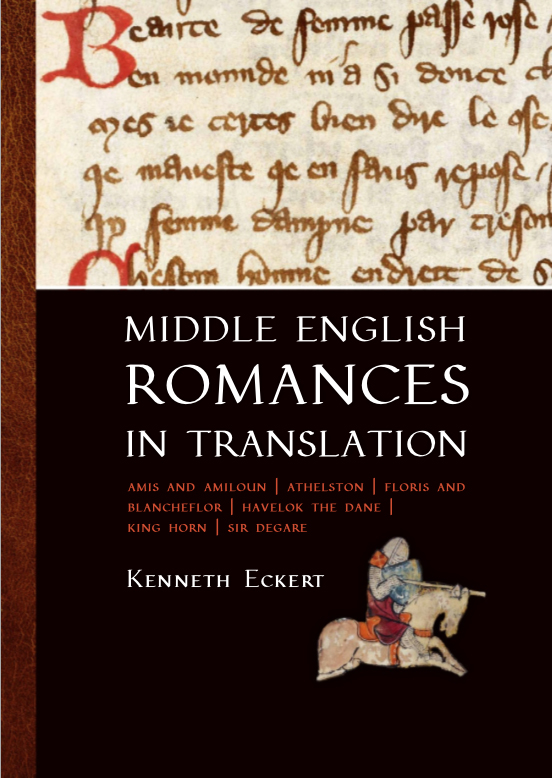
Middle English Romances in Translation: Amis and Amiloun, Athelstan, loris and Blancheflor, Havelok the Dane, King Horn, Sir Degare
Edited and translated by Kenneth Eckert
Sidestone Press 2015
ISBN: 9789088903397
The book is available in print, but may also be read for free in Scribd or downloaded as a pdf.
ABSTRACT:
The popular romances of Medieval England are fantasy stories of love at first sight; brave knights seeking adventure; evil stewards; passionate, lusty women; hand-to-hand combat; angry dragons; and miracles. They are not only fun but indicate a great deal about the ideals and values of the society they were written in. Yet the genre of Middle English romance has only recently begun to attain critical respectability, dismissed as “vayn carpynge” in its own age and generally treated by twentieth-century critics as a junk-food form of medieval literature. Chaucer’s Tale of Sir Thopas has been assumed to be a satire of the romances’ clichéd formulas and unskilled authors. But the romances evidently enjoyed popularity among all English classes, and the genre itself continued to flourish and evolve down to present-day novels and movies. Whatever Chaucer and his contemporaries thought of romances, they would have needed some personal familiarity with the stories and texts for comic tales such as Sir Thopas to be understood.
A century ago, Beowulf faced the same problem that the Middle English romances still face: no modern translations were published because few had heard of the poem- because there were no modern translations published. Where the romances have been printed, they have normally been reproduced as critical editions in their original language, or translated into heavily abridged children’s versions, but few have been published as scholarly close line translations with notes. This book is an attempt to remedy this by making some of these romances available to the student or lay reader who lacks specialized knowledge of Middle English, with the hope that a clearer understanding of the poems will encourage not only enjoyment but also further study.
Table of Contents
- Amis and Amiloun (date: c. 1330)
A saintly ‘bro-mance’ about two knights who pledge faith to each other, a loyalty tested when one is caught in a lie after being seduced by the king’s daughter and the other must break his word to save his friend’s life-a decision followed by heavenly punishment and a miracle of mercy. - Athelston (date: c. 1380)
A darker romance from the troubled time of Richard II about a capricious, gullible king who believes an accusation of treason against his blood-brother made by a jealous competitor, a murderous situation only faced by the archbishop’s miraculous tests and a hard-working messenger. - Floris and Blancheflor (date: c. 1280)
Here appearing for the first time in full with a missing introduction supplied from an earlier French version, a light and entertaining “roman rose” about a boy of a Muslim king who falls in love with his Saxon playmate and travels to Arabia to rescue her from the Emir’s marriage plans. - Havelok the Dane (date: c. 1285)
A dramatic ‘male Cinderella’ romance where Havelok, prince of Denmark, is rescued as a boy from an usurper’s plans for murder by a fisherman and brought to England, where he grows up to marry the dispossessed princess, brings revenge to both nations, and regains the throne. - Prince Horn (date: c. 1280)
A seafaring romance where prince Horn is exiled by invading Saracens and sails to a new land where King Murray raises him, complicated when he is accused of deflowering the princess and banished to Ireland; after avenging his father he returns to settle scores and rescue his lady. - Sir Degare (date: c. 1330)
Possibly from a Breton lay, a mysterious tale of a princess raped by a handsome fairy who sends away her baby to be raised by priests; after proving himself as a knight, Degare unwittingly marries his mother, but when the error is recognized he seeks out glory and his father.
ABOUT THE AUTHOR:
Dr. Ken Eckert is Assistant Professor of English at Hanyang University (ERICA), Ansan, Korea, where he teaches undergraduate courses in English literature and graduate-level composition theory. He studied at the University of Nevada, Las Vegas (PhD, 2011), with a dissertation in Chaucer and medieval romance; Memorial University of Newfoundland (MA, 2001), with a thesis and translation of Beowulf; and Concordia University of Edmonton (BA, 1990).
READ MORE:
 The Cambridge Companion to Medieval Romance
Ed. by Roberta L. Krueger
Cambridge University Press, 2000
This Companion presents fifteen original and engaging essays by leading scholars on one of the most influential genres of Western literature. Chapters describe the origins of early verse romance in twelfth-century French and Anglo-Norman courts and analyze the evolution of verse and prose romance in France, Germany, England, Italy, and Spain throughout the Middle Ages. The volume introduces a rich array of traditions and texts and offers fresh perspectives on the manuscript context of romance, the relationship of romance to other genres, popular romance in urban contexts, romance as mirror of familiar and social tensions, and the representation of courtly love, chivalry, ‘other’ worlds and gender roles. Together the essays demonstrate that European romances not only helped to promulgate the ideals of elite societies in formation, but also held those values up for questioning. An introduction, a chronology and a bibliography of texts and translations complete this lively, useful overview.
FEATURED PHOTO:
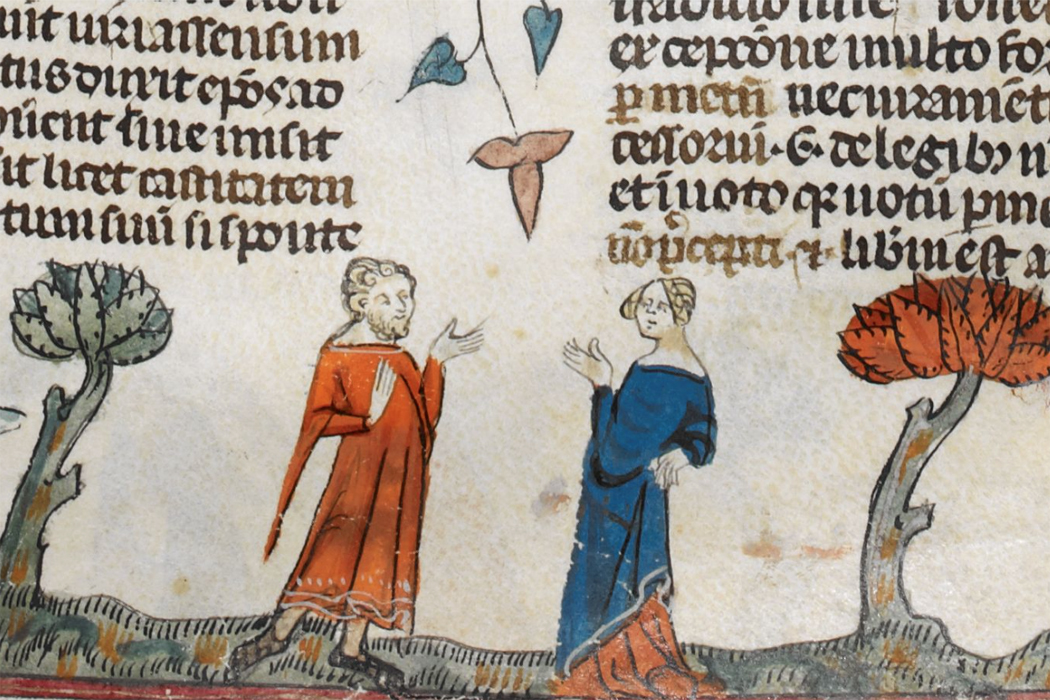
The Decretals of Gregory IX c 1300-c 1340, fol 84r. The bottom of the pages show illuminated stories. This one is from (c) story of a lion and a kinght based on the Chevalier an Lion by Chrétien de Troyes (ff. 80v-88r). © British Library