Inequality is here to stay. The question is only, how “medieval” will it become? And when will the crash set in?
Unnoticed by many, an essential EU-funded project, EINITE, has since 2012 studied Economic Inequality across Italy and Europe, 1300 – 1800. Now, the results are slowly being published, shedding important light on our own time marked by the combined downfall of economic science [1] and the manifest evidence of the rich getting richer.[2]
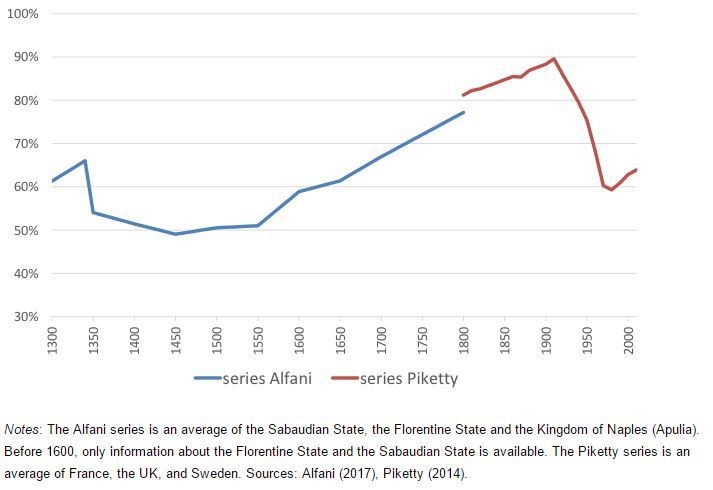
Painstakingly the historians involved in EINITE have collected and explored data from the Italian city-states to extract information about the long-term trends of wealth inequality to describe precisely how this played out. By coupling their results with Piketty’s [3], we now know about the long-term trends from 1300 – 2010.
What this shows is that a remarkable and constant growth of inequality took place throughout the centuries except during two periods. The first period was characterised by climate deterioration coupled with the plague; WW1 and WW2 marked the other period. Although the mechanisms differ slightly – and need to be explored carefully – it seems the primary trigger in both cases was the lack of workforce. It is estimated that 25 – 50% of the population died in the epidemics of the 14th and 15th centuries, causing a long-term decline in the available workforce. In the same manner, it is well-known that the wars in the 20th century caused the entry of women into the labour market while the men were out fighting and dying on the battlefields.
Walter Scheidel [4] has recently explored these phenomena on a wider time scale covering 10.000 years. In his opinion, the large equalising moments in human history may have had different roots (climate deterioration, epidemics or war); the common denominator, however, is “massive and violent disruptions of the established order”.
This is perhaps depressing. Here we thought that politics in the aftermath of the wars in the 20th century had finally found a way to square the circle by letting economists micro-manage the redistribution of wealth and welfare through the establishment of the balance invested in the “holy trinity” of the market, state and people; where the so-called welfare-state delivered welfare and education to people, thus securing a well trained and willing workforce, which could be utilised and exploited by the market, which paid the state for its services through taxes (either directly or indirectly through the tax-paying of the employers). And then we find that this merry-go-round was nothing but a short interlude in the inexorable movement towards a more unequal society in which the devil always takes the hindmost!
The question is, though, does this matter? If travelling on monkey class offers you a fraction of leg space and the possibility of buying a cup of coffee, who cares if a few unimaginably rich people tour the world in their private jets sipping pink champagne? Granted, most people in this world still live miserable lives – nasty, brutish and short (Thomas Hobbes 1651)! But perhaps, this is what we should be interested in trying to alleviate instead of thinking as peasants that the world is a zero-sum game. What about being creative, we might ask?
Looking further on this bright side, there seems to be even more hope. The new studies noted here seem to have opened up for an academic shift of seismic proportions. Up until now, the science of economics was peopled by economists occupied with developing and maintaining ever more sophisticated models used to predict and manage economic development locally, nationally and globally. Of course, the post-2007 crisis showed that none of these scientists or models had been able to predict the downfall and potential ramifications of the outfall from the American housing market. They simply failed!
Accordingly, we are witnessing now that the time has again come for the historians and, with them, the anthropologists, the psychologists and the social scientists. On a planet increasingly hot, flat, and crowded, we need more than ever to find creative and non-violent solutions. And although most epidemiologists agree that it is only a matter of time before a new plague hits the world, there is perhaps a tiny window of opportunity in which we might figure out liveable and sustainable solutions for the minority left when the shit hits the fan.
One way, it seems, is once more to take (medieval) history seriously!
Karen Schousboe
Footnotes:
[1] The Econocracy. The Perils of leaving economics to the experts. By Joe Earle, Cahal Moran and Zach Ward-Perkins. Manchester University Press 2016
[2] After a few spectacular firings and suicides in the wake of the early days of the financial crisis in 2007, it has been obvious the money-men have once again circled their wagons, redistributing even more wealth to the top-tiers of the global society. Recently (January 2017) Oxfam could thus publish a report claiming that eight persons in the world control a share of the global wealth, which corresponds to that of the poorest 50% of the world. Out of these eight, five are directly involved in the information economy (Microsoft, Telecom, Amazon, Facebook, Oracle, Bloomberg News) while the sixth built his wealth on the shoulders of the Telecom industry.
[3] Capital in the Twenty-First Century. By T. Piketty. Belknap Press of Harvard University Press 2014
[4] The Great Leveller: Violence and the Global History of Inequality from the Stone Age to the Present, By W. Scheidel, W. Oxford University Press 2017
SOURCES:
What history can teach us about inequality in Europe
By Guido Alfani
Wordl Economic Forum 27.01.2017
Economic Inequality and Poverty in the Very Long Run: The Case of the Florentine State (late Thirteenth-Early Nineteenth Centuries”, Alfani, G. and Ammannati, F. (2017). In: Economic History Review, forthcoming.
READ MORE:


FEATURED PHOTO:
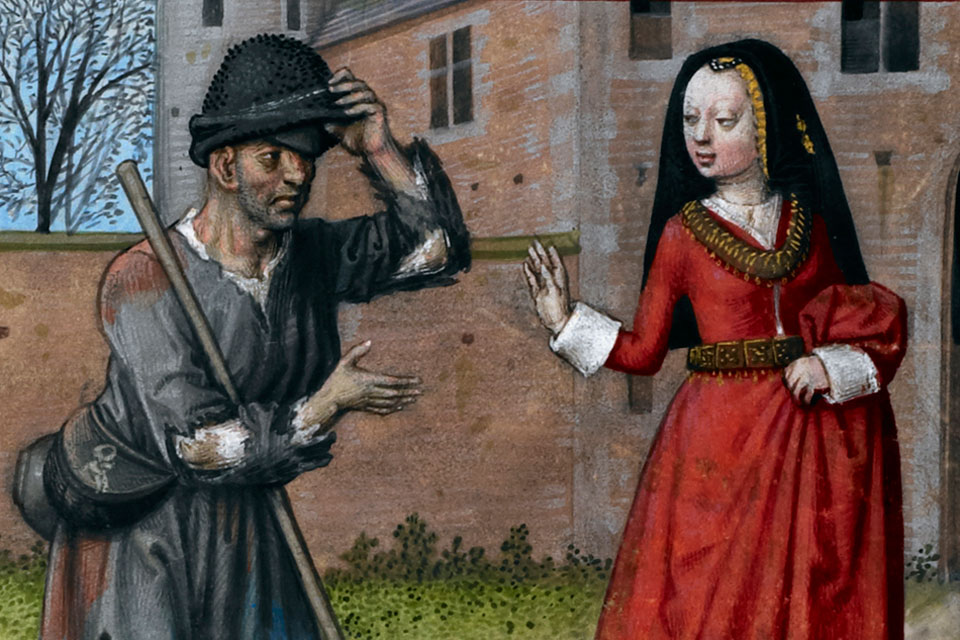
Poverty begging for mercy. Source: Harley MS 4425. British Library.