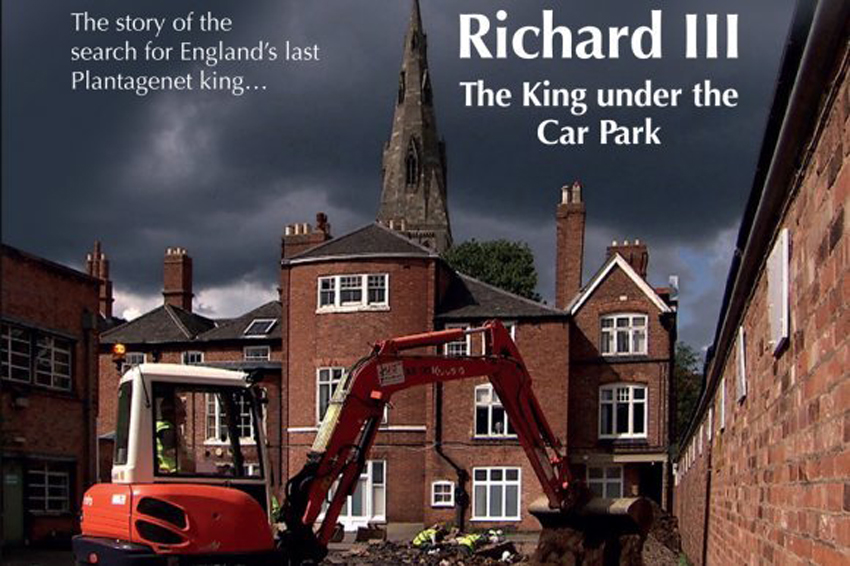
NEW BOOK: Well-presented and sober pamphlet tells the story of how the King under the Car Park was discovered and identified as Richard III…
Richard III. The King under the Car Park By Mathew Morris and Richard Buckley University of Leicester 2013 ISBN: 9780957479227
ABSTRACT
Richard Buckley and Mathew Morris, the lead archaeologists behind one of the biggest archaeological finds in history—the unearthing of human remains under a car park in Leicester, and their identification, beyond reasonable doubt, as Richard III—have written about the excavation in a new book, Richard III – The King Under the Car Park. The book, published this month (November) by the University of Leicester, is the first to tell the story from the viewpoint of those who actually found the remains in August 2012—staff at the University of Leicester Archaeological Services (ULAS) unit, who worked in partnership with Leicester City Council, and in association with the Richard III Society, to excavate Grey Friars in the City Centre. “The aim of the book is to present all of the information on the excavation of Grey Friars and Richard III in a fact-based, unbiased way,” Mathew, the site director for ULAS, said, “but also, given the huge excitement over the project, in a way that’s accessible to everyone.” The book is a comprehensive exploration of the excavation and its background, including:
- The historical context and the events that led Richard III to fall at Bosworth and to be buried at Grey Friars
- The legends that surround Richard, such as his stay at the Blue Boar Inn and the knocking of his spurs on Bow Bridge
- The research that went into determining the probable location of the friary and the burial site
- The account of the momentous days which saw the uncovering of Richard III’s remains
- The scientific methods used to confirm that the bones found at Grey Friars were in fact those of Richard III
- The research that went into tracing the genealogical line to two of Richard III’s modern-day relatives (descendants of his elder sister), making it possible to identify the remains using DNA
In many ways, it caps off the momentous story and for its authors means revisiting the excitement of the discovery: “The book reads like a detective story because it all happened like a detective story,” Mathew said. “It was amazing, as time went on, how everything slotted together—from the way we placed the trenches correctly, to finding human remains on the first day, to finding they were buried in the correct part of the church, to identifying the body.