Romansh digitisation project breaks new ground
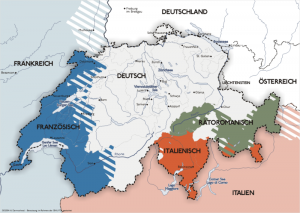
Romansh is a minority language still spoken in the Swiss Alps in the mountainous Graubünden canton. Only 70.000 people speak what is basically a Latin dialect. Nevertheless it has been an officially acknowledged national language since 1938.
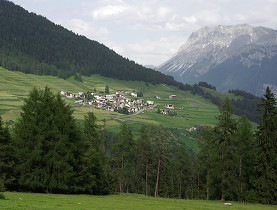
The heart of the Romansh culture is the Lower Egadine Valley (Engadina Bassa in Romansh), where a number of special customs has also been preserved (One of which – the celebrations of Epiphany – has been appointed part of the Swiss Intangible World Heritage by Unesco).
The earliest writing identified as Romansch dates from the 10th century: however major works do not appear until the 16th century. In the 19th century a nationalistic revival took place, which resulted in the publication of 15 volumes filled with texts from 1560 – 1910. Apart from lots of religious texts, the collection also contains diaries, letters, journals and accounts of Romansh speaking merchants, tradesmen, soldiers etc.
Source: Wikipedia: Sansculotte
Recently these volumes were digitised, thanks to newly developed software and a huge amount of crowd-sourced goodwill amongst present day Romansh speakers.
The project has been the brainchild of Professor Jürgen Rolshoven, a computational linguist in the Department of Linguistic Data Processing at the University of Cologne in Germany, and Wolfgang Schmitz, head of the Cologne University Library.
In a recent article Rolshoven explained to swissinfo.ch that he had started off his academic career as a philologist with a special interest in Romance – or Latin-based – minority languages, including Romansh; thus he had personal reasons for wanting to digitise the work.
SOURCE
Romansh digitisation project breaks new ground
By Julia Slater, swissinfo.ch
READ MORE:
Digitale Rätoromanische Chrestomathie
Sammlungen in rätoromanischer Sprache
FEATURED PHOTO:
Val Sinestra in the Egadine Valley. Source: Wikipedia