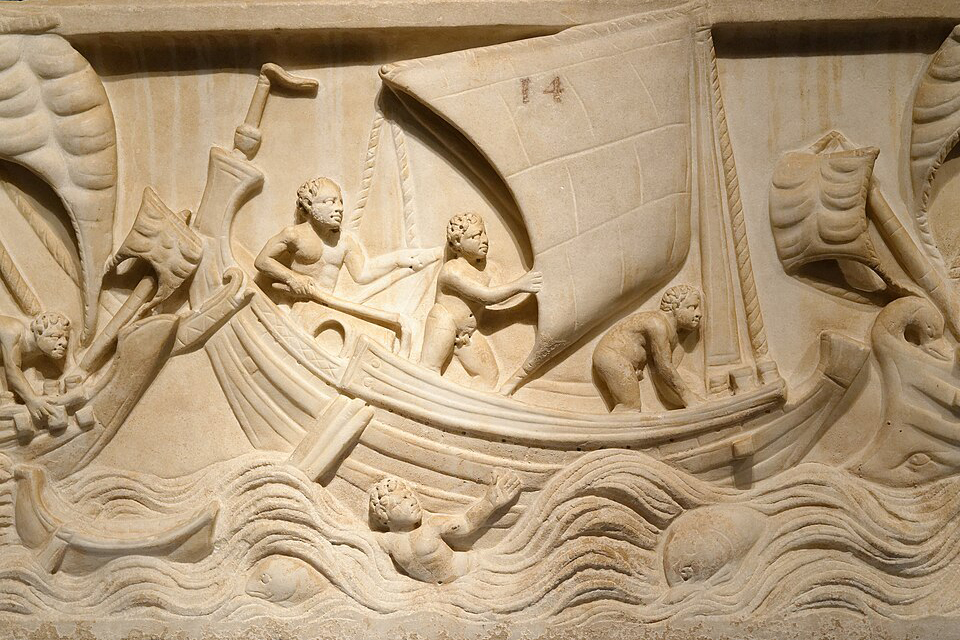
In the fifth and sixth centuries, letters, chronicles and poems tell us about Saxon pirates who raided the coasts of the Channel and the Atlantic. Who were these people? And what became of them?
Early Attacks
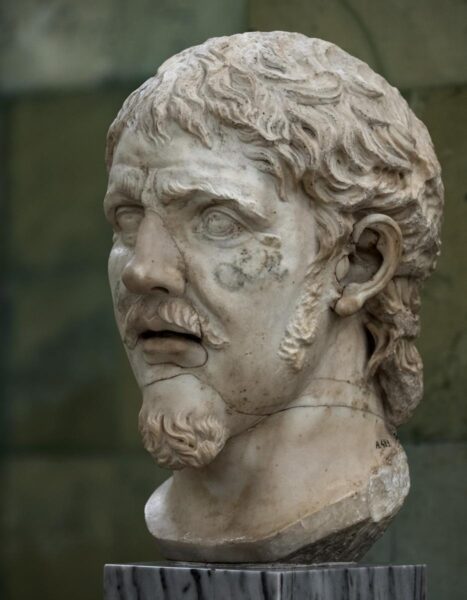
In the early fifth century, an Iberian Christian named Hydatius travelled to the Holy Land, where he met Jerome (ca. 340-420), known, among other things, for his continuation of the Chronicle of Eusebius up to AD 378. Following his return, Hydatius was consecrated bishop of Aquae Flaviae (modern Chaves in Portugal) around AD 427. Here, in the Roman province of Gallaecia, he encountered the Germanic people known as the Suevi, who had established one of the earliest barbarian successor kingdoms. At one point, Hydatius himself was taken prisoner by the Suevi.
Following in Jerome’s footsteps, Hydatius wrote a continuation of his chronicle, which ends abruptly in AD 468, probably shortly before his death. These chronicles – those of Eusebius, Jerome and Hydatius – consisted of short notices recording significant events. Covering the period from the beginning of the fifth century until AD 468, Hydatius’ chronicle is one of our few contemporary written sources for the dissolution of Roman rule in Hispania and the devastation inflicted by the barbarians, whom he regarded as pagans and heretics. As such, his chronicle presents a gloomy catalogue of the miseries suffered by his people, among them several assaults by seaborne raiders along the Atlantic coast.
In Hydatius, we read how Vandals suddenly landed at Turonium on the coast of Gallaecia in AD 445 and captured “the families of many people”. Even more interesting is the account of a group of men said to be Heruli who, in AD 456, “landed with seven ships on the shore of the territory of Lucus”. When a crowd of local inhabitants assembled, nearly 400 lightly armed Heruli were put to flight, although only two were killed. On their way home, the Heruli viciously pillaged the coastal territories of the Cantabri and Varduli along the northern coast of Iberia. Later, in AD 459, we read how the Heruli, on their way to Baetica, “attacked a number of places along the coast of the conventus of Lucus with excessive brutality”. Baetica was the southernmost Roman province of Hispania, corresponding broadly to modern Andalusia. [1]
Who Were These Heruli?
The history of the Heruli represents something of a historical conundrum. However, a recent study by Salvatore Liccardo has reconsidered the written sources in a new and inspiring way.
Often identified as migrants from southern Scandinavia, the Heruli appear instead to have been an elusive and highly mobile group of people who cropped up here, there and everywhere in Late Antiquity. Mentioned by Procopius and Jordanes, they were depicted as a migratory people moving both north and south, frequently serving as mercenaries in the Roman army. Groups identified as Heruli were active both north of the Black Sea and in the western parts of the Roman world while said to keep contact back home.
One further clue may be found in the name itself. The ethnonym “Heruli” or “Eruli” has been associated with Old English eorl and Old Norse jarl, derived from a Germanic word denoting a prominent man or leader. However, although this etymology is plausible, it does not establish the nature of the group.
Traditionally, the name Heruli has been interpreted as an ethnic designation. Yet Liccardo’s reconsideration of their history encourages us to think instead of shifting warbands of warriors and mercenaries and led by earls; often mentioned in connection with sea-faring, it appears they also operated as pirates. Moving between the battlefields of the Roman world during its final centuries, they almost resemble a kind of late-antique Wagner group, seeking employment and opportunities for plunder. The analogy may be crude, but it seems more useful than automatically treating them as a distinct barbarian gens, even though this was precisely how Roman authors tended to identify the peoples inhabiting the periphery of their civilisation. [2]
Such an interpretation also fits with the identification of other raiders operating in the same waters during the reign of Diocletian (AD 284–305). These sources identified them broadly as Franks or Germani. In later accounts, we encounter more specific references to Franks and Saxons fulfilling this role. [3]
Saxon Pirates
Some decades later, we encounter these pirates now known as Saxons in the writings of the Gallo-Roman aristocrat and later bishop Sidonius Apollinaris. In a letter to his friend Namatius, who was commander of naval operations along the Atlantic coast, Sidonius writes:
“Just as I was on the point of ending [this] letter which had rambled on long enough, lo and behold! a courier from Saintonge arrived. I whiled away some time talking with him about you; and he was very positive that you had weighed anchor, and in fulfilment of those half military, half naval duties of yours were coasting the western shores on the look-out for curved ships; the ships of the Saxons, in whose every oarsman you think to detect an arch-pirate. Captains and crews alike, to a man they teach or learn the art of brigandage; therefore let me urgently caution you to be ever on the alert.
“For the Saxon is the most ferocious of all foes. He comes on you without warning; when you expect his attack he makes away. Resistance only moves him to contempt; a rash opponent is soon down. If he pursues, he overtakes; if he flies himself, he is never caught. Shipwrecks to him are no terror, but only so much training. His is no mere acquaintance with the perils of the sea; he knows them as he knows himself. A storm puts his enemies off their guard, preventing his preparations from being seen; the chance of taking the foe by surprise makes him gladly face every hazard of rough waters and broken rocks.
“Moreover, when the Saxons are setting sail from the continent, and are about to drag their firm-holding anchors from an enemy’s shore, it is their usage, thus homeward bound, to abandon every tenth captive to the slow agony of a watery end, casting lots with perfect equity among the doomed crowd in execution of this iniquitous sentence of death. This custom is all the more deplorable in that it is prompted by honest superstition. These men are bound by vows which have to be paid in victims, they conceive it a religious act to perpetrate this horrible slaughter, and to take anguish from the prisoner in place of ransom; this polluting sacrilege is in their eyes an absolving sacrifice.” (Sidonius, Letter 8.6) [4]
Understandably, this epistle has been mined for its literary models. One particularly interesting parallel is Lucretius’ description of the sacrifice of Iphigenia in De rerum natura (1.80–101), in which the young woman is sacrificed at Aulis to secure a favourable wind for the Greek fleet. In both texts, religious obligation serves to justify an otherwise horrifying killing. Indeed, Lucretius’ famous condemnation of the evils committed in the name of religion provides a literary framework for Sidonius’ description of the Saxons. [5]
Consequently, we should hesitate before accepting the account of the sacrifice of every tenth captive as a straightforward ethnographic observation. Not least as the episode also serves a literary purpose, contrasting the supposedly barbarous world of the Saxons with the civilisation to which Sidonius and Namatius belonged.
The contrast becomes even more striking when Sidonius subsequently mentions sending his friend the Libri Logistorici of Varro and the Chronology of Eusebius. These books were intended to provide both leisure and “polish to an eloquence which must be getting rusty” while Namatius was campaigning along the watery frontier of the Atlantic coast.
Curved Boats?
The sources thus suggest the presence of mobile groups of warriors operating from the North Sea coasts through the Channel and down towards the Bay of Biscay, sometimes venturing even further south. We might call some of them Saxons, as this became a common designation for seaborne raiders in the western sources. Yet the name may also have functioned as a catch-all term rather than as the designation of a particular gens. [6]
Nonetheless, one of the more intriguing details in Sidonius’ description concerns the ships themselves. He describes them as “curved”, an expression which might encourage their identification with the clinker-built vessels known from archaeological finds such as the early Nydam Boat dated to ca. AD 180 and the later Nydam boat (AD 310-320) and the later ship from Sutton Hoo (early seventh century). However, when we examine the precise wording, we discover that Sidonius was writing somewhat more poetically:
litoribus Oceani curvis inerrare contra Saxonum pandos myoparones Approximately translated: “To range along the winding shores of the Ocean against the curved pirate vessels of the Saxons.”
Here, curvis describes the winding shores, while pandos describes the curved vessels. The latter expression belongs to a long tradition of classical descriptions of ships, familiar from writers such as Cicero, Virgil and Ovid. The word itself does not identify a particular construction technique. [7]
The Saxon pirates may well have favoured clinker-built ships, but Sidonius cannot tell us whether this was the case.
Sails?
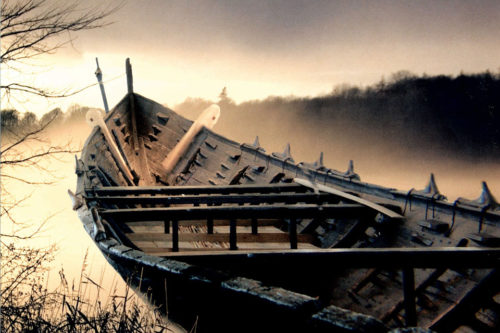
Were their ships rowed? Definitely. Sidonius explicitly mentions oarsmen, and rowing was an inherent feature of maritime technology in both the Mediterranean and northern Europe. But were these also sailing vessels?
Once again, Sidonius appears to offer a clue. Describing the Saxons preparing to return home, he writes: de continenti in patriam vela laxantes. In other words, they were preparing to spread their sails and sail home from the continent.
Of course, vela laxare was also a familiar Latin expression for setting sail. Nevertheless, we should not automatically dismiss the possibility that Sidonius was describing something he believed these pirates actually did. His words certainly suggest that he imagined the Saxons navigating sail-equipped vessels, whether or not every ship they used carried a sail.
In this light, the old dogma that the adoption of the sail in the late eighth century constituted the technological innovation heralding the Viking Age deserves renewed scrutiny. Recent discussions of large vessels and the possibility of sailing traditions in Bronze Age Scandinavia [8], together with the more holistic and less exclusively archaeological approach adopted by Kastholm [9], suggest that the question should remain open. Finally, the linguistic evidence published by Katrin Thier in 2003 ought already to have given scholars pause. Her reconstruction indicates that Germanic terminology for sails existed well before the Anglo-Saxon migrations. [10]
The problem, then, is not whether northern Europeans could have known about sails before the Viking Age, but when, where and to what extent sailing became an established part of their maritime practice. According to the written sources this practice must have been adopted early. How else might the pirates get away if pursued by the Roman fleet, which already Augustus sent reconnoitering up along the west coast of Jutland.
Litus Saxonicum
Indeed, there are good reasons to assume that seafarers from the northern coasts knew about sailing ships and how to use them. By the fifth century, Roman sailing vessels had traversed the great rivers and the Channel for centuries, supplying Britain with everything from everyday luxuries such as olive oil to the soldiers and administrators who maintained this lively corner of the Roman Empire. It seems equally likely that pirates operating along these routes would have been eager to capture such vessels and exploit their technology.
Thus, during the centuries following the Roman conquest of Britain, maintaining the supply lines to the island required an extensive network of harbours, military installations and fortified settlements. These supported the provisioning of the army and the growing presence of a Roman provincial elite.
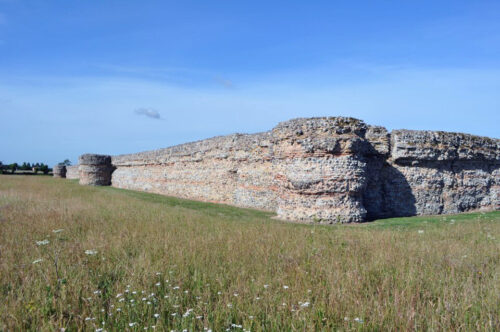
Gradually, however, this maritime infrastructure came under increasing pressure from political instability and seaborne raiding. From the late second century onwards, and particularly during the third and fourth centuries, Roman authorities constructed and maintained a series of coastal fortifications in Britain and northern Gaul.
These installations later became associated with what the Notitia Dignitatum called the Litus Saxonicum, or Saxon Shore. Traditionally, the system has been interpreted as a defensive response to Saxon piracy. However, recent scholarship has questioned whether the forts ever constituted a unified maritime defence system. Some may initially have served logistical and commercial purposes, while others were adapted to meet changing military threats. The precise meaning of the name Litus Saxonicum also remains debated. [11]
Whatever their original purpose, the installations nevertheless testify to the strategic importance of controlling maritime traffic between Britain and the continent. Moreover, the existence of these fortifications reminds us that piracy, military service, commerce and seaborne movement were closely interconnected long before the fifth-century migrations.
Finally, by the time Roman authority in Britain disintegrated, this maritime world was undergoing profound changes. During the fifth and sixth centuries, groups conventionally identified as Angles, Saxons, Frisians and Jutes crossed the North Sea and settled in Britain.
But how should we understand their arrival? Were these people pirates? Or people embarking on a diaspora? Were they relatively small groups of warriors establishing themselves as a conquering elite and imposing their language and material culture upon the existing population? Or did the movement involve substantial numbers of ordinary migrants, whose arrival fundamentally transformed the demographic composition of post-Roman Britain?
The Evidence of aDNA
Recent studies of ancient DNA have substantially changed our understanding of the migrations traditionally associated with the arrival of the Anglo-Saxons. In 2022, Joscha Gretzinger and colleagues demonstrated that individuals buried in early medieval English cemeteries, particularly in eastern England, derived a substantial proportion of their ancestry from continental northern European populations.
Across the early medieval English individuals investigated, this component averaged approximately 76%, although there were considerable differences between regions, cemeteries and individuals. This evidence supports large-scale migration across the North Sea rather than the arrival of a small, exclusively male warrior elite. It does not, however, demonstrate that 76% of the population consisted of first-generation immigrants. [12]
An even more recent study, published by Hugh McColl and colleagues in Nature in October 2026, has refined this picture. Drawing on hundreds of newly sequenced ancient genomes and thousands of previously published ones, the researchers have identified northern Germany and southern Jutland as particularly important sources of ancestry associated with the migrations to Britain. In opposition to this, their analysis suggests that northern Jutland, the Danish Isles and Sweden were not the principal areas from which these migrants originated.
More intriguingly, the same study identifies substantial population movement in the opposite direction during the Migration Period, from regions associated with northern Germany and southern Jutland into the Danish Isles and southern Sweden. The authors associate this transformation with significant cultural changes, including the emergence of a new elite culture. [13]
Thus, the genetic evidence reveals a North Sea world characterised by considerable demographic mobility in several directions. Yet it cannot tell us whether particular individuals were pirates, mercenaries, traders or settlers, nor can it establish that the people known to Roman authors as Saxons were identical with those who subsequently appeared in the written and archaeological sources as the Anglo-Saxons.
Perhaps, however, a closer exploration of what happened in the region later known as the Kingdom of Denmark can shed light on these movements.
The -lev Settlements and the Emergence of the Danir
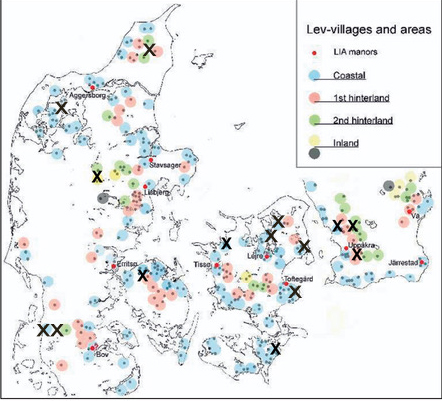
To understand what happened, we may begin by examining the approximately 360 historically attested settlements bearing names ending in -lev or -löv found within present-day Denmark and the former Danish provinces of Scania and Halland. Their geographical distribution corresponds remarkably well with the heartland of the later medieval Danish kingdom. [14]
The formation of these place names is generally assigned to the Late Roman Iron Age and the Migration Period, beginning perhaps around AD 350–400. Traditionally, the suffix -lev has been interpreted as denoting inherited property. However, research by Lena Peterson, Sofie Laurine Albris, Frands Herschend and Dagfinn Skre has opened up an alternative interpretation, according to which at least some of these settlements represented landed estates granted to members of an emerging military aristocracy. [15]
In this context, Gillian Fellows-Jensen’s observations concerning Scandinavian place names in the British Isles are particularly interesting. Discussing the relationship between the Scandinavian -lev and German -leben names, she argues that the absence of corresponding formations in England supports the view that -lev had a comparatively early and short period of currency as a Scandinavian place-name-forming element. It appears to have been imported and adopted after the migration into Eastern Denmark from the south which has been dated to c. 400-450 (see below) while at the same time it appears to have ceased to be productive well before the Viking Age. [16]
Although the absence of -lev names in England cannot in itself tell us whether people from these settlements participated in the earlier migrations across the North Sea, it encourages us to consider the Danish -lev settlements as the product of a relatively circumscribed historical process rather than a continuing tradition of naming newly established settlements.
In view of this, the martial character of the personal names incorporated into these place names, appear striking. In his analysis of 150 name forms, Herschend identified 71 as referring directly to warfare, weapons or warriors. When names referring to estates and property are excluded, these constitute approximately 52% of the remaining material. Moreover, several names classified under other semantic categories may carry implicit military connotations. [17]
Among the most interesting are those incorporating the element harjaz, denoting an army or warrior. These include compounds potentially referring to geographical origin, ethnic affiliation or military specialisation: Austaharjaz (eastern warrior), Westaharjaz (western warrior), Sunþaharjaz (southern warrior), Gautaharjaz (Geatish warrior), Swābaharjaz (Suebian warrior), Winiþharjaz (Wendish warrior) and, of course, Saiwiharjaz (sea warrior).
It is unlikely that these names were bestowed at birth. More likely, they constituted military sobriquets acquired during adulthood or designations of particular military functions, which perhaps later evolved into personal names. However we interpret these names, the acquisition of a landed estate might have represented the culmination of a successful military career. And indeed, this is how the names are now understood.
Equally significant is the geographical distribution of the -lev settlements. Predominantly situated in fertile agricultural districts and accessible coastal landscapes in the Danish archipelago, many subsequently occupied prominent positions in the administrative and ecclesiastical geography of medieval Denmark. More than half became parish centres, while eight became centres of hundreds (herreder). [18]
Taken together, these observations invite us to consider whether the -lev settlements constitute the surviving onomastic imprint of an extensive redistribution of landed wealth in connection with the establishment of a new political and military order.
Winiþharjaz of Vindelev
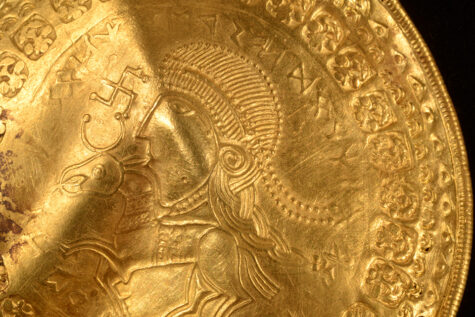
The discovery of an extraordinary gold hoard at Vindelev in eastern Jutland in 2020 provides a further opportunity to explore this hypothesis. Weighing nearly 800 grams, the treasure includes Roman imperial medallions, Nordic gold bracteates and a sword fitting, reflecting extensive connections across northern and central Europe.
The place name Vindelev may preserve the memory of a military commander whose name or designation was Winiþharjaz, “the Wendish warrior” or “the Wendish military commander”. Although the linguistic reconstruction, considered in isolation, remains tentative, the combined analysis of the runic inscriptions, the iconography of the bracteates and the composition of the Vindelev treasure lends considerable weight to this interpretation. In the historical reconstruction proposed here, it seems likely that a military commander originating from or associated with the region south of the Baltic acquired the estate during the political upheavals around AD 450. [19]
The Vindelev treasure also provides material evidence of the extensive international networks within which this emerging aristocracy operated. Its Roman medallions have parallels in hoards discovered further east in Europe, while the bracteates demonstrate how Roman imperial imagery was appropriated and transformed into a distinctive northern representation of rulership. Particularly significant is the inscription identifying a figure as “Odin’s man”, suggesting a close relationship between political authority, military leadership and religious allegiance. [20]
These developments should also be considered alongside the earliest construction phases of the Danevirke, which testify to the capacity to mobilise considerable resources and organise labour on a scale transcending that of individual settlements.
The emerging picture is thus one of a highly mobile military elite operating across the North Sea and the Baltic, acquiring wealth through warfare, mercenary service, piracy and political alliances before establishing themselves as landed proprietors in southern Scandinavia.
Saiwiharjaz and Serslev
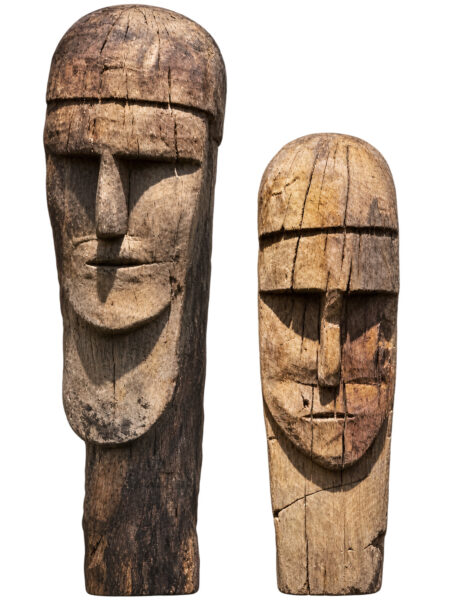
A particular group of these warriors deserves special attention. Although we cannot know precisely how they all arrived, the place-name evidence suggests that some possessed a distinctly maritime identity. Among them were the Saiwiharjōz and possibly the Sigiharjōz, whose designations may be preserved in the names of up to fifteen settlements scattered across Scania, Zealand and further west.
While Saiwiharjaz may be interpreted as “Søherre”, that is, sea-lord or, in this historical context, perhaps pirate, Sigiharjaz in principle simply means victorious warrior.
Of particular interest is the suggestion that Saiwiharjaz was not originally a personal name but a common noun denoting a sea warrior. In 2017, Simon Karlin Björk presented a new argument in favour of this interpretation, drawing attention to the old Scandinavian island name Särsö, which he believes incorporates the same first element as the Särslöv names. Since personal names rarely constitute the first elements of old island names, this provides further support for the interpretation of Saiwiharjaz as an appellative. [21]
Such an interpretation would lend weight to the hypothesis that the Særslev and Särslöv settlements were estates assigned to sea warriors or naval commanders.
Moreover, of the six place names identified in the literature as potentially derived from Sigiharjaz, some appear in medieval sources in forms closely resembling those attributed to Saiwiharjaz. An additional candidate is the now-vanished village of Serridslev near Copenhagen, recorded in the earliest source from 1186 as Serslef. Whether these similarities reflect a common origin or the subsequent convergence of originally distinct names deserves further investigation. [22]
On the attached map kindly provided by Frands Herschend, we see how many of the -lev settlements were located near the shores of the Danish archipelago. Among these, the locations of settlements bearing names potentially connected with Saiwiharjaz and Sigiharjaz have been indicated with an “X”, illustrating their concentration in eastern Denmark.
A preliminary enumeration suggests that between 67 and 69 place names ending in -lev may incorporate the element harjaz, either independently or as part of a compound. Of these, six, or approximately 9%, belong to the conventionally identified group of Saiwiharjaz settlements. If the additional candidates are included, the proportion potentially connected with seafaring rises to approximately 22%. [23]
The concentration of these settlements in the eastern parts of the Danish archipelago, particularly around the Øresund, is intriguing. Might some of the warriors who conquered the region in the fifth century and subsequently took possession of their “levs” have sailed into the Danish archipelago from across the Baltic, perhaps from what is today the northern coastline of Germany to which they had migrated from the south (perhaps even fleeing in front of the Huns)?
Such a hypothesis would fit with the interpretation of the Vindelev treasure outlined above and with the population movements identified by recent genetic research.
The Danir and the Conquest of Britain
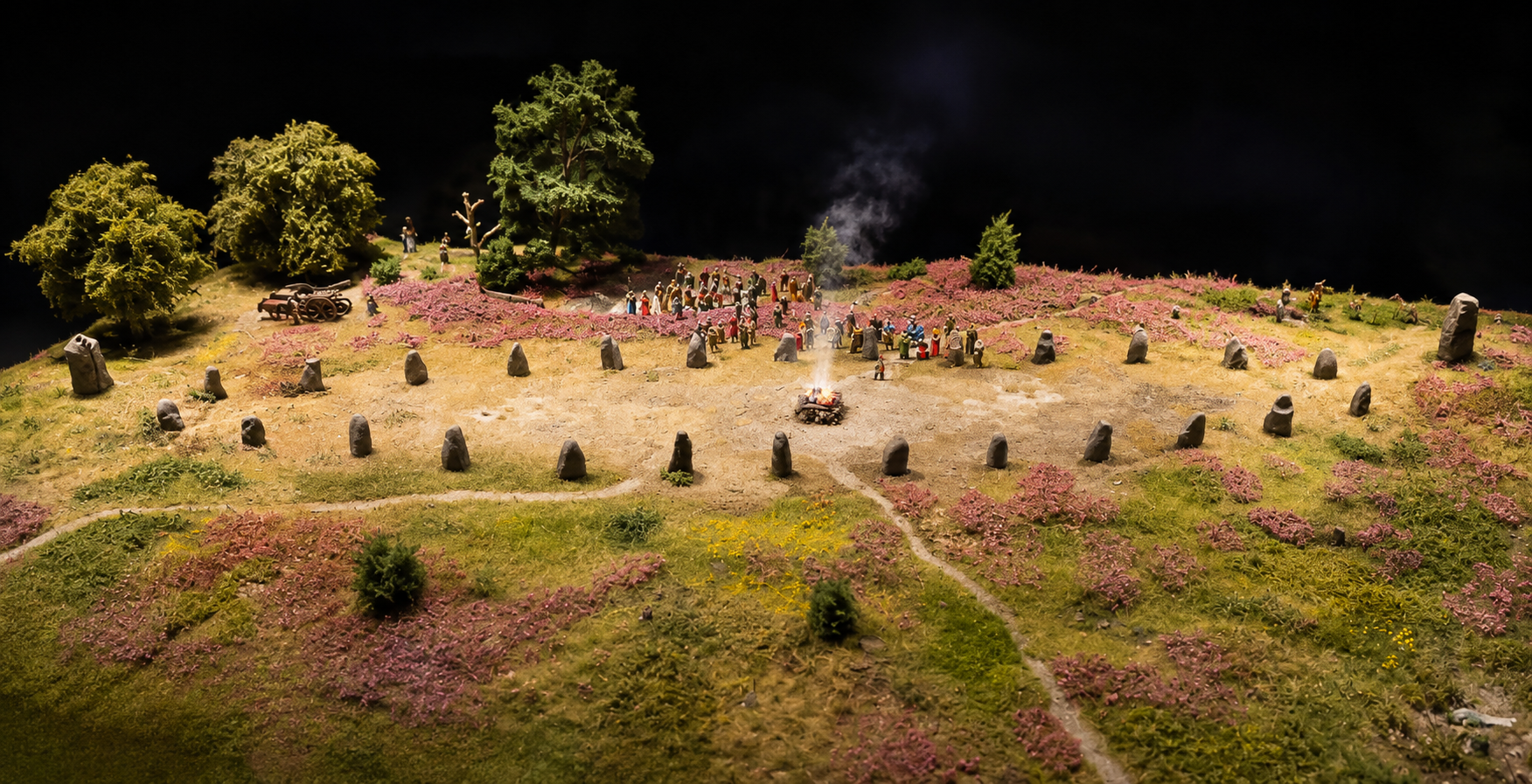
Against this background, the appearance of the Danir in written sources in the sixth century acquires particular significance.
Rather than envisaging a single migratory movement from southern Scandinavia and northern Germany to Britain, we may be dealing with two interconnected processes of political and demographic transformation: a movement from across the Baltic, involving the establishment of a new military aristocracy in southern Scandinavia, and a movement across the North Sea, involving the conquest and settlement of eastern Britain.
While ancient aDNA documents these population movements, their political and military character must be inferred from other sources. Particularly significant in the British context is the linguistic evidence. The extensive replacement of Brittonic by Germanic dialects in what later became England, coupled with the relatively limited contribution of Brittonic to the Old English lexicon, suggests a profound transformation of society, rather than merely the establishment of a thin military elite. Considered alongside the genetic evidence and the written accounts of warfare, this lends weight to an interpretation of the Anglo-Saxon settlement as a process of conquest rather than simply peaceful and gradual immigration. [24]
Furthermore, the written sources offer an intriguing succession of ethnic designations. Gildas, writing in the sixth century, identifies the invaders of Britain as Saxons. Procopius, writing around AD 550, identifies the inhabitants of an island called Brittia as Angles, Frisians and Britons. Meanwhile, Jordanes, writing in AD 551, explicitly attributes the displacement of the Heruli to the Dani, thus indirectly identifying the Heruli as the migrants to England. Only with Bede, writing around AD 731, do we encounter the canonical tripartite division of the Germanic settlers into Angles, Saxons and Jutes. [25]
Of course, we shall not adopt these historical and ethnographic descriptions wholesale. Rather than describing identical ethnic or political configurations, these accounts may reflect successive stages in the formation of new political identities.
Thus, while Saxons and Frisians, already experienced in maritime warfare along the Atlantic and North Sea coastlines, may have spearheaded the conquest of eastern Britain, they were perhaps joined by groups of Angles and Jutes displaced from the Jutland peninsula in the course of the Danish expansion in the Øresund region. In this reconstruction, the latter were not necessarily the principal protagonists of the conquest of Britain. Rather, as suggested by the new aDNA evidence, their migration may itself have been a consequence of the political upheavals in southern Scandinavia.
Meanwhile, the Danir, arriving from across the Baltic, may have established themselves primarily in eastern Denmark, where the distribution of the -lev settlements, and in particular those potentially associated with maritime military commanders, suggests a substantial reorganisation of landed property. The emergence of Lejre as an archaeologically identifiable aristocratic centre in the sixth century fits this chronology, allowing for a period of political consolidation following the initial appropriation of landed estates. [26]
Seen from this perspective, the Saxon pirates encountered along the Atlantic coastline of the former Roman Empire and the military men commemorated in the Danish -lev settlements may have belonged to the same wider maritime and military world. Whether some of them were even “cousins of a sort” remains an intriguing possibility.
Taken together, the linguistic, onomastic, archaeological, runological and genetic evidence invites us to reconsider the relationship between the emergence of the Danish and Anglo-Saxon kingdoms. Rather than constituting separate historical processes, the conquest of eastern Britain and the establishment of the Danir in southern Scandinavia may have been intimately connected, reflecting the extensive political and demographic upheavals which characterised the North Sea and Baltic worlds in the fifth and sixth centuries. At present, this constitutes a working hypothesis capable of accommodating several otherwise disparate strands of evidence.
FEATURED PHOTO:
Sachophagus with nautical scene showing a Roman ship carrying a square sail and rig. © Ny Carlsberg Glyptoteket, IN 1299 n3. Source: Wikipedia
NOTES AND REFERENCES
[1] Hydatius, Chronicle, entries for AD 445, 456 and 459. See R. W. Burgess (ed. and trans.), The Chronicle of Hydatius and the Consularia Constantinopolitana: Two Contemporary Accounts of the Final Years of the Roman Empire. Oxford: Clarendon Press, 1993.
[2] Liccardo, Salvatore (2024). “Who in the World Are the Heruli?” Early Medieval Europe. Particularly relevant is Liccardo’s critical examination of the presumed Scandinavian origins of the Heruli and the difficulties of treating the eastern and western groups mentioned in the written sources as a historically coherent ethnic entity.
[3] Wood, Ian (1990). “The Channel from the 4th to the 7th Centuries AD”. In Seán McGrail (ed.), Maritime Celts, Frisians and Saxons: Papers Presented to a Conference at Oxford in November 1988. London, pp. 93–99, especially pp. 93–97.
[4] Sidonius Apollinaris, Letters, Book VIII, Letter 6. Translated by O. M. Dalton (1915), vol. 2. Oxford: Clarendon Press.
[5] Squillante, Marisa (2016). Modello lucreziano e superstitio nell’epistolario sidoniano”. In Forme di accesso al sapere in età tardoantica e altomedievale, vol. 6, pp. 179–187.
[6] Harland, James M. (2020). Imagining the Saxons in Late Antique Gaul. Harland argues that Sidonius’ description should be understood within the rhetorical and social context of his correspondence with Namatius rather than treated as transparent ethnographic evidence.
[7] Giannotti, Federico (2023). News from a mundus senecens: Romans, Visigoths and Saxons in a Letter by Sidonius Apollinaris (8.6). In José Luís Brandão, Cláudia Teixeira and Ália Rodrigues (eds), Confronting Identities in the Roman Empire. Bloomsbury Academic.
[8] Bengtsson, Boel, Magnus Artursson and Joakim Wehlin (2024). Evidence of Large Vessels and Sail in Bronze Age Scandinavia. Norwegian Archaeological Review, 57(1), pp. 59–84.
[9] Kastholm, Ole Thirup (2025). Sejlet, skibet og kongemagten i yngre jernalder. Kuml, pp. 41–78.
[10] Thier, Katrin (2003). Sails in the North – New Perspectives on an Old Problem. International Journal of Nautical Archaeology, 32(2), pp. 182–190.
[11] Drinkwater, John F. (2023). The ‘Saxon Shore’ Reconsidered. Britannia, 54, pp. 275–303.
[12] Gretzinger, Joscha, Duncan Sayer, Pierre Justeau et al. (2022). The Anglo-Saxon Migration and the Formation of the Early English Gene Pool. Nature, 610, pp. 112–119.
[13] McColl, Hugh, Guus Kroonen, J. Víctor Moreno-Mayar et al. (2026). Tracing the Spread of Germanic Languages Using Ancient Genomics. Nature.
[14] Schmidt, Tom (2015). De store stedsnavnklassene. Namn och bygd, 103, especially p. 68. The figures for the distribution of the -lev/-löv names derive from historical onomastic surveys. The approximate total of 360 should not be regarded as a definitive census of independently established Migration Period settlements. See also Sofie Laurine Albris and Peder Dam (2019), Status og perspektiver på de danske -lev-navne, in Bebyggelsenamnens dynamik, NORNA-rapporter 97, pp. 71–82.
[15] On the alternative interpretations of the -lev element and the personal names or designations incorporated into these place names, see:
– Peterson, Lena (2004). Lexikon över urnordiska personnamn. Uppsala.
– Peterson, Lena (2011). Reconstructing Lost Words from Old Personal Names – and the Meaning of the Place-Name Element -lev”.
– Albris, Sofie Laurine (2017). Stednavne og storgårde. PhD dissertation, especially pp. 167–169.
– Herschend, Frands (2022). The Pre-Carolingian Iron Age in South Scandinavia: Social Stratification and Narrative.
– Skre, Dagfinn (2025). The Northern Routes to Kingship: A History of Scandinavia AD 180–550.
[16] Fellows-Jensen, Gillian. To Divide the Danes from the Norwegians: On Scandinavian Settlement in the British Isles. Nomina, 11, especially p. 42.
[17] Herschend, Frands (2022). The Pre-Carolingian Iron Age in South Scandinavia: Social Stratification and Narrative. Uppsala: Department of Archaeology and Ancient History, especially pp. 48–53 and Table 2, p. 50.
[18] Albris and Dam (2019), “Status og perspektiver på de danske -lev-navne. The authors discuss the prominent position of the -lev settlements within the subsequent administrative and ecclesiastical geography of Denmark. See also the earlier survey by Schmidt (2015).
[19] For the proposed identification of Winiþharjaz and the historical interpretation of the Vindelev hoard, see Schousboe, Karen, Winiþharjaz from Vindelev – A Danish Military Commander from AD 450. For further references, see this microhistory
[20] On the Vindelev hoard and its inscriptions, see particularly: Imer, Lisbeth and Krister S. K. Vasshus (2023). Lost in Transition: The Runic Bracteates from the Vindelev Hoard. NOWELE: North-Western European Language Evolution, 76(1), pp. 60–99. See also “Vindelevskatten: Et dynastisk offer fra folkevandringstiden”, published in Kuml, which explores the dynastic and religious significance of the hoard, including the relationship between Odin and the named individual Jagaz.
[21] Karlin Björk, Simon (2017). Särsö och personnamnet fisl. Sævarr. Namn och bygd, 105, pp. 85–90.
[22] Peterson (2004), entries for Saiwiharjaz and Sigigaizaz/-harjaz. On the possible relationship between these name forms, see also Karlin Björk (2017).
[23] Preliminary calculations based on Peterson (2004), pp. 23–35 and Table 2, p. 44, supplemented by Albris (2017), pp. 167–169.
[24] On the linguistic evidence for the transformation of post-Roman Britain, see particularly: Coates, Richard. Invisible Britons: The View from Linguistics. In Nick Higham (ed.), Britons in Anglo-Saxon England. See also: Coates, Richard. Celtic Whispers: Revisiting the Problems of the Relation between Brittonic and Old English. Namenkundliche Informationen. Coates explores the historical implications of the limited survival of Brittonic vocabulary and place names, including the possibilities of expulsion, enslavement, assimilation and substantial migration. The extent of the language shift is well established, although the precise social and political mechanisms remain debated.
[25] The principal written sources are: Gildas, De excidio Britanniae, chapters 23–26, Procopius, Wars, VIII.20 (also numbered Gothic War, IV.20), Jordanes, Getica, III.23 and Bede, Historia ecclesiastica gentis Anglorum, I.15.
[26] Christensen, Tom (2015). Lejre bag myten: De arkæologiske udgravninger. Jysk Arkæologisk Selskab. See also Christensen’s earlier presentation, Lejre Beyond Legend – The Archaeological Evidence, Journal of Danish Archaeology, 10 (1991), pp. 163–185. And Viking Dynasties: The Royal Families of Lejre and Uppsala Between Archaeology and Text (2025), edited by Tom Christensen, John Ljungkvist, and Neil Price