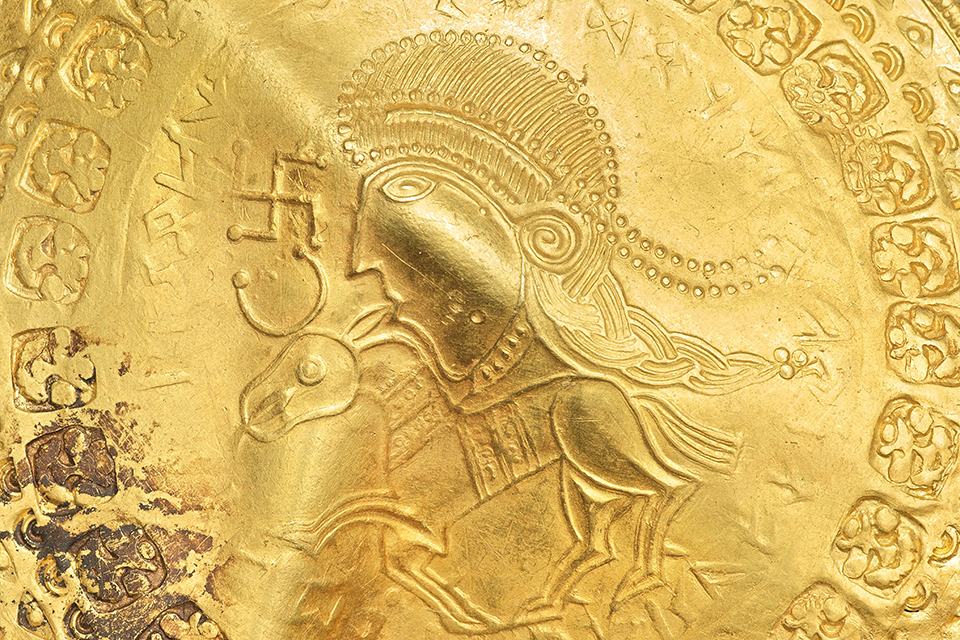
The village of Vindelev in Eastern Jutland was presumably a gift to a Vendish military commander, who operated east of Vejle in the middle of the 400s. An impressive gold hoard opens up the world, in which he lived.
In 2020, two Danish amateur archaeologists found a fabulous gold hoard in the small village of Vindelev in eastern Jutland. With a weight of 794 grams, it is one of the largest gold hoards found in Denmark. But what is really the story behind this hoard? And who was the Vendish military commander, Winiþharjaz, who gave his (nick)name to the village Winiþharjazhlaib sometime in the middle of the 400s?
Vindelev
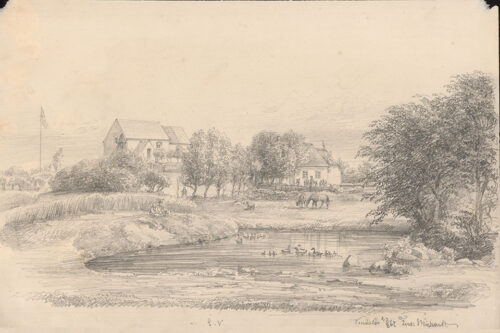
Although the village of Vindelev today does not appear particularly idyllic or remarkable, a cultural, geographical and historical study of the settlement history tells quite a different story. Once—1,500 years ago, when the village got its name—the place must have appeared more inviting. At that time, a Vendish chieftain from eastern Pomerania received the village as a reward for his efforts in the Danes’ military expedition into what later became Denmark. We naturally do not know whether Winiþharjaz was satisfied with the place that became his lot and share. But something suggests that it was even more attractive 1,500 years ago.
The best insight we get by looking at the village’s geological location as well as the landscape as it appears today.
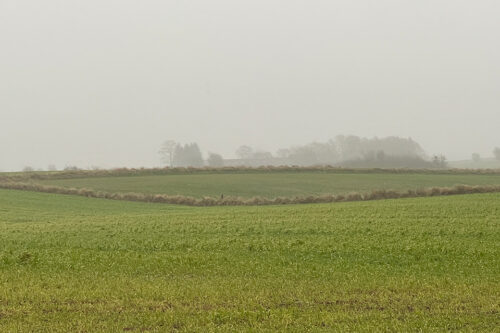
The parish is characterized by consisting of a typical East Jutland ground moraine dotted with some bog and larger and smaller meltwater and erosion valleys. Today, the landscape appears as a predominantly cultivated area located on the edge of the Grejs River Valley running to the south. The proportion under cultivation is almost total, and the fields are extremely well drained. The cost of taking agricultural land out of production in connection with the Green Tripartite Agreement from 2025 has therefore also been calculated to lie at the highest end north of the old village, while to the south and east of it it has predominantly been set at medium.
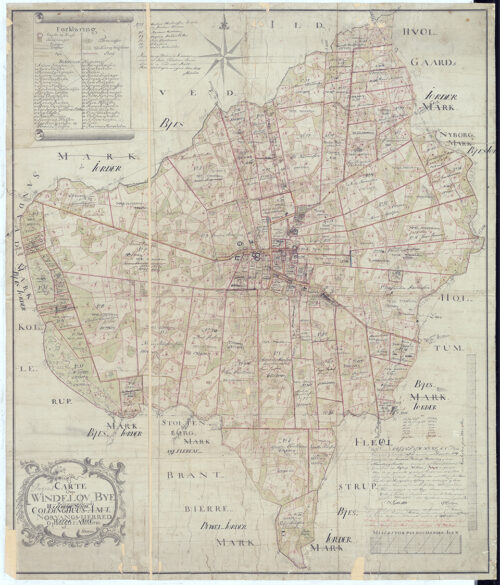
This impression the village also gave in 1682, when Denmark was cadastered and described. At that time, the parish consisted of one village with twelve farms and a smaller woodland settlement to the south with four farms (Fløjstrup). Even then, the proportion under cultivation was very high, namely 57.1%, and with a very high quality stated as tdr. hartkorn per km² (12.6). (1)
The yield from cultivation was at the absolute top, just as grassland farming testifies to an operating form that allowed the farmers more freedom to work alternatingly with cultivation and rest periods. Grassland farming with closes, tyes or glebes (tægter or løkker) meant that the number of fields could be up to eight or more, which made possible longer rotations and more crop changes. Grassland farming therefore meant that different enclosed pieces of land could lie scattered among the cultivated ones and gave better leeway for the peasants to decide their own regime. Nevertheless, there was no fencing between the village fields, and the cattle were instead tethered so that they did not roam freely as in the classic open-field system (vangebrug). The only fence apart from temporary, which appeared in the landscape was thus the fence between the enclosed farmsteads (tofts), the cultivated infield and the outfield with its meadows, pastures, bogs, woodland, groves, etc. (2)
What is interesting about these villages with grassland farming is that they very clearly stand out in the landscape as representatives of the cultivation system that was introduced in many places between AD 400 and 500, when the Iron Age’s old system with small square fields protected by banks became gradually replaced by a system with larger enclosed fields, which were manured more extensively. But which therefore also could lie uncultivated for longer periods, and then later be cleared and cultivated again. In order to establish such an agricultural system, however, more powerful tools were required than the traditional Iron Age ard. Although we do not know when the plough with its mouldboard began to be introduced in Denmark, we do know that the technology became increasingly common in the early Middle Ages after the Migration period. Likewise, we know that the Romans were perfectly familiar with it, and it is not inconceivable that Winiþharjaz knew of it and adopted its use. Archaeological excavations at Feddersen-Wirde near Sievern, which has been pointed out as near the place, the Danir set off from (see below), definite evidence of the use of ploughs with mouldboards has been uncovered.
Til village of Vindelev itself must be characterized as an irregular settlement with the farms placed along the east/west-oriented road, and with the church – and perhaps the “main farm/manor”– lying about 300 m northeast of it on an artificial rise or hill close to the old road between Vejle and Viborg. The church itself is from the 1200s and built of tufa stone and brick. No excavations have been carried out in and around the church itself, and it is therefore not known whether the church originally was a magnate’s church built in connection with a great farm/estate. The placement on the hill does, however, bring to mind Lisbjerg Church near Aarhus, where such a connection and background is archaeologically documented. The written sources from the Middle Ages are, however, late and few, and therefore the hypothesis that there was a fortified stronghold from the Viking Age and/or Middle Ages close by the church cannot at present be justified by anything other than the church’s high position in the landscape.
A Fertile Landscape c. AD 500
It can be difficult to imagine what Vindelev looked like 1,500 years ago. One of the new maps developed in connection with our attempt to solve the nitrogen problem (the fact that far too much nitrogen leaches down into the streams and out into the fjords and coastal waters in Eastern Jutland) nevertheless lifts a corner of the veil.
The village lies precisely on the dividing line between the parish’s northern high plateau and the lower south-facing and gently sloping land that undulates down toward the Grejs River Valley. The southern part of the parish thus lies about 25 meters lower than up by the church. Where the northern part of the parish therefore holds on very well to its nitrogen, the same does not apply to the south-facing part, which drains down toward Grejs. This divide was even more distinct in the landscape 1,500 years ago before drainage and cultivation erased the impression of the sloping terrain. The reason is, that the parish lies north of the line where Denmark experienced a land uplift. It is calculated that the parish has risen about two meters in the last 4,000 years. That means we must imagine a landscape that, all else equal, lay substantially lower 1,500 years ago and correspondingly therefore also was wetter in the part that slopes down toward Grejs. Water, as is well known, finds its way.
Be that as it may, the location of Vindelev at that time must have appeared advantageous to the people of the day. With a relatively elevated ridge to settle on, with soil suitable for cultivation to the north, wet meadows to the south and east, and ample forests nearby and glacial kettle lakes with enough drinking water for livestock and people, it must have seemed inviting.
Exactly how the settlement looked like, however, we do not know precisely. After the discovery in 2020, archaeologists excavated the spot and found part of the remains of a hall surrounded by a number of other buildings. However, the hall was not exceptional in terms of size, although the archaeologists discovered that the treasure had been buried in one of the postholes (or nearby). We need more excavations carried out to get a firmer picture (3).
Vindelev – a lev-village
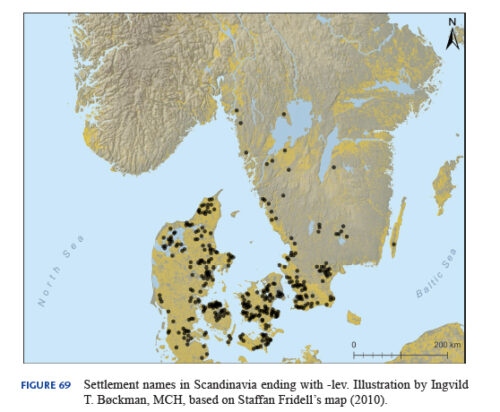
We do not know whether there was a village in these parts before Winiþharjaz arrived and received—or seized—power over the landscape. But we can assume that the attractive location invited settlement already in the Bronze Age, and that people lived there before he arrived. Likewise, we must also assume that it hardly happened particularly peacefully there in the middle of the c. AD 450, when he arrived, staked out his place and named it as his.
The place name, Vindelev, belongs to a type that begins to appear precisely in this period, i.e. approx. 350-400. One of the reasons we can date these -lev names very precisely is that they do not occur in the Danelaw, i.e. the part of England that the Danes conquered and settled in after about AD 800. (At that time, they called the new places in the Danelaw -by, cf. Grimsby = Grim’s By near the mouth of the Humber in Lincolnshire.) At that point lev-villages appear to have gone out of fashion.
The other reason is that the -lev names differ by being to a high degree composed of personal names, which one has therefore been able to study in relation to the linguistic shifts that took place in the Migration Period and later. And which therefore means the naming of these settlements can be dated relatively precisely.
But first a little about the suffix -lev. Linguistically, lev is a noun that in Old Danish was lēf. Etymologically, the word derives from Proto-Germanic *hlaibaz, Westgermanic hlaib, and later Old Norse hleifr. The word, which means bread, is known as loaf in English and is also found again in the English status terms lord and lady, which we understand as “loaf-givers.” It is also known much later from Danish dialect vocabularies. Cf.: “Adam and also Eve, they baked big leve; when Adam was dead, smaller bread was baked.” (4)
On the other hand, in Danish, the word is also related to the nouns levn and levning as well as the verb levne, i.e. something that is handed over, left behind, or spared/left. The word is known from high medieval sources (King Valdemar’s Land Register from ca. AD 1240), where it indicates the King’s inherited property. Kongelev equalled the king’s (private) inherited property, which thus could be distinguished from the Crown’s estates.
Accordingly, Winiþharjazhlaib or -leifr may be interpreted either as the princely landed property that Winiþharjaz received from his superior as payment for his services, or as land he obtained in the distribution of war booty, including land. Or the place name may refer to the land as the inheritance that he passed on as private property to his heirs. To decide this, we have to dig further into the story of the suffix -lev.
Gift or Inheritance?
The vast majority of -lev villages are, as said, characterized by consisting of a first element in the form of a personal name and/or a so-called appellative that characterizes a person. Thus, there is general agreement among onomastic scholars that Winiþharjaz means “the Vendish military commander,” but whether our man was called this in everyday speech or had another and more personal name cannot be determined (although see below in the presentation of the hoard).
The question is is not so easy to answer. How should we, for example, understand a first element such as Saiwa- or Saiwiharjaz known from, for example, Særsløv and Sjørslev, which means the sea’s military commander? The first element is known from two villages in Scania as well as one each in Zealand, on Funen and Falster and one in Jutland. Another example here is Saiwilaugaz, i.e. one who has sworn his oath to the sea. Is it a personal name or a characteristic of the person’s activity? Belonging to this group is also Wagagastiz, i.e. the guest who comes from the waves.
The answer to this question is actually not so easy to clarify. Studies by Herschend, (5) have shown that the first elements that refer to persons are distributed as follows:
- 13% refer to people’s social and individual roles
- 10% refer to personal appearance
- 10% refer to origin
- 52% refer to warriors, weapon-bearers, or heroes
- 15% may possibly refer to the new era’s world of gods
Besides the fact that these -lev places for well over half directly refer to the persons’ status as army leaders, warriors, weapon-bearers and the like, there are also a few that simply indicate power, such as Walda = the powerful and violent, or Anuwinduz = the victorious (fore)father (ancestor). Finally, it should also be mentioned that certain -lev names refer to persons who were characterized as the rich one, the victor, or the one who protects (-rikiaz, winduz, and warduz). That is, words which we still hear the eccho of in the names of modern day institutions such as the Kingdom and the Realm (Danish: Kongerige, with “rige” derived from -rikiaz).
A comparison of the name material in the earliest runic inscriptions with that figuring in the first elements of the -lev villages finally shows that there is a decisive difference. Only half as many names in these early runic inscriptions refer to the persons’ martial status or character. And that despite the fact that these inscriptions to a large extent derive from engraved names on military equipment found in the era’s great weapon sacrifices from ca. 300. Here we instead typically find references to persons with bynames such as guest or servant (-gastiz and –thevaz).
In a recent study, a Norwegian archaeologist, Dagfinn Skre (5) have therefore concluded that the persons, who are mentioned as first elements in the -lev villages, must have had a quite special status as military leaders. This in contrast to the broader popular name stock which, as said, is found in the runic inscriptions (6).
The most likely thing that can be said about Vindelev is therefore that it is compounded of a personal name + lev and not, as has sometimes been put forward, that “Vindelev” should refer to a locality near a stream or road. After the discovery of the Vindelev hoard this interpretation seems entirely to have to be rejected (about the hoard, see below).
The name type is otherwise found primarily in the Medieval Danish kingdom, i.e. in Denmark to the river Eidern as well as in the Scanian lands. Although one can encounter -lev names in Norway, Sweden and Germany around Magdeburg, they are clearly much more scattered occurrences. In Denmark, the name type is otherwise almost absent from the poor West and Central Jutland heaths, just as they are also absent in the forest regions on the islands. On the contrary, the lev-villages are characterized by being located in the center of some of the country’s best soil as well as located out by the coasts. Later on, the lev-villages present the highest church frequency, just as around the lev-villages there is a high frequency of stray finds from the Viking Age.
Thus, while the traditional understanding of the -lev villages has been that they should be understood as inherited property, it is in fact more likely that Winiþharjaz’ “lev” simply was part of the war booty that was handed over to him as a reward for his participation in a campaign that ended with the major parts of Denmark and Scania being conquered. Or alternatively, that he “won it” in a lottery in the same manner as the Romans distributed land allotments to their soldiers after military service. The latest research actually suggests that this is precisely how we should understand the lev-villages, i.e. as settlements governed by elite warriors in the early Kingdom of Denmark.
Danir
The discussion of the names involved in the -lev villages fits well wit other evidence concerning the Migration Period. It is precisely at this time that we first hear of the people/tribe “Danir,” which appears in the writings of several authors from Late Antiquity. The Gothic nobles, Aithanarid, Heldebald and Marcomir, are thus all said to have authored works in the beginning of the 500s at Theoderic’s court in Ravenna. Their works are unfortunately lost, but they were quoted around 700 in a chronicle called Ravennatis Anonymi Cosmographia. Added to this are remarks by the Roman statesman and author Cassiodorus (c. 485–585), who wrote in the 520s, and Procopius (c. 500–565), whose work is dated to c. 530. The latter two were quoted by Jordanes (c. 540) (7).
At the centre of all these convoluted writings features the history of the Goths. It is believed that the Gothic king Theoderic of Italy AD 493-526 took the initiative for these many “accounts” to be written down, so that through them he could honor his ancestors’ heroic deeds, the Gothic language, and the Gothic history. In these works, the Goths’ “Swedish” origin was naturally also mentioned. It is as part of these geographical writings that the tribe Danir is mentioned in a couple of side remarks, which presumably may be dated to around the year 500 and a little later.
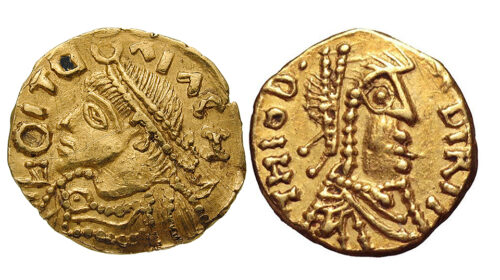
What is interesting now is that from roughly the same time there is another source that also mentions the Danes. In Gregory of Tours, who writes in the late 500s, we hear about the Danish king Chlochilaicus – Hygelac. According to Gregory, Hygelac arrived with a fleet that sailed into the Rhine delta. Here, however, he was killed by Theudebert, son of Theoderic, who was king over the Franks 511–533. Historians agree that the event must have taken place around 520. Gregory of Tours must thus have heard or read about the event elsewhere. It is therefore not surprising that he may have mistakenly referred to Hygelac as king of the Danes. According to the Scandinavian (Anglo-Saxon) heroic poem Beowulf, from about the same time, Hygelac is there described as king of the Goths, i.e. the Swedes (from Götaland or Gotland).
The question, though, is not so much over whom Hygelac ruled – and what form this kingship otherwise had—but rather that Gregory knew of a people called Danir, and that he allowed himself to call their leader “king,” i.e. “rex.” This was generally not a title Gregory used lightly, and he has therefore indirectly revealed that this is how one spoke in Tours in Francia around 580 about the Danes, namely as a people led by a “king.” Moreover, the anonymous chronicle from Ravenna (700s)—but based as said on Aithanarid, Heldebald and Marcomir – tells that these Danes were the fastest of all peoples and that their land was an island realm that bordered on the Elbe and thus the Saxons and the Frisians.
What is interesting now is that it is actually from that area that a group of people, who precisely immigrated to Denmark after the year 450, according to the newest genetic research, are assumed to derive.
New Genetic Research
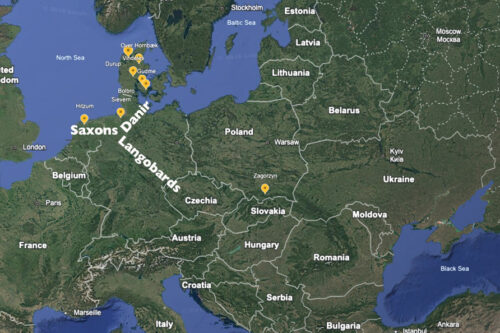
In order to understand who these Danir were, however, we must reach a bit back into prehistory, more precisely the Bronze Age. Back then Denmark was populated by a group of steppe people coming from the east, who settled throughout the Baltic area. With extensions to Norway, these peoples took control of southern Scandinavia. Until around the beginning of our time, these people constituted genetically and linguistically a unified group who spoke a common Germanic language, which developed from palaeo- and proto- into Common Germanic. A little later—around year zero—this language split into an eastern and western variant, West and East Germanic (Gothic). The boundary between the West Germanic and East Germanic language areas probably ran somewhere down through Pomerania between Stettin and Gdansk.
This linguistic split has been connected with the final phase of the great and extensive migrations that took place between AD 350 and 550, and which ended up reshaping all of Europw politically as well as culturally and linguistically. And which – show the newest studies – seem also to have had decisive influence on the population composition and language in the future Denmark.
Exactly who drove whom into flight in migration period Europe is still a convoluted question. However, new genetic studies of aDNA first of all show how much people moved around – and also that it happened in our corner of Europe as well as elsewhere. Thus, the newest studies of the genetics of individuals buried in the period between 400 and 700 in present-day England, northern Germany, Denmark, southern Sweden, the Czech Republic and northern Italy indicate that a larger group of the descendants of the Bronze Age population in Denmark emigrated from here and to England: Jutes, Angles, Saxons and Frisians are genetically identified ancestors for many of the people who today live in modern England. At the same time, other groups of southern Scandinavians migrated southward and ended up, among other things, forming the core of the Goths and later the Lombards, who via the Czech Republic and Hungary in the middle of 500 ended up in northern Italy. (8)
Finally – and this is the most interesting point for our understanding of the events in Vindelev – there was a return migration to Funen and Zealand of people from a broad belt in northern Germany, who after admixture with Frisians and Saxons and other southern and eastern folk spread into eastern Jutland and over to the islands. Presumably, it was a mixed group of former mercenaries from Denmark in the Roman army who along the way had mixed with fellow soldiers and friends to return to seek their fortune northward. Likely, Winiþharjaz, was part of this well-organised “Wagner-group” of mercenaries.
These re-immigrated and yet new people of more or less mixed ancestry appear to have had a genetic profile consisting of South Scandinavian genes mixed with all sorts from Europe, but primarily Saxons and Frisians. Due to the prevailing lack of inhumation graves in the period, researchers are not entirely clear as to what the “new” mixed genetic profile looked like. But overall it appears that these people displayed a cocktail consisting of people from the previous Denmark, but now mixed with Saxons and Frisians in northern Germany. From here they now made the movement “back” to southern Scandinavia—and that means in practice Denmark. How far from the east some of these new/old people came from is, however, at present not possible to determine genetically.
However, since the Nordic language developed via West Germanic, the researchers behind the studies assume that at a minimum they originated from the western side of the boundary between West and East Germanic that is assumed to have run somewhere between Stettin and Gdansk, i.e. Pomerania. And in practice they appear to have derived from a core area further west between the sources of the Elbe and the Weser.
In that connection it is interesting to note that the designation “Danir” has precisely been interpreted as a “people who live on the flat land,” i.e. in a landscape type that spreads north of the Elbe’s mouth and all the way over to Gdansk, i.e. the southern coast out to the Baltic Sea, thus licking the later “Vendic” homeland. In this connection, it may be pertinent to note that the Danir in the chronicle from Ravenna is mentioned in connection with the river Lena. This might be reference to the river Lyna, which rises south of Olsztyn and flows out by present-day Kaliningrad. West of this lies Pomerania. The whole northern area that stretches from Rostock over towards Kaliningrad is characterized by being both flat and wet. But as said, this also applies to significant parts of the region further west, which the geneticists believe they have identified as the core of the area from which the new people’s aDNA originates.
Nevertheless we should further note that a German archaeologist in 2013 precisely mapped the settlement pattern in this area between 750 BC and AD 1450 (9). These studies uncovered some quite dramatic changes that occurred in the period after AD 180 and which then accelerated. The end result was a landscape in Mecklenburg and Pomerania that was reduced to 80–90% of the population density that had been at its highest 200 years earlier. From about 400–700 this was in reality a near-empty area that spread over most of the flat marine foreland with an extensive lowland behind it. The explanation that Armin Volkman puts forward is that there must have been a massive outwards migration, and that this can be assumed to reflect the changed climatic conditions after the year 200, when the known world became increasingly wetter and colder. One can observe that when the climate changes set in, people initially move higher up. Later they moved away entirely.
But as said, the researchers who have mapped this “new” people, the Danir, are not in doubt. They indicate the area by the Elbe’s estuary as the core of the area from where these people migrated in order to head to Denmark. It is moreover interesting that it is precisely here, a very early Saxon kingship from the same time has been tentatively identified, which archaeologically has yielded a handful of late D-bracteates (10). This where the Vindelev hoard can really be brought into play. For even though the lowland people from the Elbe’s mouth constituted the genetic backbone in the new/old “Danir,” others may also have played a role. And at least one of them may have been a Vend (Slav), namely Winiþharjaz who may even have been known by another name, Jagaz. A closer analysis of his hoard tells us about the wider network he was part of.
The Hoard from Vindelev
The hoard itself was found by chance by two amateur archaeologists in 2020. As is proper, they contacted the local museum which acted decisively. Very quickly it became clear that they were dealing with a completely unique hoard. Not only the weight of the hoard (794 g gold) proved remarkable, but also its composition of both 4 Roman medallions, 13 Nordic bracteates, a glass-inlaid pendant, and a gold sword mouthpiece/guard mount from around AD 520 were testimony to the exceptional find (11).
Apart from a hoard from Zagórzyn in Poland, which unfortunately has not been preserved in its entirety, such “mixed” hoards have not previously been found, in which both medallions and bracteates were included. Together, the individual objects stem from a period from about 335 to 535, with the Roman medallions as the earliest element, while the sword’s mouthpiece with its early animal style decoration dated to c. AD 520 constitutes the absolute latest element in the hoard. This is thus a hoard collected through several generations, and with definite roots in southern Poland.
The Roman Medallions
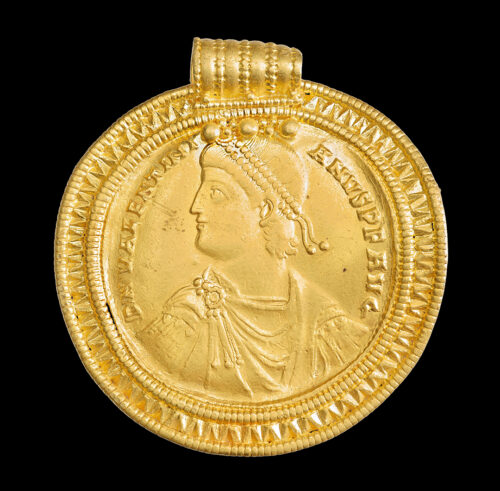
The four Roman medallions belong to a type that the Roman emperors awarded their generals and commanders for long and loyal service (12). Such medallions existed in different sizes and were awarded according to merit, so that the heaviest were given to the most deserving. The four medallions were minted respectively in Trier and Thessaloniki in the period 335–375 AD. Two of these medallions have, it has since been shown, close “relatives” found in deposited hoards in respectively Romania (Szilágy Somlyó) and Poland (Zagórzyn). Especially the “duplicate” found in the above-mentioned mixed hoard from Zagórzyn near Kraków is interesting, since it has been shown that it is minted with the same die as the medallion from Vindelev. Likewise, it has been shown that the two medallions from respectively Vindelev and Zagorzyn were later equipped with the same suspension loop and rim in the same goldsmith workshop. We can—almost—assume that the four medallions in the Vindelev hoard, which by weight belonged to the middle category, were presented to one or more of Winiþharjaz’s Vendish ancestors, and that he later brought them with him from Zagórzyn or further north when he joined the campaign that ended with the conquest of large parts of what was later to become Denmark.
The Gold Bracteates
It was precisely such Roman medallions that from around AD 450 inspired the development of the Nordic bracteates with their special form and image language. Overall, the more than 1,100 known bracteates are divided into four chronologically distinct types, A, B, C and D. While Type A imitates the Roman imperial images, and B shows several persons in full figure, C-types are adorned with a man with a horse. Finally, the D group is more abstract.
In Vindelev, 9 A-bracteates have been identified (including two identical) as well as four C-bracteates. One of these is identical to a bracteate previously found near Odense. All bracteates are dated to the period between AD 450–490.
Particularly remarkable is that the bracteates are very large. Not only does the hoard contain the largest bracteate that has so far been found. Today, it weighs 123.7 g and measures 13.8 cm in diameter. But closer studies have shown that it has been even larger, about 15,6 cm. Together the 13 bracteates in Vindelev today weigh 576 g. From this could have been produced about 100 bracteates of ordinary size. Together with the exquisite craftsmanship, this says something about how rich and powerful Winiþharjaz must have been. If we look at the bracteates’ frames, there is moreover clearly high-quality goldsmith work (13).
Iconography
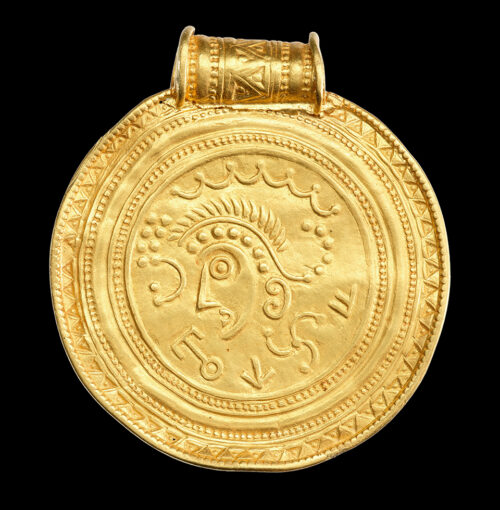
It is clear that the earliest bracteates (type A) are local copies of the image world that the Roman medallions carry. Here we see Roman emperors depicted in their Late Roman consular dress, trabea triumphalis, holding a globe or a sceptre in one hand and a mappa, i.e. a ceremonial cloth, in the other. At the same time, the ruler image has an expression corresponding to the emperor with diadem and long neck hair. But already one of the A-bracteates shows another ruler type with a long braid at the back of the neck. At the same time, the mappa is replaced by a knot ring or arm ring that is held out. On another of the bracteates, the hair is still styled in Roman fashion. Nevertheless, he is also portrayed with a fine mustache, which no true Roman emperor would dream of showing himself with. This ruler is moreover equipped with a sceptre on which a man dances around holding a globe in one hand and a gold ring in the other. Beside him is depicted a small tree, while the dancing figure is wrapped in a cloak with a fish tail. Perhaps it is a transformed Roman military standard, although we are far from Roman iconography? Another possibility is that the sceptre depicts a deity, pointing toward a religious ceremony, such as that which the Odin sceptre in the grave from Sutton Hoo may have been part of.
Such a hybrid expression is also found in the last bracteate, where the ruler looks Roman with diadem and long neck hair. This is then matched by the fact that he holds a drinking horn instead of a mappa or sceptre. No true Roman emperor would allow himself to be depicted brandishing a horn. If we are to summarize the bracteates from the Vindelev hoard, it is best done by describing them as “cultural” admixtures – hybrids that echo Roman iconography while mixing with inspiration from Merovingian cultural patterns and a new Nordic artistic “look”, the new animal styles.
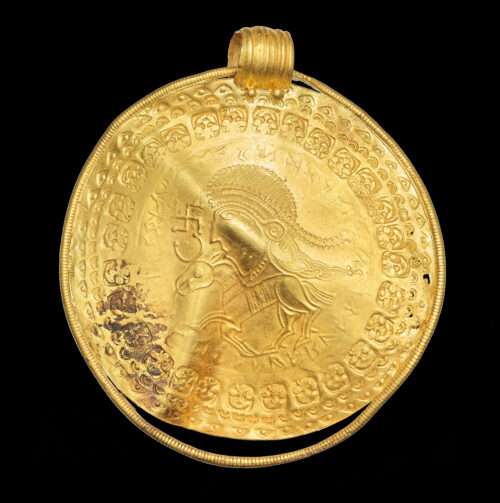
The most remarkable find, however is the C-bracteate known as IK 738. Wōd[a]nas weraz, – “Odin’s Man”– we read in the inscription, where the man is fitted out with a mighty braid. This bracteate is not unique as a slightly less fine copy has been found at the Island of Funen nearly 200 years ago and with a somewhat corrupted runic inscription. Luckily, the Vindelev-version provides us with the full text. Here is the version best liked by the runologists “Hostiōz. Helpu ufar fatai Jaga[i]. Iz Wōd[a]nas weraz.” Or in translation: “Sacrifices(?). (I) help the catcher Jagaz. He (is) Óðin’s man.” (14).
Maybe our Vendic warrior was also carrying the personal name Jagaz, not otherwise documented. (Though it may be known in Gothic as Arjagais or Harjagais, a combination of “army” and “spear”) (15). What we do know, though, is that the bracteate does not depict Odin as such. Rather, the portrait seems to represent and illustrate a man, who is identified as a hunter providing food and beer for religious feasting, donating golden rings to his followers and all in all being Odin’s man. Just as the portraits on the Merovingian coins depict the Frankish kings, we may presume the bracteates are not just portraits of the God(s) as has often been suggested. Rather, they may portrait the king enacting his role as “leader of the pack”.
In this connection we should also compare the Vindelev bracteates with those identified by Alexander Bursche (16) as having been part of the treasure discovered at Zagórzyn. One of these depicts the myth of Baldr, son of Odin, and his much lamented demise instigated by Loke. The other – although not a replica – show much the same iconography as IK 738. It is an intriguing fact that the two treasures –Vindelev and Zagórzyn – both hold identical medallions and bracteates, which echo each other: one with the earliest inscription of Odin, another featuring the myth of Baldr known from 11 other bracteates found in Denmark (but not in Vindelev) and finally the standardised iconography dominating the C-bracteates.
Girdles or Necklaces?
To conclude, the bracteates from Vindelev provide a detailed and highly articulated representation of the kings and warlords who dominated southern Scandinavia in the fifth and sixth centuries. With their long Merovingian hair, Roman diadems and sceptres, and adorned with golden torques – probably accompanied by armour – these figures, about whom Dagfinn Skre has written extensively, fashioned themselves as successor kings, positioning themselves on a par with the Frankish, Visigothic, Burgundian and Lombard rulers. While the latter’s reputations became more secure and “official” through chronicles and other written testimonies, this was not the case with the very early Danish kings. Nevertheless, as Dagfinn Skre has recently stressed so emphatically, this did not make them “lesser” kings, “proto-kings”, or just plain “warlords”, etc. – eponyms hitherto used to refer to these enigmatic (successor) kings (17).
This iconography further affords insight into aspects of their aristocratic lifestyle: they appear accompanied by horses, engaged in hunting, presiding over feasts where beer and mead are consumed from golden horns, and distributing golden rings to their retainers. This repertoire closely parallels the cultural inventory articulated in heroic poetry such as Beowulf. Finally, the imagery offers a glimpse of the sacral dimension of rulership, as the warlord appears in a sacrificial capacity, presiding over ritual feasting in honour of the “new” god, Wōd[a]nas, Odin.
Although our man from Vindelev hardly was the ‘man in charge’ of the formation of this very early ‘Nordic kingdom’, the evidence points to his close connection to Gudme, which evidently played the role of the “Central Place”, that is, the place where the “Centre” was located. This is documented by the Vindelev bracteate IK 738, together with its close replica from Fyn and hence Gudme. Pondering the life and career of Winiþharjaz makes it worthwhile as it opens up to a slightly more fleshed-out idea of what life was like in Northern Europe in the Migration Period.
A persistent question, however, concerns the archaeological context: why are these bracteates most frequently found in female graves when not recovered as hoards or stray finds? The most plausible explanation is that they were worn by “queens”, signalling their authoritative roles within elite warrior households.
Marriage practices among so-called barbarian societies differed markedly from those of the Roman or southern European world. Whereas Roman marriages were typically endogamous within established kin networks – often involving cross-cousin unions –and structured around dowry arrangements, barbarian marriage was in principle exogamous and involved the payment of a bride-price to the bride’s father as compensation for the loss of her labour. An integral component of this transaction was the Morgengabe (Morning Gift), a personal endowment presented to the bride on the morning following the wedding. This property remained in her possession throughout her lifetime and was either transferred to her son’s bride or interred with her.
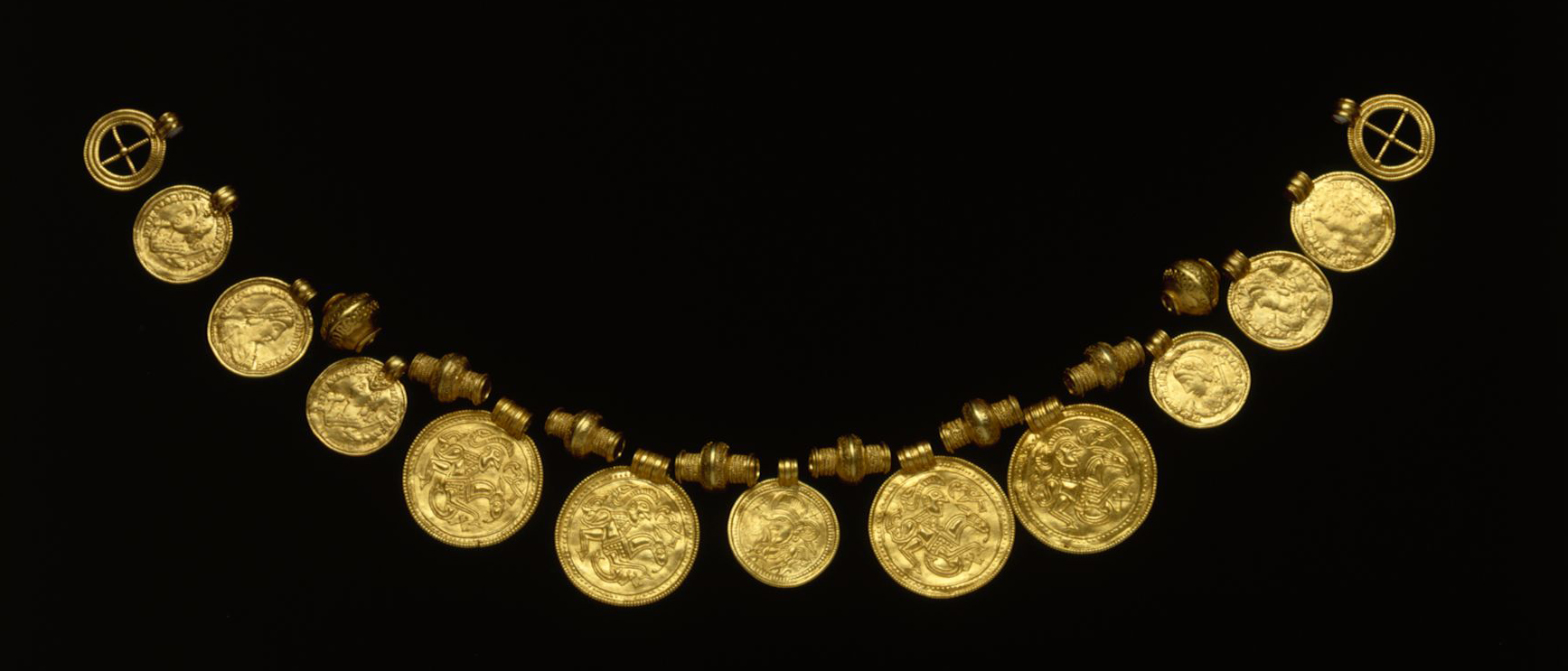
Grave studies have further demonstrated that the wearers of earlier disc-on-bow brooches were often elderly women, who have been interpreted as custodians of lineage and ancestral memory. It has generally been assumed that bracteates such as those from Vindelev were worn as necklaces, following the reconstruction of an example from a hoard discovered on Bornholm. The exceptionally large Vindelev bracteate, however, with an estimated diameter exceeding 15 cm, calls this interpretation into question. If the wearer also was expected wear one of the impressive fibulas under her chin as is known from figurines and amulets, It is worth considering whether the Vindelev bracteates may instead have formed part of a girdle ensemble?
A substantial Byzantine gold girdle from the sixth century, composed of Roman medallions and a series of solidi, preserved in the Metropolitan Museum of Art in New York, provides a relevant comparative example. Similarly, a piece of jewellery with suspended amulets from the treasure at Şimleul Silvaniei in Romania is frequently interpreted as a necklace, although its construction arguably corresponds more convincingly to a girdle. Conversely, the Tunic of Balthild (c. 680) preserves an embroidered representation of an elaborate medallion necklace. The precise manner in which the Vindelev bracteates were worn must therefore remain an open question.

Danevirke
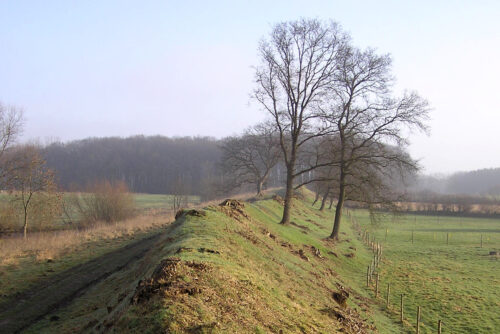
It may at first appear implausible to suggest that barbarian kings in Scandinavia operated on a level comparable to the Merovingian rulers of Francia during the fifth century. Yet a striking feature of the Danish landscape in precisely this period was the construction of the earliest phase of the Danevirke, a monumental defensive earthwork extending from the Schlei Fjord in the east to the marshy estuaries of the rivers Eider and Treene in the west.The earliest rampart was constructed of turf and earth and appears to have had a rounded crest profile. It extended for approximately 30 km and measured about 7 metres in width. Along its southern frontage, a ditch approximately three metres wide was excavated, forming an integral component of the defensive system. Around AD 500, the original rampart was reinforced with additional layers of heath turf. This second construction phase has been radiocarbon dated to c. AD 500. The initial phase of construction must therefore be assigned to an earlier point in the fifth century. The scale and engineering of the first rampart renders it highly unlikely that such a project could have been executed without centralised planning and coordinated labour mobilisation. It is therefore plausible that the construction was initiated by the Danir who moved northwards around AD 450. Some scholars have speculated whether their movement was precipitated by pressure from the Huns, as the rampart was evidently designed to prevent mounted assault from the south; its configuration would have significantly impeded cavalry attempting to breach it.
Perhaps Winiþharjaz also known as Jagaz was leader or instigator of this impressive defensive work? We shall probably never know.
Karen Schousboe
POSTSCRIPT
This essay has been much inspired by the recent books:
FEATURED PHOTO:
Portrait of Winiþharjaz? Detail of bracteate IK738. Photo: National Museum of Denmark/Arnold Mikkelsen. CCBYSA
NOTES:
1. Dam, P. De danske landbebyggelser i 1680erne (Selskabet for Udgivelse af Kilder til Dansk Historie, 2022), p. 231.
2. Frandsen, K.-E. Vang og tægt: studier over dyrkningssystemer og agrarstrukturer i Danmarks landsbyer 1682–83 (1983), pp. 1–10, 250–259.
3. Laursen, K. O. Rapport for arkæologisk efterudgravning og forundersøgelse VKH 8206 Vindelev (Vejle Museerne, 2023).
4. Laale, P. c. 1400. In: Kjær, I. & Petersen, E. (eds.) Danmarks gamle ordsprog I, 1–2 (1979).
5. Herschend, F. The Pre-Carolingian Iron Age in South Scandinavia: social stratification and narrative (Uppsala, 2022), p. 50 ff. See also Skre, D. The Northern Routes to Kingship (Routledge, 2025. Se also: Albris, S. L. Stednavne og storgårde i Sydskandinavien i 1. årtusind (PhD thesis, University of Copenhagen, 2017).
6. Peterson, L. Lexikon över urnordiska personnamn (Institutet för Språk och Folkminnen, 2004).
7. Andersen, K. H. Da danerne blev danske. Dansk etnicitet og identitet
til ca. år 1000 (Unpublished thesis. Aarhus Universitet, 2017).
8. McColl, H. et al. Steppe ancestry in Western Eurasia and the spread of the Germanic languages. bioRxiv (2024). See also: Speidel, L. et al. High-resolution genomic history of early medieval Europe. Nature 637, 118–126 (2025).
9. Volkmann, A. Siedlung — Klima — Migrationen: Geoarchäologische Forschungen zum Oderraum zwischen 700 vor und 1000 nach Chr. mit Schwerpunkt auf der Völkerwanderungszeit. Studien zur Archäologie Europas 18 (Verlag Dr. Rudolf Habelt, Bonn, 2013).
10. Nicolay, J. A. W. Ein frühes Königreich im Elbe-Weser-Dreieck. In: Ludowici, B. (ed.) Saxones, 132–140 (Theiss, 2019).
11. Laursen, K. O. & Ravn, M. Guldfundet fra Vindelev og verdens største brakteat – en brik i puslespillet om den tidlige rigsdannelse i Danmark og vikingetidens begyndelse. In: Ravn, M. & Lindblom, C. (eds.) Magt og guld – vikinger i Øst, 52–77 (Forlaget Turbine, 2022). See also Antonsen, J. & Martinussen, H. P. Vindelevskatten. Et sted – et fund (Trykværket, 2024) and Ravn, M. & Laursen, K. O. Vindelevskatten. Et dynastisk offer fra folkevandringstiden. Kuml (2024).
12. Horsnæs, H. Large imperial gold medallions from the fourth century: reflections on the distribution and use of Roman medallions in Barbaricum – the medallions from the Vindelev hoard, Denmark. Numismat. Chron. (2023).
13. Axboe, M. The world’s largest gold bracteate: a brief presentation of the Migration Period gold hoard from Vindelev, Denmark. Eur. Archaeol. 74, 54–62 (2022).
14. Imer, L. M. & Vasshus, K. S. K. Lost in transition: the runic bracteates from the Vindelev hoard. NOWELE 76, 60–99 (2023).
15. Mees, B. The Dziedzice inscription and West Germanic rhotacism. Lingua Posnaniensis Vol 62 No 2 2020
16. Bursche, A. Germanic Gold bracteates from the hoard in Zargórzyn near Kalisz.
In: M. Wołoszyn (Ed.) Byzantine Coins in Central Europe between the 5th and 10th Century, Moravia Magna, Seria Polona vol. III, Kraków 2009, p. 133-153
17. See the conclusion in the book: Skre, D. The Northern Routes to Kingship (Routledge, 2025). For another perspective, though, se I. Wood: The Making of “the Burgundian Kingdom”. Reti Medievali Rivista, 22, 2 (2021), wherin the status of the so-called kingdom of the Burgundians from an emic point of view was in fact considered a “provincia” and “regio” and not a “regium”. However, arguably, Burgundy was a close former part of the Roman Empire. That was of course never the case with Scandinavia.
READ MORE ABOUT BRACTEATES:
Die Goldbrakteaten der Völkerwanderungszeit 1 . By K. Hauck (Ed.). München 1985.
Iconographic Catalogue 1: Text
Iconographic Catalogue 1: Plates
Die Goldbrakteaten der Völkerwanderungszeit 2 By K. Hauck (Ed.). München 1986.
Iconographic Catalogue 2: Text
Iconographic Catalogue 2: Plates
Die Goldbrakteaten der Völkerwanderungszeit 3 By K. Hauck (Ed.). München 1989.
Iconographic Catalogue 3: Text
Iconographic Catalogue 3: Plates
M. Axboe. Die Goldbrakteaten der Völkerwanderungszeit – Herstellungsprobleme und Chronologie
Series: Ergänzungsbände zum Reallexikon der Germanischen Altertumskunde 38
Berlin/New York 2004.
R. Bruder. Die germanische Frau im Lichte der Runeninschriften und der antiken Historiographie.
Berlin, New York 1974
Die Goldbrakteaten der Völkerwanderungszeit – Auswertung und Neufunde.
By W. Heizmann and M. Axboe (Hrsg.),
Series: Ergänzungsbände zum Reallexikon der Germanischen Altertumskunde 40
Berlin, New York 2011
A. Pesch. Thema und Variation – Die Goldbrakteaten der Völkerwanderungszeit
Series: Ergänzungsbände zum Reallexikon der Germanischen Altertumskunde 36
Berlin, New York 2007