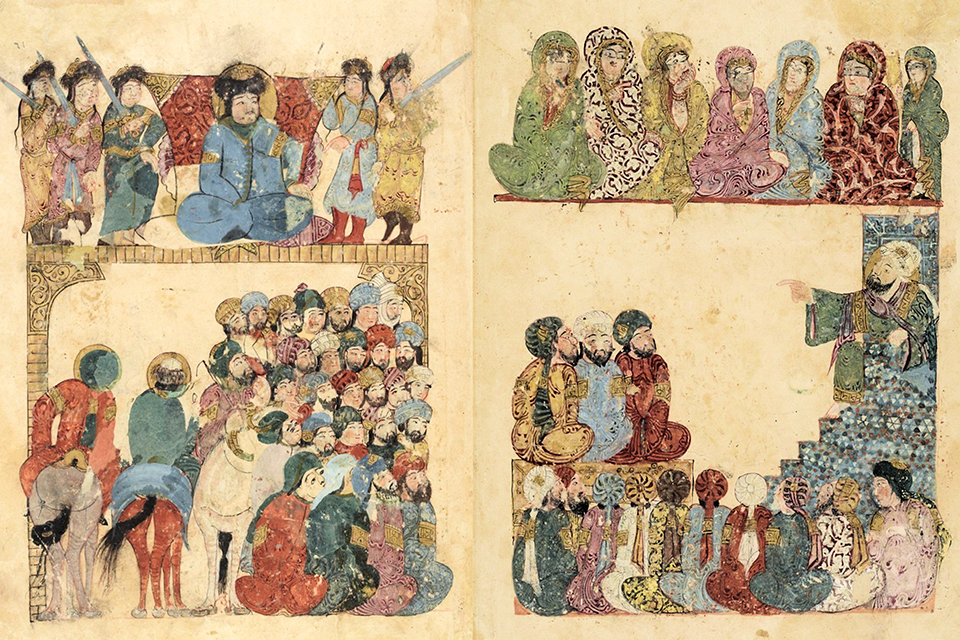
New book studies the relationship between political thought, preaching and emotions through the writings of Ibn al-Jawzi (d. 1201), a celebrated hortatory preacher in late Abbasid Baghdad.
Preaching Pious Rulership in Medieval Islam. Ibn al-Jawzi’s Political Thought
By Han Hsien Liew
Series: Edinburgh Studies in Classical Islamic History and Culture
Edinburgh University Press 2026
ISBN-10 : 1399511297
Studies the role of preaching and emotions in medieval Islamic political thought
- Explores the connection between hortatory preaching and political thinking
- Challenges scholarship that frames the history of Islamic political thought as a gradual evolution towards the principle of ‘might is right’
- Analyses Ibn al-Jawzi’s political works in relation to his preaching manuals, sermon collections, polemics and biographies of caliphs
- Uncovers the emotional vocabulary and norms of Arabic hortatory sermons
- Provides an accessible survey of political concepts found in medieval Muslim advice literature and legal and theological treatises
An Islamic teacher, Ibn al-Jawzī
 Ibn al-Jawzī (1126–1200) was a jurist, theologian, historian, and preacher who came to dominate the intellectual milieu in Baghdad in the 12th century. He was a leading teacher and advocate of traditionalist Islam.
After having received a traditional religious education, he became a master at two religious colleges in 1161. A fervent believer in the Ḥanbalī doctrine (one of the four schools of Islamic law and part of the roots of the present-day conservative Wahhabi movement), he became a public figure in the conservative ruling establishment, which he served as a fervent preacher favoured by the caliphs. In 1178–9 he was appointed the master of five colleges after having played the role of a semi-official inquisitor policing the doctrinal challenges and heresies committed by spokespersons for the other schools of thought.
In this endeavour, he was particularly critical of Sufis (Muslim mystics) and of the theologians who practised Shīʿism (one of the two major branches of Islam).
However, in 1194, his old friend and patron, the Abbasid vizier and patron of the arts, Ibn Yūnus, was arrested. This led to a closing-off of Ibn al-Jawzī’s access to court. Later the same year, Ibn al-Jawzī was detained and exiled to the garrison town of Wāsiṭ. Not until his death six years later was he allowed to return to Baghdad.
Much of Ibn al-Jawzī’s scholarly work was of a hagiographical and polemical nature, reflecting his staunch support of the Ḥanbalī doctrine. Central to this work was his multi-volume chronicle, al-Muntazam fī Tārīkh al-Mulūk wa’l-Umam (The Ordered History of Kings and Nations), in which he outlined the history of the Middle Eastern world.
However, of particular interest was also his Ṣifat al-ṣafwah (“Attributes of Mysticism”), an extensive history of mystic spirituality, which argued that the true mystics were pietists forming their lives on those of the Prophet’s companions.
Through an intertextual analysis of Ibn al-Jawzī’s works in various genres, this book details how his ideal form of rulership reflected the emotional norms and pietistic moral virtues promoted in Muslim hortatory sermons in the 12th century.
It also examines the emotional strategies deployed in his efforts to reform the rulers of his time. In highlighting the importance of piety in Ibn al-Jawzī’s political discourses, the book points to a new reading of the history of Islamic political thought that, rather than foregrounding order and military prowess, considers competing political languages among medieval Muslim intellectuals. In doing so, it calls for the need to rethink notions of ‘politics’ and the ‘political’ when studying Islam.
About the Author
Han Hsien Liew is Assistant Professor of Islamic Studies in the School of Historical, Philosophical and Religious Studies at Arizona State University. In addition to the history of Islamic political thought, his research interests include Qur’anic exegesis, Islamic theology, Islam in Southeast Asia and the history of emotions. His work has been published in Al-Qanṭara: Revista de Estudios Árabes, Journal of Islamic Studies, Journal of the American Oriental Society and Arabica. He was recently awarded a Herodotus Fund Membership from the Institute for Advanced Study in Princeton, New Jersey.
FEATURED PHOTO:
Preaching scene at Ravy in Maquma. From Maqamat al Harari 1237. Source Wikipedia
READ ALSO:
 History of the Nations
Al-Muntaẓam fi tarikh al-muluk wa-al-umam
by Ibn al-Jawzi
Translated and published by by Al Reshah 2020
This is the translation of the fourth part in a sequence of books written by the Imam Ibn al-Jawzī. He was an Arab Muslim judge, preacher, orator, heresiographer, traditionist, historian, judge, hagiographer, and philologist who lived in Baghdad during the twelfth century.
In this book, he collected what was known in his time about the nation’s history. As the reader will note, this book focuses first on parts more closely related to the Middle Eastern region and on the prophets known to Jews and Christians. The reason for this is that Baghdad was the heart of the Islamic world, and much of the knowledge of other nations had been concentrated there during the Golden Age of the Islamic Empire. It is essential to understand that the first and second parts of this book, covering the period up to 600 AD, were based on what the Imam read and gathered from Israelites known to him in his time. Therefore, similarities may be found between the historical events mentioned in those two parts and Biblical stories.
Starting from the end of the second book, the nature of the authentication differs greatly, as these sections are more closely related to Islamic history and to the states surrounding the Islamic empire. The spread of knowledge and literacy within the Islamic world resulted in better record-keeping, and references to events were recorded in different documents.
This part makes this book one of the important works on the history of the region, especially for the period from 600 AD to the author’s death.