Maroboduus or Marbod was a Suebian king living at the time of Augustus and Tiberius.
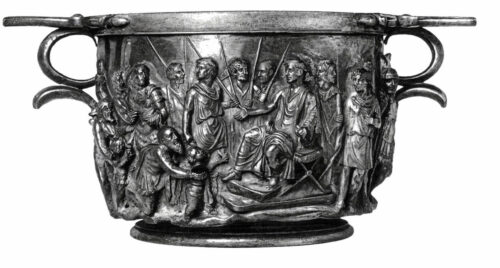
Sometime in the early reign of Augustus, the Suebian Maroboduus or Marbod travelled from the area to the east of the Elbe, his Suebian homeland, to Rome. Whether as a guest, military mercenary, hostage, or exile, we do not know. Nonetheless, during his sojourn in the eternal city, he befriended Augustus as well as his brother in arms and later rival, Arminius – the victor in the Teutoburger forest in 9 AD.
However, in 10 BC, the Suebian people from east of the River Elbe were severely beaten by Roman forces, and Maroboduus returned to play his role as what the Romans regarded “a friendly client king”. Here, he set himself up as a king (or emperor) enacting his realm as if he was on par with Augustus. Villeius Paterculus, who had opportunity to take part in the endgame around AD 17, wrote that he was a “man of noble family, strong in body and courageous in mind, a barbarian by birth but not in intelligence. He achieved among his countrymen no mere chief’s position gained as the result of internal disorders or chance or liable to change and dependent upon the caprice of his subjects, but, conceiving in his mind the idea of a definite empire and royal powers –certum imperium vimque regiam – , he resolved to remove his own race far away from the Romans and to migrate to a place where, inasmuch as he had fled before the strength of more powerful arms, he might make his own all powerful. Accordingly, after occupying the region we have mentioned [Bohemia] he proceeded to reduce all the neighbouring races by war, or to bring them under his sovereignty by treaty.” (Villeius Paterculus CIX:4) (1)
Later, Maroboduus led his people (called the Marcomanni in the Roman sources) to what is present-day Bavaria and Bohemia to settle them north of the Danube. In the following years, he worked tirelessly to forge a Roman army out of his people numbering (according to the sources) 70.000 infantry and 4000 cavalry, de facto setting up, what the Romans and their emperor acknowledged as more than just a petty threat.
In this context It is pertinent to know that Marbod or Maroboduus derives from Celtic: Maro-bodos, from Maro meaning great and Boduos, crow or raven, that is the scavenger birds picking clean the battlefields. In Proto-Caeltic/Irish, *bodb means “war-divinity”(2). Thus, in the romantic poem “Punica” by Silius Italicus from 2nd century AD, we read that ” to these men death in battle is glorious; And they consider it a crime to bury the body of such a warrior; For they believe that the soul goes up to the gods in heaven, If the body is exposed on the field to be devoured by the birds of prey”. (3)
Nonetheless, Velleius tells us that Marbod did not seek to provoke the Romans to war, but rather worked to create a defensive position securing non-interference of the Romans. However, we are also told by Velleius that his envoys to Augustus, commended their king as sometimes a servant sometimes as the equal of Caesar.
Eventually, the Romans came to fear this Germanic power operating just north of the Alps mounting a campaign against Marbod in AD 6. Unfortunately for the Romans, though, they were attacked elsewhere, and in due course, Tiberius was obliged to enter into a treaty with Marbod in AD 6 recognising him as a king. Later, Marbod was part of Arminius’ war against the Romans in AD 9, and the story goes that Marbod received the head of Varus as a gift from Arminius after the annihilation of the nine legions at Teutoburg. Marbod sendt it on to Augustus. Finally, in AD 17 Arminius and Marbod engaged in hostilities, and Marbod was obliged to once again retreat into the Bohemian hills and forests. Later that year, yet another Romanised “barbarian”, Catualda, entered the scene defeating Marbod. Surrendering to Rome, Tiberius detained him for 18 years in Ravenna, where he died in AD 37.
Arguably, Marbod was what later Roman histories regarded as a classic “inserviens rex”, a client-king in the service of his patron, the emperor. On the other hand, Tacitus also acknowledged, that kings were all-together of another ilk than emperors. In his Histories (I:16) from ca. AD 105, he writes to his emperor: “For us there is not, as among peoples where there are kings, a fixed house of rulers while all the rest are slaves. Rather, you are going to rule over men who may endure neither complete slavery nor complete liberty.” In Tacitus’ view, kings were per definition non-elected tyrannical owners of their people, while emperors were elected by their armies willing to take their “coins”, thus two different “things”. During the time of Augustus, however, such kings were sought to be enrolled as “client-kings” thus creating a myth of their client-status and establishing them as vassals, positioning them in the orbit of the Empire.
To conclude: The Romans definitely knew of kings and worked to establish and control them as “clients” in the classical Roman manner. However, as was the case with Maroboduus or Marbod, kings were apparently also something “other” located outside the periphery of the Roman Empire. Emperors did not need kings in their entourage to enact imperial rulership, as was the case later when archbishops needed suffragan bishops to construe proper archdioceses. However, they subsumed them whenever it was politically opportune, turning them into game pieces whenever it was opportune.
We may perhaps try to envisage such a “Barbarian king” as a dynastic chieftain known in Proto-Germnic as a *druhtinaz, the ancestor of various Germanic words for lord, such as the Old English dryhten or Old Norse drótt or dróttin, the leader of the pack, his *druhtiz (the entourage). The word is also known from antrustion, the royal merovingian bodyguard.
NOTES:
(1) Villeius Paterculus: Compendium of Roman History. Ed. and transl. by Frederick W. Shipley. The Loeb Classical Library, London and New York 1924
(2) Delamarre, X.: Les Noms des Gaulois. Studies in Old Celtic Names. Les Cent Chemins. 2017.
(3) Silius Italicus, Punica, Book III: 325-343.
FEATURED PHOTO:
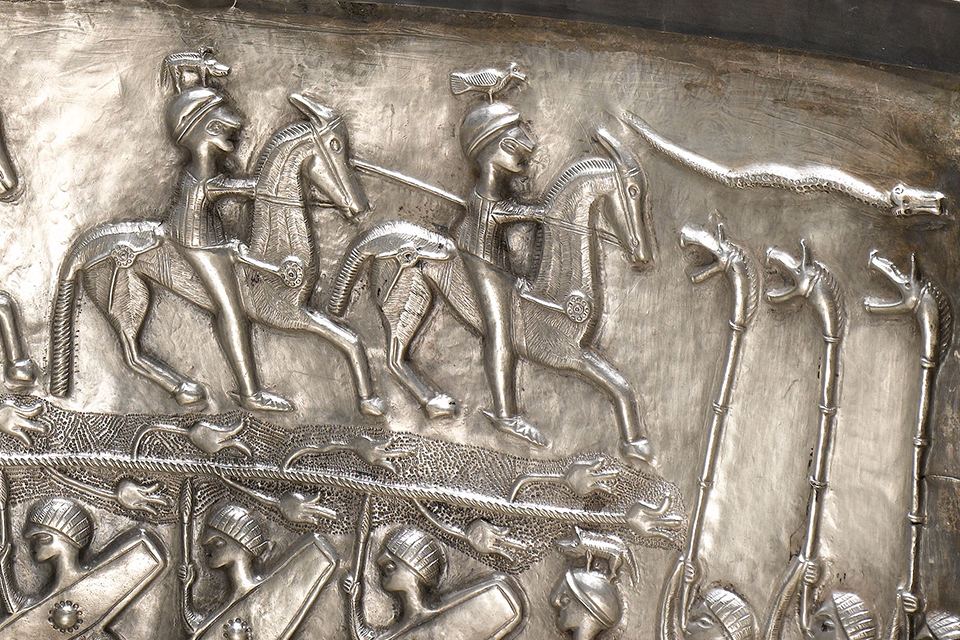
Gundestrup cauldron ca. 150 BC – AD 1 © National Museum of Denmark CCBYSA
SOURCE:
Gowing, A. M: Tacitus and the Client Kings. Transactions of the American Philological Association (1974-2014), Vol. 120 (1990), pp. 315-331 (17 pages)
READ ALSO:
Braund, D. C.: Rome and the Friendly King. The Character of Client Kingship. Routledge 1984