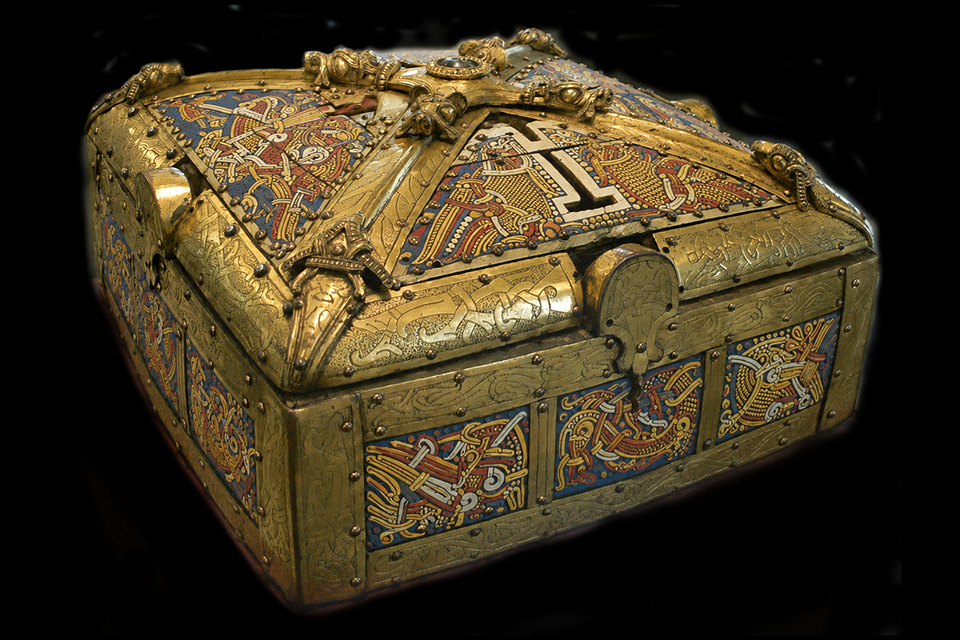
Could the Bamberg Shrine have been a diplomatic gift presented to Otto the Great by the emissaries of the Danish king at Quedlinburg in AD 973?
In AD 973, Otto the Great finally returned from Italy to spend time in his Saxon homeland. The highlight of his journey was the Easter celebration at Quedlinburg, where his mother, Matilda, had died during his Italian sojourn in AD 968 and been laid to rest beside his father, Henry the Fowler.
This imperial assembly had clearly been planned well in advance. The rulers of Poland and Bohemia attended in person, while embassies arrived from across Europe and beyond, including the Spanish Caliphate, Byzantium, Hungary and Bulgaria. Denmark, too, sent an official delegation to take part in the political negotiations with the emperor.
Such gatherings were as much displays of diplomacy as of piety. Prestige objects, lavishly crafted and rich in symbolism, played a central role in expressing alliances, respect and political ambition.
Against this background, it has been suggested that the Bamberg Shrine was one of the ceremonial gifts presented to Otto by the Danish envoys. Both its date and its distinctive artistic vocabulary—the Mammen style—fit remarkably well with such an interpretation.
At some point, the casket then came into the possession of Kunigunde, the saintly wife of Henry II, and subsequently became known as Kunigunde’s Shrine. It may have entered the Bamberg Treasury between 1003 and 1024. More likely, however, it was returned there together with Kunigunde’s personal possessions when she was reburied in 1201, following her canonisation.
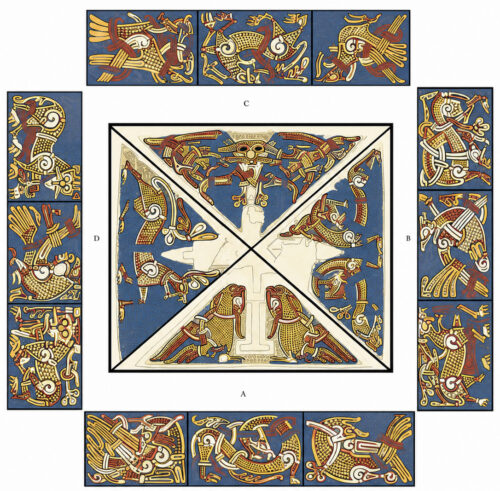
The Bamberg Shrine is a sumptuous Viking casket crafted from wood, mounted with a gilt-bronze framework and embellished with finely carved walrus-ivory plaques. Its distinctive Mammen-style ornaments places it in the second half of the tenth century. The casket measures 26 × 26 × 13 cm, is made of oak and is fitted with a gently vaulted lid. The gilt-bronze mounts are covered in an exuberant display of Viking animal ornament, featuring entwined gripping beasts. The walrus-ivory plaques have been suggested to depict the symbols of the Four Evangelists—the lion, the ox, the eagle and the man. On the basis of this Christian iconography, scholars have proposed that the shrine originally housed either a Gospel manuscript or sacred relics.
A Royal Design?
Whatever its original function, the Bamberg Shrine was clearly not a unique creation.
In 2004, an iron fitting from a casket of the same type was recovered from a Viking Age grave at Haldum, some 20 km north-west of Aarhus.
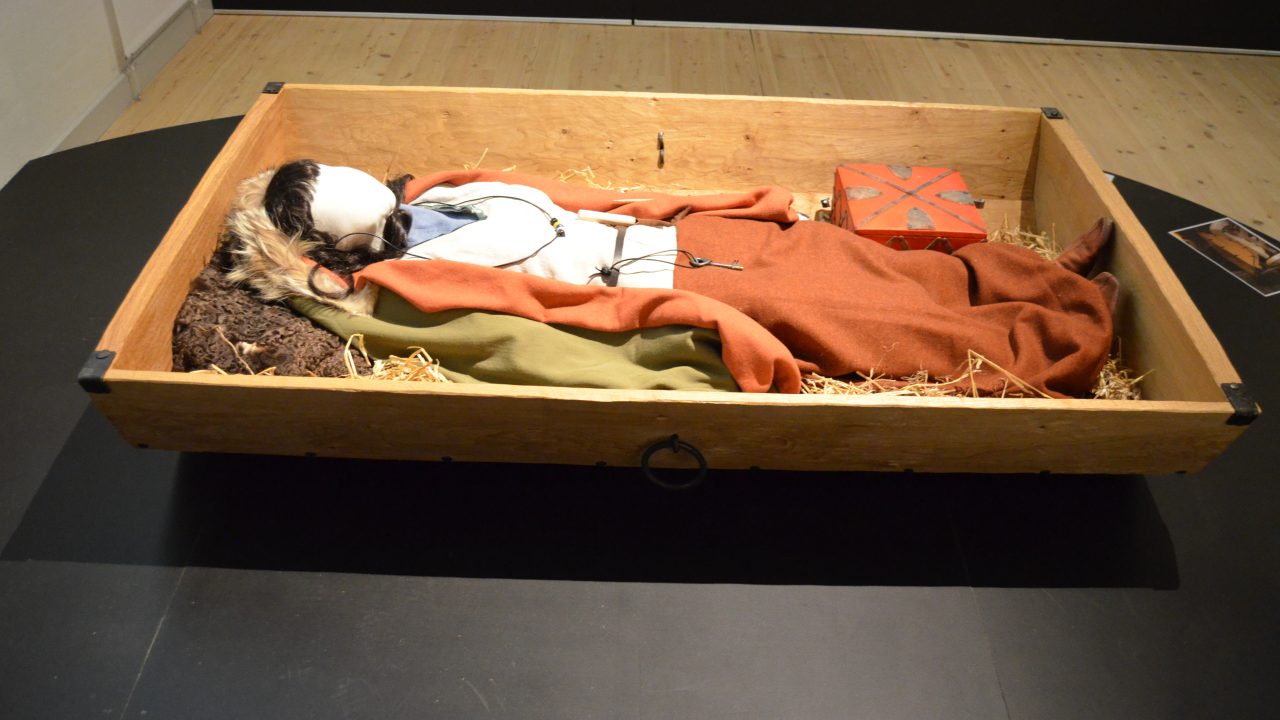
Then, in 2012, a remarkably similar casket was excavated among the grave goods from Haarup, near Silkeborg. It belonged to an elite woman buried in a wagon and dressed in garments trimmed with silver braid. The casket was secured with a lock, and the deceased was accompanied by two keys, one of which fitted the lock.
Most recently, in 2025, the remains of another casket of the same type were discovered in a grave within the burial ground associated with the elite settlement at Lisbjerg.
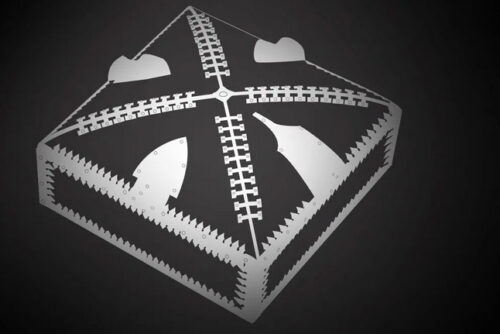
Because this casket had survived in a highly deteriorated state, it was first examined by X-ray in order to preserve as much information as possible before excavation began. The radiographs revealed several broad iron straps spanning the casket, a handle mounted in the centre of the lid, and an elaborate locking mechanism. They also showed that a pair of scissors lay inside.
Subsequent excavation established that the casket had originally been clad in thin iron sheet and ornamented with small bronze nails. Hinges decorated with incised grooves and finely modelled animal heads had been mounted on the lid together with a twisted handle, whose details only became apparent after careful sandblasting.
Microscopic examination also revealed traces of silver corrosion, probably originating from a textile woven with silver thread that had been draped over the casket before burial. Similar traces were found around the skull and were initially interpreted as the remains of an elaborate headdress. It is equally possible, however, that they derive from a larger cloth covering both the deceased woman and the casket.
Conclusion
The archaeological report on the Lisbjerg burial ground has yet to be published, while the Haldum find likewise remains unpublished. The Næsby casket, however, has been fully documented, and additional information about the other discoveries has emerged through museum press releases and newspaper reports.
Taken together, the available evidence indicates that all three archaeological caskets share the same fundamental construction, although their locking mechanisms differ in detail. Equally striking is the fact that every example has been recovered from a burial of exceptional status.
Their overall form also displays a remarkable affinity with the Bamberg Shrine, suggesting that all four caskets may have originated from the same workshop—or, at the very least, from a closely related artistic tradition serving the Scandinavian elite during the late tenth century.
FEATURED PHOTO:
Unfortunately, none of the decorative surfaces of the excavated caskets has survived. We therefore cannot determine whether they were as lavishly embellished as the Bamberg Shrine. Also, we do not know whether they were painted.
However, we know that most medieval ivories were originally painted. Whether the same was true of Viking carvings fashioned from walrus ivory remains uncertain.
Thus, there is good reason to think that colour formed an integral part of elite Scandinavian craftsmanship. The carved wooden objects from the Oseberg ship burial were richly painted, as was the furniture recovered from the royal graves at Jelling and Ladby.
The colours used in the present reconstruction of the Bamberg Shrine have been copied from the surviving paint traces preserved on Jelling Stone 2.
SOURCES
Fornemt skrin– i en kvindegrav fra vikingetid
Af Jens Jeppesen and Marianne Schwartz
Kuml 2007
Der Bamberger und der Camminer Schrein: zwei im Mammenstil verzierte Prunkkästschen der Wikingerzeit.
By Arnold Muhl
In: Offa. 1990, Vol. 47, p. 241-420, 103 ill.
Decoding Viking Art. The Christian iconography of the Bamberg Shrine
By Jörn Staecker:
In: On the Road. Studies in Honour of Lars Larsson. Ed by Birgitta Hårdh. Acta Archaeologica Lundensia in 4º, No.26, pp. 301-320.