A new excavation at Søften, near Lisbjerg, has revealed an extensive production environment that may have supplied Viking Age Aarhus with textiles and other craft products.
At Søften near Lisbjerg, just 10 kilometres north of central Aarhus, Moesgaard Museum is investigating a large Viking Age settlement. The findings point to a specialised production environment, with a particular emphasis on textile manufacture.
The excavation is located only four kilometres from Lisbjerg, where Moesgaard has previously uncovered a high-status settlement closely connected to the Viking town of Aros, which served as a centre of royal power and international trade. In addition, a young archaeology student discovered a Viking Age silver hoard at Elsted—approximately five kilometres from Søften—in 2024.
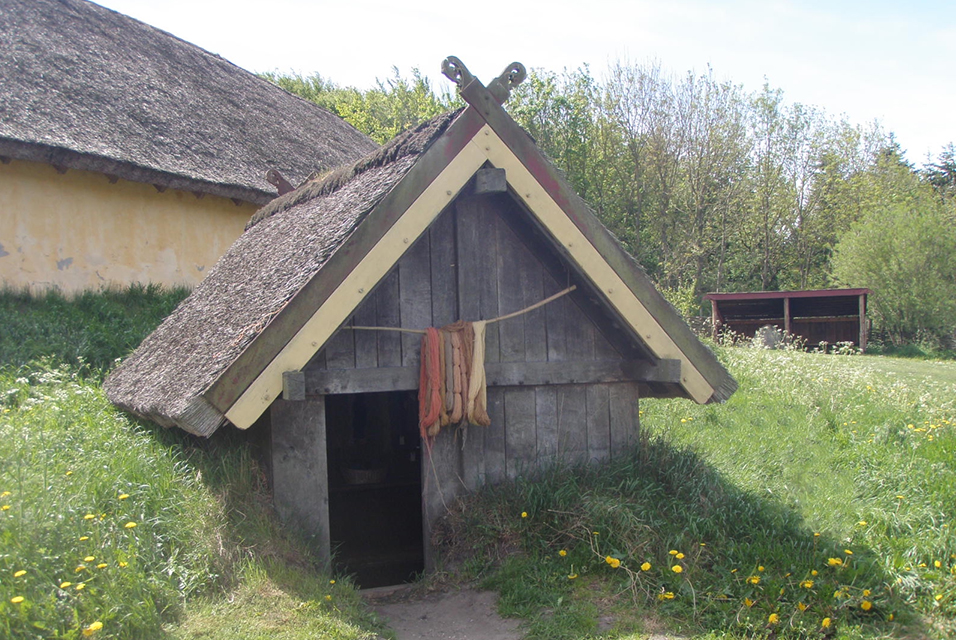
The settlement at Søften appears to have accommodated extensive and organised production. Among the features uncovered are areas associated with flax processing, as well as a large number of pit houses—sunken workshop buildings typically linked to craft activities and production. In total, 82 pit houses have been identified at the site.
The ongoing excavation at Søften covers an area of just over 60,000 m². Previous investigations south of the current excavation area have revealed similar settlement and production features dating from the same period. Overall, the settlement is estimated to have covered at least 100,000 m².During the current excavation, 48 pit houses have been identified. Earlier excavations uncovered a further 34, bringing the total number of pit houses discovered at the site to 82.

The large marked field shows the ongoing excavation. The smaller fields below indicate areas excavated in 2008 and 2013.
On the square at Søften, weaving scales and loom weights have been found, which testify to extensive textile production. In addition, silver clippings, coins and beads have been found, which testify to trade and economic activity at the site. Whether or not sails or tunics were the main product, it appears to have been an impressive factory.
In the first report, the archaeologists tentatively identified the site as a proto-industrial workshop producing manufactured goods for the emporium of Århus. More recently, however, the identification of Århus as a significant trading centre before the turn of the first millennium has been seriously questioned (1). Depending on the precise dating of the site at Søften, it is more likely to have been a local “factory”, intended to produce the textiles necessary to equip part of the royal fleets operating in the second half of the 10th century. Perhaps Søften was owned and operated by the king’s man, Ketil, lord of Lisbjerg?
But then, the conquest of England in 1016 took the combined effort of 17.500 persons working for a whole year to outfit and organise Cnut’s war on England. With an estimated population of no more than 5-650.000 people in wider Denmark at this time, and with the possibility of a agricultural yield of no more than 3 to 1, it may be estimated that these 17.500 people at least needed a backing group of more than 35.000. Around 10% of the population were thus directly involved in this venture.
The archaeological studies have been ongoing since August 2025 and are expected to be completed by the end of June 2026.
“We are not seeing the remains of an ordinary village but rather a production complex that was specialised and organised on a large scale. The settlement comprises distinct areas dedicated to production and craft activities, together with a single residential building. This organisation suggests that the activities were directed by a central authority exercising control over resources and production.” says Liv Stidsing Reher-Langberg.
NOTES:
From Landing site to Local Centre. New Insights into the Developments, Activities and Maritime Networks of Aarhus, Denmark, in the Viking Age c.750-1050
By Jette Linaa
In: Danish Journal of Archaology 2024, vol 13., 1-30,
SOURCE:
Liv Stidsing Reher-Langberg, Excavation Director and Archaeologist, Moesgaard Museum