
The Huns and the Avars were famous for their lusty greed for gold. But what did they do with it all? Recent research by the German historian Matthias Hardt has explored this cultural capital and how it was used to signal power in the early Middle Ages from the 5th to the 8th century
“In truces they are treacherous and inconstant, being liable to change their minds at every breeze of every fresh hope, which presents itself, giving themselves up wholly to the impulse and inclination of the moment; and, like brute beasts, they are utterly ignorant of the distinction between right and wrong. They express themselves with great ambiguity and obscurity; have no respect for any religion or superstition whatsoever and are immoderately covetous of gold…” Thus wrote Ammianus Marcellinus app. 375 AD about the Huns in his “Rerum gestarum libri qui supersunt” Vol 31:2)
In an inspiring article about “The Nomads Greed for Gold” Miatthias Hardt (building on his German dissertation from 2004) gives an overview of this greed for gold and the background for it. In the article he lists the exorbitant amounts of gold, which was collected first by the Burgundians and other Germanic warbands and later by the nomadic tribes following in their path – the Huns and later the Avars descending on Europe from the steppes North of the Black Sea. It has been calculated that Attila was able to extract more than 9 metric tonnes of gold before he lost his grip on his Roman adversaries and was killed.
But why this enormous greed for gold? Matthias Hardt explores in his work, how the different war-leaders were only as powerful as the generosity, they were able to enact towards their followers when redistributing all this wealth. In this context power had continuously to be demonstrated by war-leaders, keen to amass new followers in their fight for support. Lack of gold was essentially seen as lack of power=lack of ability to attract new people . And “seen” should here be understood literally and not metaphorically. Jewellery, armbands, golden rings, sword-hilts, scabbard fittings, buckles, strap-ends and not least horse-trappings, handles for their whips etc. were all meant to parade the scope and size of their networks.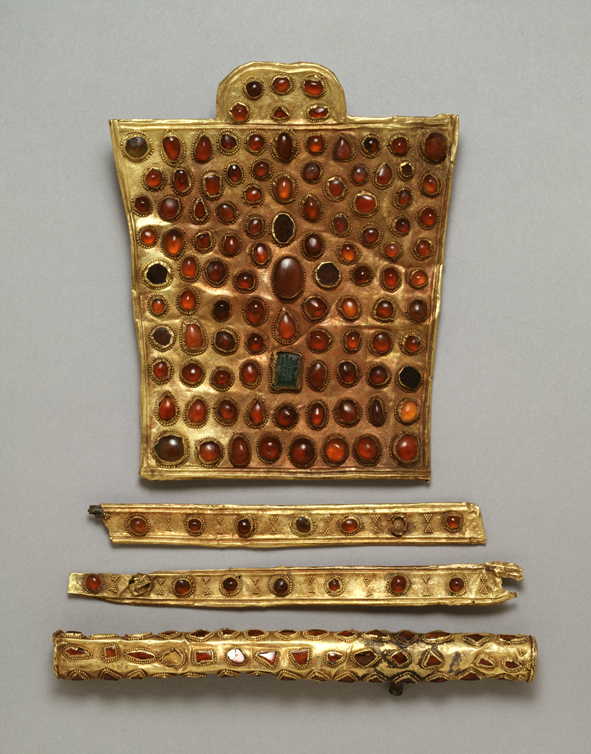
One detail found on two small golden bowls from the Avar treasure (6th -10th century) found in Nagyszenmiklós is a soldered-on strap mount.It is probable, writes Matthias Hardt, that the original owner of thise bowls had the straps fastened on in order to be able to flaunt his gold, hanging from his horse tack. The Avars were – as the Huns – simply nomads living of their herds of horses and whatever pillage might yield them. The greed for gold thus had its rationale in a peculiar form of conspicuous display literally visualising the power to pillage and to cater for any dependents, attracted by the gold.
It is this image of glittering and greedy horsemen, which they forged in the minds of their contemporaries and which we find witnessed by the incredible golden hoards, which from time to time are found hidden in the ground from the Rhine to the shores of the Black Sea.
READ MORE:
The Nomad’s Greed for Gold: From the Fall of the Burgundians to the Avar Treasure.
By Matthias Hardt
In: Construction of Communities in the early Middle Ages: Texts, Resources and Artefacts.
Brill Academic Publishers pp. 95 – 107
Gold und Herrschaft. Die Schätze europäischer Könige und Fürsten im ersten Jahrtausend.
By Matthias Hardt
Series: Europa im Mittelalter. Abhandlungen und Beiträge zur historischen Komparatistik 6.
Akademie Verlag GmbH, Berlin 2004
ISBN-10: 3050037636
ISBN-13: 978-3050037639