Why did Muslim mercenaries serve in the medieval armies of the Aragonese kings? What role did they play? New book explores the religious considerations, which both king and mercenary undertook while collaborating with each other.
 The Mercenary Mediterranean
Sovereignty, Religion, and Violence in the Medieval Crown of Aragon
By Hussein Fancy
University of Chicago Press 2016
Sometime in April 1285, five Muslim horsemen crossed from the Islamic kingdom of Granada into the realms of the Christian Crown of Aragon to meet with the king of Aragon, who showered them with gifts, including sumptuous cloth and decorative saddles, for agreeing to enter the Crown’s service.
They were not the first or only Muslim soldiers to do so. Over the course of the thirteenth and fourteenth centuries, the Christian kings of Aragon recruited thousands of foreign Muslim soldiers to serve in their armies and as members of their royal courts. Based on extensive research in Arabic, Latin, and Romance sources, The Mercenary Mediterranean explores this little-known and misunderstood history.The question, which the book sets out to answer is: why? Might it be explained as a nothing but a practical solution for the Aragonese kings to people an army? Was it pure mercenary reasons, which obliged the “Jenets” to enter into the service of the king?
Far from marking the triumph of toleration, Hussein Fancy argues, the alliance of Christian kings and Muslim soldiers depended on and reproduced ideas of religious difference. On one hand the Aragonese kings saw their Muslim soldiers as visual symbols of the his role as a Christian king, ultimately subjugating “the religious others” (the Muslims). On the other hand the Muslim soldiers saw their participation in the King’s wars with his Christian neighbours as a continuation as their role as Holy Warriors. Their shared history represents a unique opportunity to reconsider the relation of medieval religion to politics, and to demonstrate how modern assumptions about this relationship have impeded our understanding of both past and present.
In his book, Hussein questions the widespread tendency to reduce the Middle ages to “a period of either serene faith or frustrated secularism” and to invoke the spirit of convivencia as the primary key to understand the interplay between the people of different faiths in Medieval Iberia.
TABLE OF CONTENTS:
- Introduction: A Mercenary Logic
- Chapter One: Etymologies and Etiologies
- Chapter Two: A Sovereign Crisis
- Chapter Three: Sovereigns and Slaves
- Chapter Four: A Mercenary Economy
- Chapter Five: The Unpaid Debt
- Chapter Six: The Worst Men in the World
- Epilogue: Medievalism and Secularism
ABOUT THE AUTHOR:
Hussein Fancy is assistant professor of history at the University of Michigan.
FEATURED PHOTO:
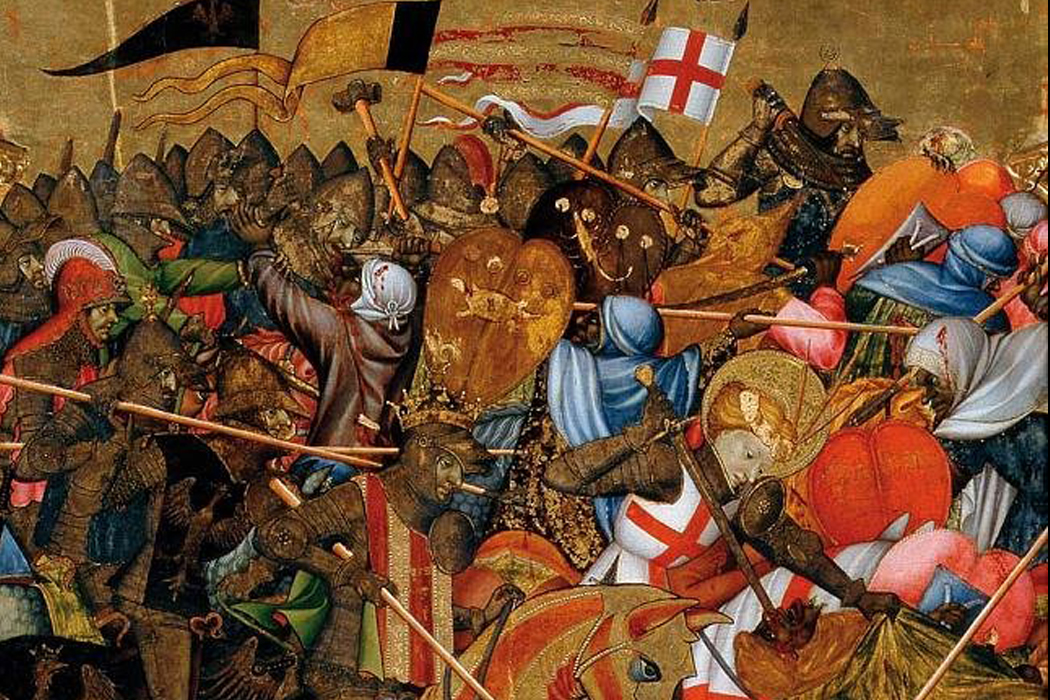
The Battle of the Puig de Santa Maria by Andrés Marzal de Sas. The Battle of the Puig, also known as the Battle of the Puig de Santa Maria, the Battle of the Puig de Enesa, or the Battle of the Puig de Cepolla was a battle of the Spanish Reconquista and of the Aragonese Conquest of Valencia. The battle took place in 1237, pitting the forces of the Crown of Aragon, under the command of Bernat Guillem d’Entença, against the forces of the Taifa of Valencia, under the command of Zayyan ibn Mardanish. The battle resulted in a decisive Aragonese victory and the conquest of Valencia by the crown of Aragon. The painting is part of a retable telling the story of St. George.