
Book: The Poor and the Perfect.The Rise of Learning in the Franciscan Order, 1209–1310
In one of the more charming stories told about St. Francis of Assisi we hear that he went and begged forgiveness from a novice, whom he had allowed to keep a psalter and thus incited him to break the rule of 1220, according to which books were banned in the order. Whatever the truth behind the legend might be the story more than anything encapsulates one of the controversial questions, which came to dominate the order of the Franciscans as soon as they got more official recognition. Already in 1223 the Regula Bullata thus required provincial ministers and the minister general to have some knowledge of canon law and theology and allowed them the uses of breviaries; within a few years after the death of the founder an office of lector 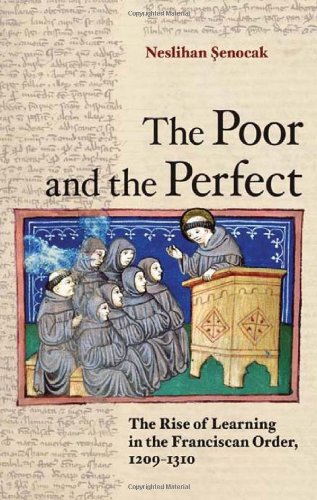 was introduced.
In the end the theologians won the day: “Within a century of its foundation, the Order of Friars Minor could claim hundreds of permanent houses, schools, and libraries across Europe; indeed, alongside the Dominicans, they attracted the best minds and produced many outstanding scholars who were at the forefront of Western philosophical and religious thought” we can read in a recent book by Neslihan Şenocak.
In The Poor and the Perfect, the author “provides a grand narrative of this fascinating story in which the quintessential Franciscan virtue of simplicity gradually lost its place to learning, while studying came to be considered an integral part of evangelical perfection. Not surprisingly, turmoil accompanied this rise of learning in Francis’s order. Şenocak shows how a constant emphasis on humility was unable to prevent the creation within the Order of a culture that increasingly saw education as a means to acquire prestige and domination. The damage to the diversity and equality among the early Franciscan community proved to be irreparable. But the consequences of this transformation went far beyond the Order: it contributed to a paradigm shift in the relationship between the clergy and the schools and eventually led to the association of learning with sanctity in the medieval world. As Şenocak demonstrates, this episode of Franciscan history is a micro-history of the rise of learning in the West.“
CONTENT:
Prologue: The Challenges to the Historian
1. The Formative Years, 1219–1244
2. Studying as Evangelical Perfection
3. Beyond Preaching and Confession
4. Paradise Lost
5. The Educational System around 1310
Conclusion
Neslihan Şenocak is an Assistant Professor of Medieval History at Columbia.
The Poor and the Perfect. The Rise of Learning in the Franciscan Order, 1209–1310
By Neslihan Senocak
Cornell University Press 2012
ISBN-10 0-8014-5057-8
ISBN-13 978-0-8014-5057-0