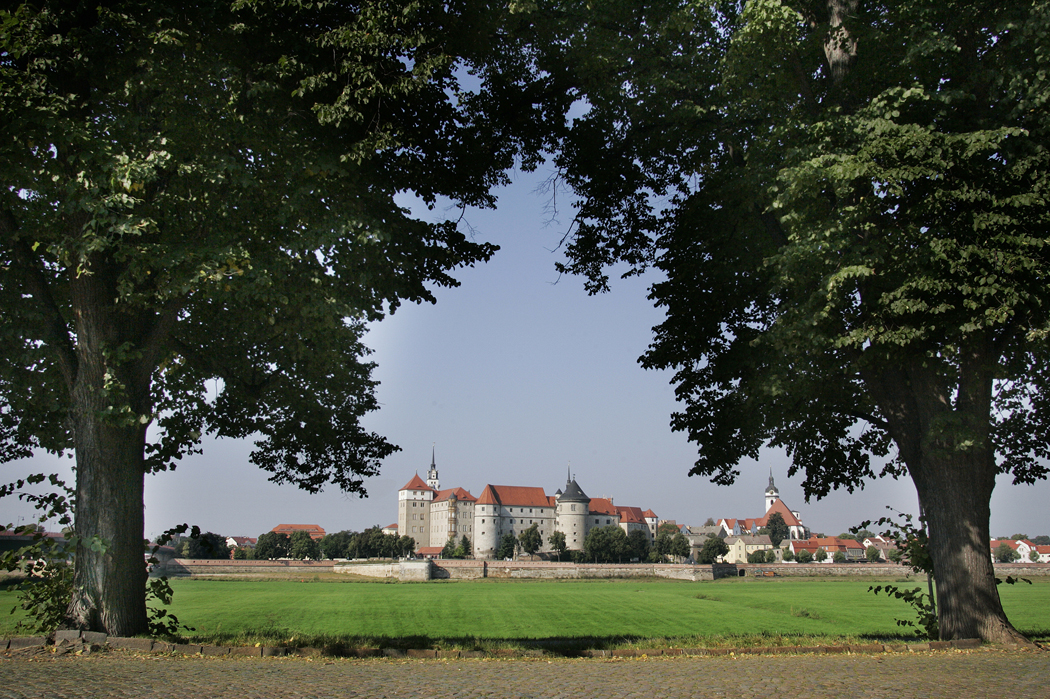
Known as home to the German princes, who furthered the Reformation in the 16th century, Torgau boasts an impressive castle with a splendid Reformational Chapel and the house, where Luther’s wife, Katarina von Bora died
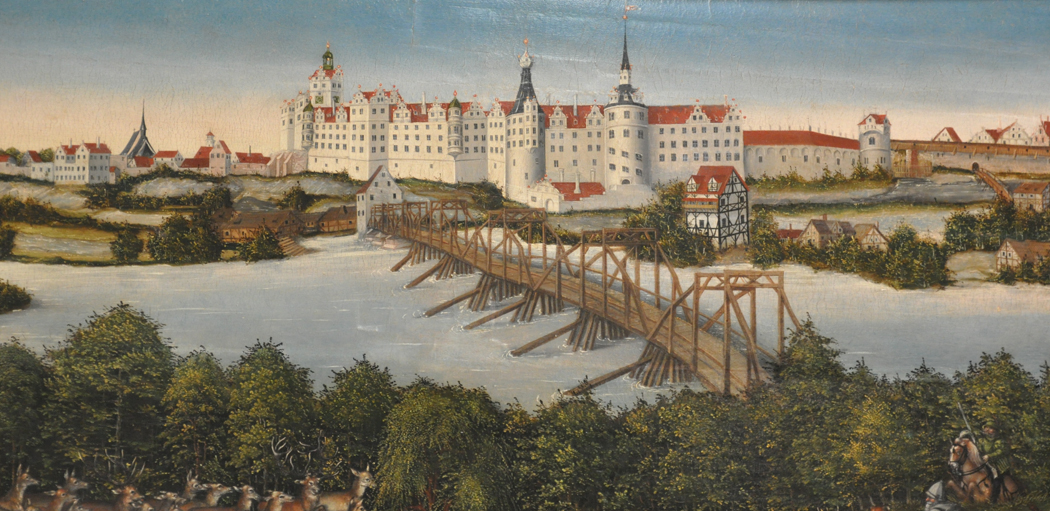
‘Torgau’ is Slawic and means something like ‘marketplace’. It was founded some time in the 10th century, but became of strategic importance in the 12th century, when the counts of Meissen erected a castle there to protect the crossing of the River Elbe. In 1267 it is mentioned as a proper town. In 1485 it became the principal home of the Ernestines, a branch of the Saxon electors. During this period it experienced a set of political and cultural upheavals connected with the fact that the ducal family was one of the principal defenders of their protégée, Martin Luther. Apart from his role as Reformational theologian, he also acted as their political and spiritual advisor. It has been said that while Wittenberg was the crucible of the Reformation, Torgau was the wetnurse.
The Castle of Hartenfells, the “Wendelstein” and the Chapel

Down by the river Elbe in Torgau stands the renaissance castle of Hartenfells, built between 1482 and 1623. Most prominent is the main wing with the impressive staircase, the ‘Wendelstein’, from 1533 by Conrad Krebs. Somewhat later a third wing was added, which was designed by Nickel Gromann. The castle was sumptuously decorated with murals by Lucas Cranach the Elder, celebrating the reformation and the history of the ducal family, the Ernestines. Unfortunately this decorative scheme was due to its programmatic Reformational character totally destroyed during the Smalkaldic war 1546 to 1547. In 1636 the castle was plundered once more in the thirty years war and afterwards it was used as paupers’ hospital, prison, military barracks and local court. Today, it serves as administrative centre for the local region of Torgau-Oschatz and as exhibition space.

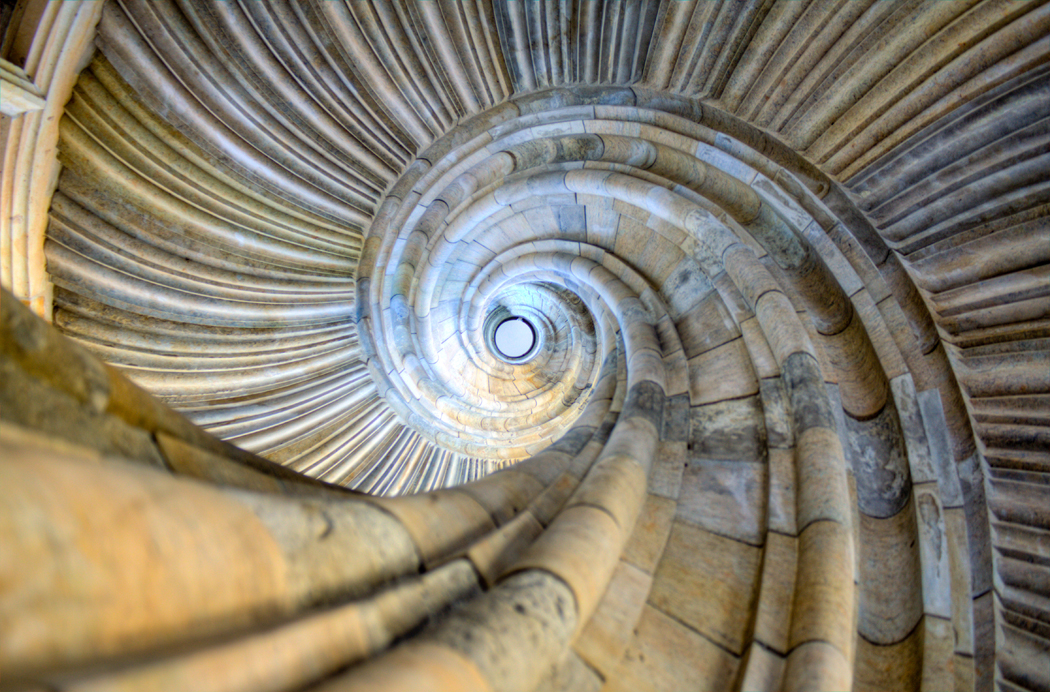
The ‘Wendelstein is a spiral staircase with no inner “newel” (inner central support). As seen from below, its 163 steps seem to spiral into thin air. It is built of sandstone from the Elbe. Its beautiful sandstone-sculptures and carvings were originally painted, but the exact colour-scheme is no longer known. Below, it is decorated with a famous heraldic frieze. Generally considered a wonder that it has survived, the staircase was recently restored to its former glory and it is now possible once more to ascend it in order to access the platform of the Hausmann Tower, where awaits a spectacular view over the river Elbe.
The Torgauer Chapel is generally considered the first Reformational church built as a testament to the new church order. This is, however, not quite correct. The chapel at the Neuburg Castle in Bavaria was consecrated a year before and is in its own right important to visit (beautiful fresques). Nevertheless, the chapel in Torgau is important for one reason: Luther personally consecrated the church in October 1544. Afterwards the rather traditional late-Gothic chapel became the master-plan for a large number of other Reformational chapels in Dresden, Freiberg, Augustusburg, Gotha, Schwerin and Schmalkalden as well as abroad, e.g. in Sønderborg in Denmark.

As it stands today, it seems a very peaceful room, primarily dedicated to hold the assembled congregation together. The retable was early on destroyed and its stead an alabaster altarpiece was installed. In 1945 this also fell as a victim to war and fragments are exhibited in the main hall. Today the altar is a plain table carried by sculptured angels by Stefan Hermsdorf and Simon Schröter, who were also responsible for the portal.
This main hall is of course dominated by the pulpit, which is the original one, from which Martin Luther preached. It is decorated with reliefs by Simon Schröter, which show Christ in the Temple – sola scriptura – , Christ with the Adulteress – sola gratia – and Christ Cleansing the Temple – sola fide.
To what extent Martin Luther was personally involved in the design and decoration of the new Church is not known. However, there is no doubt the Prince was personally involved: he had direct access from his private apartment where personal prayer stools opened up to glimpses of the church. A year after the consecration he had a memorial plaque made commemorating the events in 1544.
The Chancery
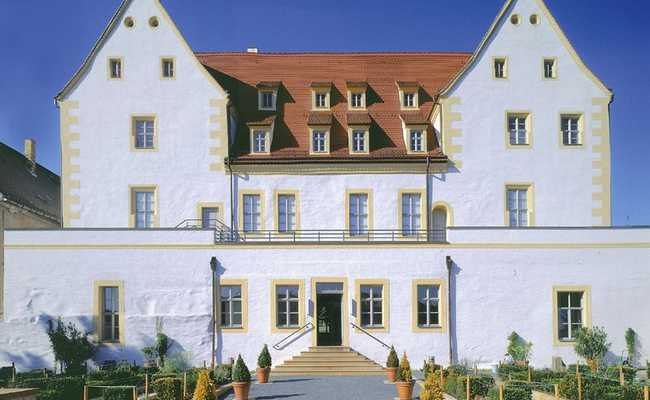
Just outside the castle itself, the prince had an impressive chancery built, which still stands. The earliest part of the Chancery was from the end of the 15th century and probably belonged to a local convent. However, in the 1530’s and in connection with the rebuilding of the new castle, the present Chancery was constructed. Although finished at a later stage there is no doubt the building was intended to signal the important “new” role of the Saxon electors as administrative competent rulers of the total life and well-being of their subjects.
Today, the chancery is used a the local museum of the city. It has recently undergone a total renovation and has reopened in connection with the exhibition 2015: Luther und die Fürsten
St. Mary’s Church
Although the chapel in the castle was not thought of as the private chapel of the prince, the congregation primarily consisted of the people employed in the princely household. The main church in the town, St. Mary served the ordinary people.
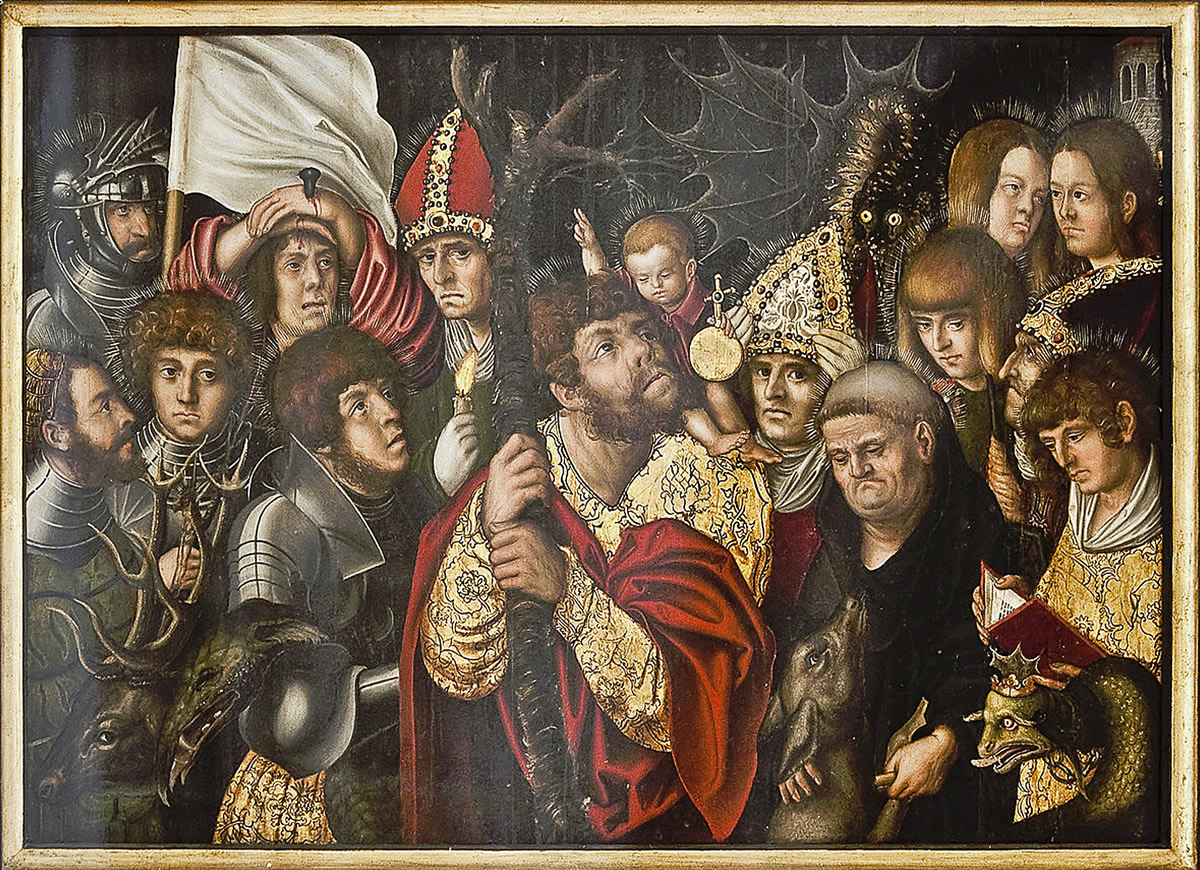
At the western end the Romanesque portal of the first church is intact. However, most of the building stems from the late-Gothic period of the 14th century with a Baroque tower. One of the main exhibits is the altar-piece by Cranach the Elder, the Fourteen Holy helper (14 Nothelfer), painted before the reformation. It is located behind the grave of Sophie of Meckelenburg (1481 – 1503), who was married to Johann the Steadfast, one of the protectors of Martin Luther. At her death, her husband and his brother founded and altar in her memory and dedicated it to Saint Anne and the Fourteen Helpers. Her bronze grave plate was crafted by Peter Vischer the Elder in his workshop in Nuremberg, after a design by Jacopo de’ Barbari. Lucas Cranach the Elder was commissioned to paint an altar-piece. This is generally believed to be identical with the Tourgau Altar, now exhibited in Frankfurt at the Städel Museum. This piece is famous for its Late Medieval/ Early Modern household scenes.
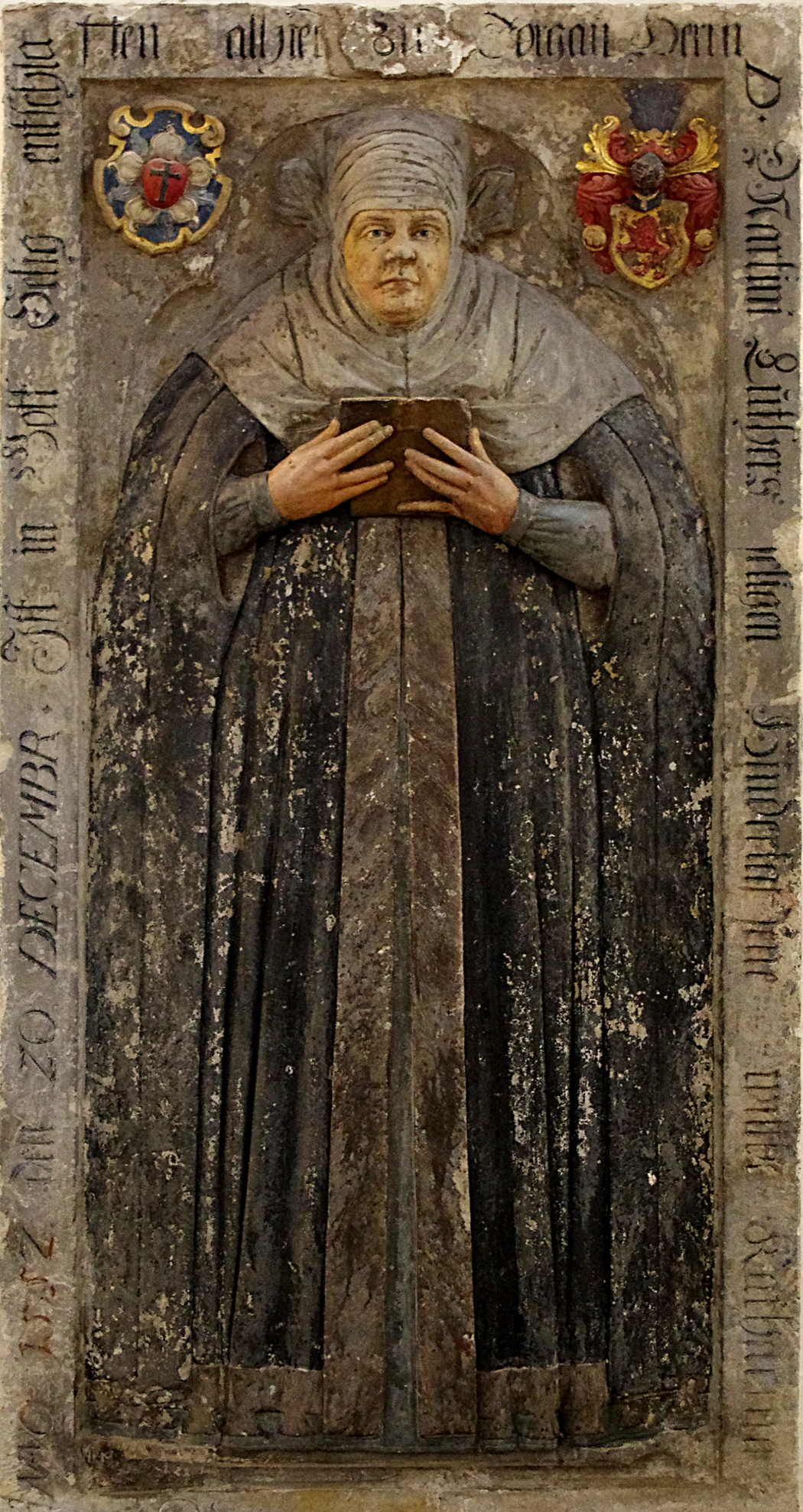
The mains sight in the church of St. Mary is nevertheless the memorial for Katarina von Bora, Luther’s wife. Widowed in 1546, she was soon a fugitive from the Schmalkaldic War. However in the summer of 1547 she was able to return to Wittenberg and start anew, when in 1552 plague broke out and she had to flee once more. Unfortunately on the way to Torgau her wagon was overturned and she ended up in a ditch with a complicated broken leg. The last three months of her life she spend in terrible pain until her death just before Christmas 1552. She was buried in Torgau where her grave is covered with a peculiar plate. It seems odd, she was never reunited in death with her famous husband. Nevertheless, here she is.
 Katharina von Bora’s House

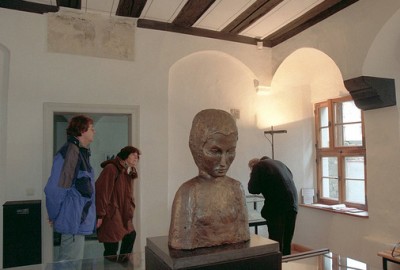
The house, where Katarina von Bora died, has been turned into a memorial house for this remarkable woman. The pretty Renaissance building is now a memorial site and a museum dedicated to Luther’s wife. The exhibition presents artworks and objects of everyday culture of Katharina’s time
Katharina-Luther-Stube
Katharinenstraße 11
04860 Torgau
 Spalatin-Haus
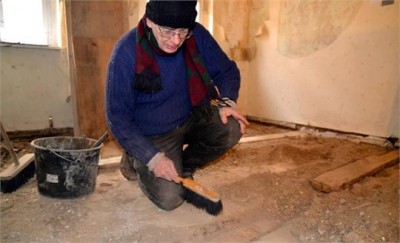
Georg Spalatin (1484 -1545) was employed in the central administration of the electors from 1509, first as teacher and librarian, later as councillor and chief administrator in the chancery. He was a close friend of Martin Luther and was very early on active as middleman between the monk and the prince. In 1523 he was given the house in Katharinen Strasse 8 to live in. It is one of the oldest houses in town, originally built as a priest’s house at the end of the 15th century. It is currently under restoration. The plan is to open it as a museum for the history of the reformation. Part of this plan is to recreate the interiors of a priest’s office and living room.
Spalatin-Haus
Katharinenstraße 8
04860 Torgau
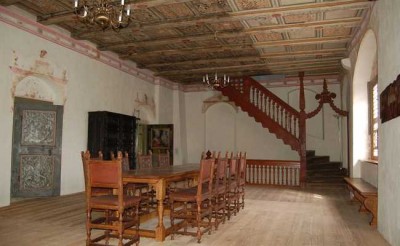 The Mayor’s House
Part of the official city-museum, this house is representative of the wealth accrued by one of the elders of the city, Paul Ringenhain. He began to build it in 1596 and It is remarkable for its renaissance lofts and murals. It is privately owned, but nevertheless open as a museum.
Bürgermeister-Ringenhain-Haus
Breite Straße 9
04860 Torgau
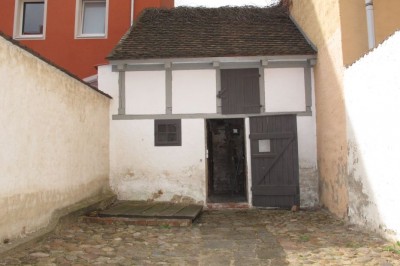 The Craftsman’s House
The small renaissance-house measures no more than 4 metres in width. Nevertheless it was in the 17th century home to at least two different families including their apprentices. It is decorated with a series of precious murals of the more humble kind.
Historisches Handwerkerhaus
Rosa-Luxemburg-Platz 4
04860 Torgau
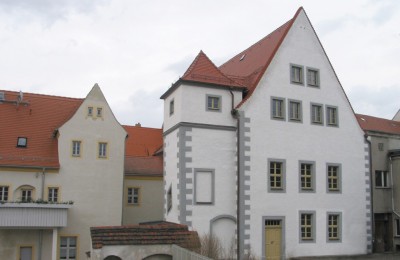 The Freihaus-Hahnemann-Haus

Yet another late medieval house, the Freihaus-Hahnemann-Haus, is open for visitors, because it was home to the inventor of the homeopathic medicine, which continues to be a beloved German part of the German market for alternative medicine. We, however, will primarily visit the house for its staircase from the beginning of the 16th century placed in an adjacent tower and the general feeling, which may be had of what the house of a citizen at the time of Martin Luther looked like. Especially precious are the murals from the renaissance.
 The Brewery
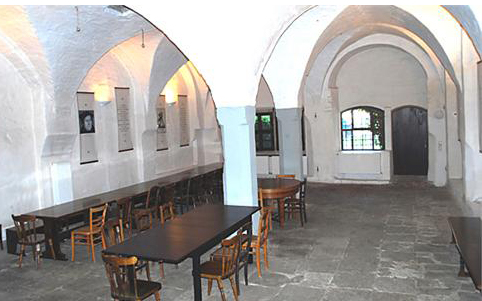
The brewery is housed in an impressive renaissance house, which with its preserved brewery is ideal to house the Torgauer Museum for Brewing
Braumuseum
Fischerstraße 11
04860 Torgau
READ MORE:
Luther und die Fürsten. Selbstdarstellung und Selbstverständnis des Herrschers im Zeitalter der Reformation.
Austellung in Torgau 15.05.2015 – 31.10.2015
VIEW MORE: