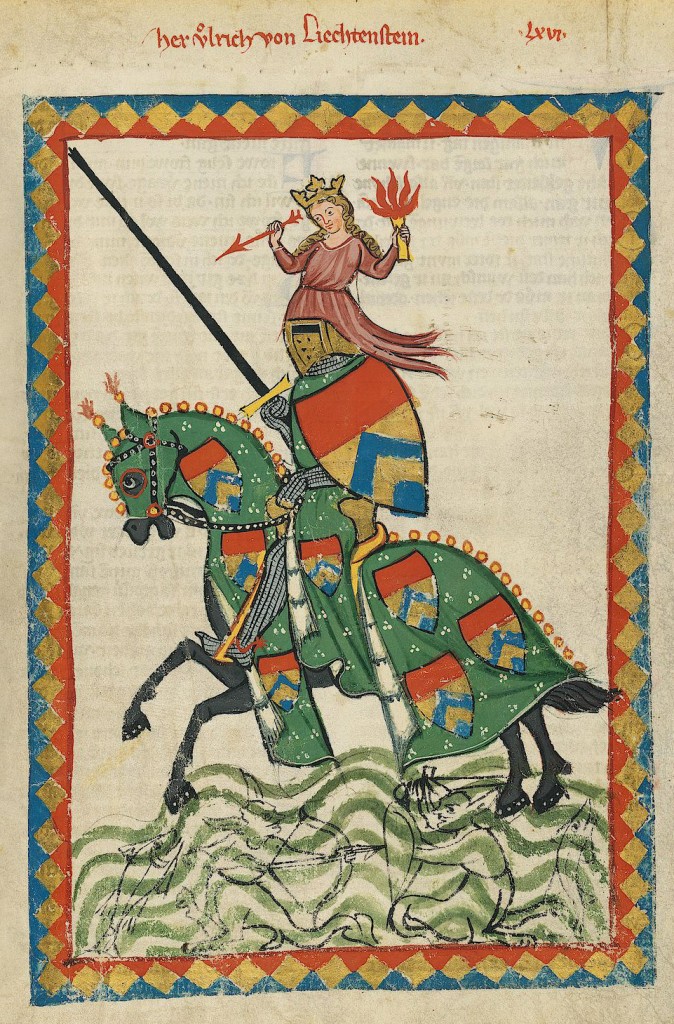
Men and women cross-dressing were often seen as sinful and regarded as prostitutes or whores. However, medieval literature presented a much more playful and ambiguous way of viewing the praxis.
Transvestite Knights: Men and Women Cross-Dressing in Medieval Literature
By Debbie Kerkhof
University of Utrecht 2013 (Thesis)
ABSTRACT:
In her thesis, Dennie Kerkhof, looks at cross-dressing knights in medieval literature and tries to answer why cross-dressing was common in literature while in reality, cross-dressers were seen as sinful. She specifically explores Ulrich von Liecthtenstein’s “In the Service of Ladies”, Malory’s “Le Morte d’Arthur”, “Berengier au Long Cul”, Dietrich von der Glezze’s “Der Borte”, Heldris of Cornwall’s “Le Roman de Silence”, and “Yde et Olive”.
A number of historical sources are also studied in order to understand the medieval literature. The importance of intention as well as what kinds of clothes were worn to cross-dress and how the different genders were viewed is also discussed.