
In 775, Charlemagne dispatched an army into Saxony, part of which ended in the battle at Braunsberg on the brinks of Weser in 775. Exhibition tells the story of the Saxon Wars from a local perspective
” While the king spent the winter in the royal villa at Quierzy, he decided to attack the treacherous and treaty-breaking tribe of the Saxons and to persist in this war until they were either defeated and forced to accept the Christian religion or entirely exterminated. The pious and noble Lord King Charles held an assembly at the Villa of Düren. From here, he launched a campaign into Saxony”
(Royal Frankish Annals 775, p. 51).
The Saxon Campaign in AD 775
Although historians traditionally date Charlemagne’s first incursions into Saxony to AD 772, the Carolingian Saxon Wars should be dated to AD 775. This year, according to the Annales Nordhumbrani, also called the York Annals, Charlemagne was “raging and out of control with fire and sword while he was wildly shaken with anger. (Annales Nordhumbrani, a. 775: “vastavit, igne ferroque debacchans, quia erat consternatus animo.” According to the Royal Frankish Annals, the Saxons had broken their treaty.
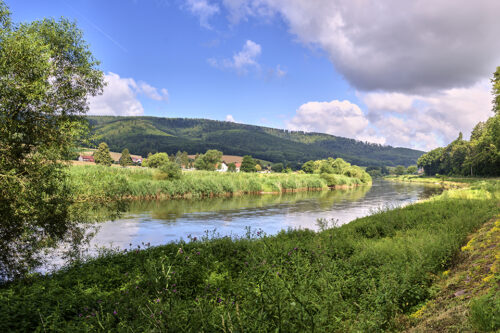
During this campaign, the Saxon army prepared to meet the Franks at the banks of the Weser at Braunsberg, “which they wished to defend”. Unfortunately for the Saxons, they were defeated, and the Franks settled on both sides of the river, thus opening up the gradual annexation of the lush homeland of their pagan neighbours. Often understood as a missionary effort, the Weser Hills (Wesergebirge) also offered ample opportunities for raising horses. Evemn today, the horse is a pregnant symbol featured in the State’s official coat of arms,
Exhibition in Höxter
This year, at an exhibition in Höxter in the Weserbergland, near Corvey, modern technology meets archaeology by staging a virtual battle of Braunsberg. With VR experiences, montres with archaeological finds, and interactive stations for all ages, visitors are invited to directly participate in one of the vicious battles in the Saxon Wars, the early medieval conflict between the Saxons and the Franks. Virtual reality is a central element of the presentation, allowing visitors to immerse themselves directly in historical scenes such as the Battle of Braunsberg in 775 or the confrontation between Frankish missionaries and Saxon burial culture.
The digital worlds were developed by the Beverungen-based company NUSEC XR. The deliberately comic-like style of the animations is intended to make the topic easier for younger audiences to access.
Historical objects to touch
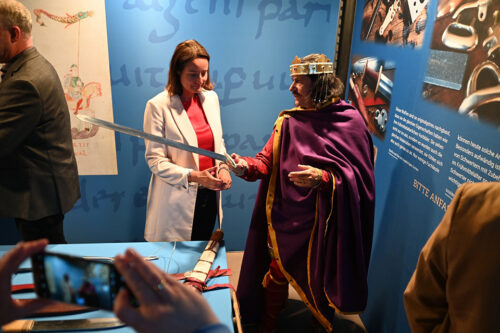
Then again, the exhibition offers more than a digital immersive involvement. There are also hands-on experiences, where visitors can touch and feel clothing, weapons, and jewellery from the early Middle Ages. The objects have been reconstructed according to the latest research. Interested visitors can also get hands-on with a loom and operate the shuttle.
A highlight is the reenactment weekend on July 19th and 20th, where actors in early medieval clothing demonstrate daily life as well as fighting. Visitors may plan their tour to Paderborn and Corvey as well as the lovely landscape in the Wesergebirge at this time.
In addition to the virtual and reconstructed exhibits, the exhibition also features original archaeological finds from the region. Among them are divinational rods, early Christian brooches, loom weights, and a human skull with a fatal sword wound. Early medieval weapons such as the spatha and sax are also displayed.
In addition to the exhibition, educational programs are offered. Children can, for example, craft round shields and chains based on historical models or design postcards in beautiful handwriting. A rally with questions about the exhibition is specifically aimed at young visitors.
Inclusion in the cultural program “1250 Years of Westphalia.”
The exhibition is part of the anniversary program “1250 Years of Westphalia,” which is supported by the LWL Cultural Foundation. The program’s patron is Federal President Frank-Walter Steinmeier. A companion exhibition organised by the state may be visited in the museum in the Caroligian Imperial Palace in Paderborn, titled 775 – Westphalia. Here, visitors are invited to get a more comprehensive look at the events during the Saxon Wars. showcases recent finds from a cemetery in Schieder-Schwalenberg, which was only recently discovered.
VISIT
Schlacht am Brunsberg – Aufbruch in eine neue Zeit
Neu im Historischen Rathaus Höxter
10.05.2025 – 19.10.2025
The exhibition will be on display until October 19th, 2025, in the market hall of Höxter’s historic town hall. It is open daily, except Mondays, from 1 p.m. to 6 p.m. Group tours are also available in the morning upon request. Admission costs €5, with a concessionary rate of €3. The location near the train station and the Weser Cycle Path makes it easy to get there. Guided tours of the neighbouring Huxarium Garden Park can also be booked.
FEATURED PHOTO
Charlemagne enjoying VR at Höxter 2025 © Huxarium
SOURCES:
Carolingian Chronicles: Royal Frankish Annals and Nithard’s Histories.
Ed. and transl. by Berhnard Walter Scholz and Barbara Rogers.
The University of Michigan Press 1972.